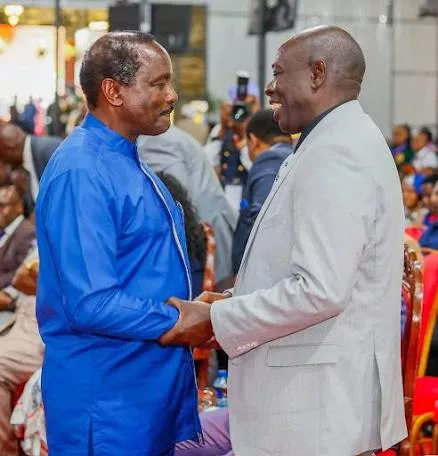
 Wiper leader Kalonzo Musyoka and DCP boss Rigathi Gachagua.
 Ever since Independence, the position of vice-president, and later deputy president under the 2010 Constitution, has come with huge doses of intrigue, suspicion, political backstabbing and humiliation of the holder.
It has always seemed that successive Kenyan presidents fill the slot only to fulfil the requirements of the law but feel inconvenienced by having someone so close to their own seat.
It doesn’t help that the tribal mafia around every president hasn’t had much regard for his principal deputy.
Because of this feeling that the VP and DP have been uncomfortable distractions for the president in the enjoyment of power, the appointing authority in the old days of a VP always ensured they picked a rather colourless and politically “harmless” individual.
They selected one whose words, actions and ambitions did not appear to disturb the president’s intended longevity in office.
VPs Joseph Murumbi, Daniel arap Moi, Mwai Kibaki, Josephat Karanja and George Saitoti were all appointed based on such considerations.
Karanja’s stay, however, would end up very short-lived, after he forgot the rule about never outshining the master, and started exercising power on his own, in his central Kenya region.
His unceremonious exit, with a vote of no confidence hanging over his head in 1989, was a stark reminder that the VP was always beholden to presidential whims and couldn’t show any ambition at all.
Of course, the appointment of founding VP Jaramogi Oginga Odinga was different. A principled and forthright politician with a massive following across the country, Jaramogi was almost an automatic pick in the early coalition of “freedom tribes”.
That choice was due to the Kikuyu and Luo communities, having played a major role in securing the nation’s freedom, united to form the inaugural government. In every sense, Jaramogi had earned his spot.
But still, as a radical, hot-headed leftist politician, he would last just three years in office, as the falling out within the Independence generation unfolded.
The advent of multiparty democracy in 1992, and especially after Moi’s exit in 2002, came with the decline of large, dominating political parties with a wide national reach such as the Independence party, Kanu.
In its place, electoral contests started to revolve around a presidential candidate from a big tribe, forming a coalition with a popular politician from another big tribe in order to consolidate numbers and have a bigger impact on the election.
This became the norm, especially after the 2010 Constitution created the office of the DP, the individual usually picked as a running mate pre-election, rather than appointed post-election as in the old days.
The first election under the new supreme law, in 2013, showed just how difficult sustaining this new arrangement would be.
To beat Raila Odinga (now deceased), in an election that was hardly a beacon of credibility, Uhuru Kenyatta was forced to partner with William Ruto as running mate. The two hailed from the feuding communities that had turned the previous election in 2007 into a civil war.
Both were facing trial at the International Criminal Court over the post-election violence of 2008. They were a mismatch from the word go: one raised in aristocratic surroundings, the other a political brawler from village settings. Brought together only by the need to unite two voting blocs.
The delicate Uhuru-Ruto experiment would ultimately come to a head in their second term, following the 2017 election. If they had tolerated each other to sustain their regime, Uhuru, done with the need to seek another term and needing to entrench his legacy, came out forcefully to try and stop his deputy from succeeding him.
He opted to back their joint political adversary, Raila, in the 2022 election. Ruto, however, chose to embrace Uhuru’s Mt Kenya communityand chose a running mate who would help lock it up, one Rigathi Gachagua.
Once again, shared chemistry was never a consideration in making this pick. Neither was any joint political philosophy.
Tribal numbers and electoral convenience took over. The two egos wouldn’t fit in one room for long. Gachagua was a rough-on-the-edges political operator who had no regard for the tenets of statecraft. And because he had been elected on the same ticket as Ruto and considered his position indispensable, he gave the President a big headache before his impeachment in October 2024.
Predictably, Ruto then settled on his current DP, Kithure Kindiki, who fits perfectly in the Murumbi-Moi-Kibaki-Saitoti mould: a principal assistant who doesn’t question the boss, harbours no ambition and lives to please the master.
As the 2027 election draws closer, the question of running mates, one of whom will be DP, reared up again, fiercely. ForRuto, this was supposed to be a straightforward matter: he would stay with Kindiki and negotiate with opposition outfits, such as ODM, for an election coalition.
This arrangement, if everything went according to plan, was meant to vanquish the opposition and almost effortlessly secure a second term. Except nothing is going according to plan.
First, the President gradually lost the support of the Mt Kenya region after the impeachment of Gachagua. The appointment of Kindiki from Tharaka Nithi on the eastern slopes was meant to pacify the mountain and show them Ruto still desired a partnership with the region.
But the legal scholar and law professor isn’t Gachagua of the rough and tumble and hasn’t made any impact in terms of consolidating regional support for the President.
To make it worse, the recent Ol Kalou by-election, on which Kindiki had vowed to unleash fire and brimstone on Gachagua, on behalf of Ruto, went all wrong and the ruling UDA’s candidate was trounced.
Subsequent to that election on July 16, the ODM broad-based bandwagon ¾ which had toned down its demand for the running mate position as a pre-condition for backing Ruto’s re-election ¾ has now cranked up the volume, making the position their bare minimum for their support. Media reports have caricatured Kindiki as a man under siege, and rightfully so.
The new ODM demand cannot be a random thing. On these shores, political events are never random. There must be someone high up who has decided that another run with the current DP isn’t viable, and has unleashed the dogs, to start barking at the former Tharaka Nithi senator.
Kindiki comes from Mt Kenya East, which loosely encompasses Embu, Meru and Tharaka Nithi counties. They are not as vote-rich as their counterpart counties in the West, which have enjoyed state largesse for ages and have used their numbers to devastating effect in entrenching their powerful economic and political dominance.
Kindiki is therefore aware that with Mt Kenya West gone, and Ol Kalou demonstrating this in a landslide, he does not possess the bargaining power to hold onto the position should the President opt to look elsewhere.
This past weekend, the ODM brigade first unveiled Cooperatives CS Wycliffe Oparanya as their preferred candidate for number two on the Ruto 2027 ticket.
The very next day, they purportedly give the President two more options in Mining CS Hassan Joho and Homa Bay Governor Gladys Wanga. The problem is that Oparanya’s Western backyard is currently caught up in the Edwin Sifuna wave and the Linda Mwananchi movement.
If Nairobi Senator Sifuna ends up on the presidential ballot, the former Kakamega Governor will have a very limited chance of helping Ruto in his vote quest. Hence, the alternatives of Joho and Wanga.
Additionally, Ruto himself, in his quest to manipulate ODM following Raila’s death, has created the divisions that have both weakened that party beyond repair, while also elevating Sifuna as a presidential challenger outside the party.
In this scenario, the irony of the head of state seeking ODM’s support is not lost. His post-Raila manoeuvring brought them to a point where support from a powerful unified ODM is no longer possible. What remains of Raila’s party depends largely on state resources to operate and survive the difficult terrain.
It is therefore inconceivable that the President will get much from Governor Wanga and Siaya ODM head Oburu Oginga, the Siaya senator, as both also fight to retain their own seats.
The problem is not a phenomenon that bedevils only Ruto. The opposition also has to deal with an even ruder awakening. Just a few months ago, Senator Sifuna was merely ODM’s secretary-general and deputy Whip of the minority side.
He seemed to revel in introducing himself by those three titles ¾Senator, SG and Deputy Whip. Life seemed good.
Then ODM, now without Raila, decided to go for him and clip his wings for disregarding the “collective responsibility” to turning the party into a Ruto praise choir.
Sifuna launched a legal challenge against his removal. But with every week, a movement around him and Linda Mwananchi, launched by young people, gradually grew into a potent political force that has now transitioned into a presidential campaign.
Millions of his supporters across the country now demand that their man must be on the ballot. The net effect is that over the last six months, the Nairobi senator has moved from preparing to defend his Senate seat, to being a potential running mate to an opposition luminaries, to now being the main man around whom the opposition must rally in order to block Ruto’s plan for a second term.
Before Sifuna’s emergence as a presidential contender, the joint opposition had considered naming a flagbearer before postponing the exercise a few times, to await the Linda Mwananchi brigade led by the Nairobi senator.
I am certain that the opposition itself never imagined that by the time they joined up with their Linda Mwananchi allies, Sifuna would be the runaway national favourite for the ticket. This is where the running mate debate gets more uncomfortable.
Opposition luminaries Gachagua, Wiper leader Kalonzo Musyoka and former CS Fred Matiang’i, who is also the preferred Jubilee presidential candidate, are old hands in politics and governance.
As the national momentum has built in favour of the much younger Sifuna, these gentlemen must have looked on in alarm, because ultimately, it will be difficult to find a formula whereby the now popular Sifuna would be a running mate and play second-fiddle to anyone.
Besides, the millions of young people across the country who want Sifuna as a presidential candidate are not prone to the politics of tribal balances. In this equilibrium, a popular politician from one region partners with another from a different region to create a multi-tribal coalition of numbers.
The Sifuna movement is largely devoid of tribe and will likely vote for its man regardless of whom he picks as his running mate, should he opt to go all the way.
There is something else about this new movement. The people who back the Nairobi senator do not do so at the bidding of their tribal lords, as has been the tradition.
In other words, Sifuna supporters in Ukambani are not necessarily doing so through Kalonzo’s Wiper, just like the masses in the Mount Kenya region who chant “Sisi Ndio Sifuna” do not do so at the direction of Gachagua and his Democracy for Citizens Party.
What’s especially interesting is that this political “luxury” of choice enjoyed by the Linda Mwananchi leader has never been “available” to any previous presidential candidate.
It allows him to practically pick anyone as running mate, and to recalibrate Kenyan politics away from the bad manners of regional coalitions. This is based on the assumption that none of his opposition allies not chosen by Sifuna, will bolt to run alone or join Ruto, which would muddy the waters and split votes.
As things stand today, the two major political formations ¾ pitting Ruto’s coalition on one side and the joint opposition alongside their Linda Mwananchi allies on the other ¾ may be on course to unveil their presidential candidates for the 2027 general election.
However, the negotiations, horse trading and backstabbing that will take place before they pick running mates will be very intense. You can’t envy them.
Because this exercise will make or break their coalitions, and will determine the destiny of the 2027 election.