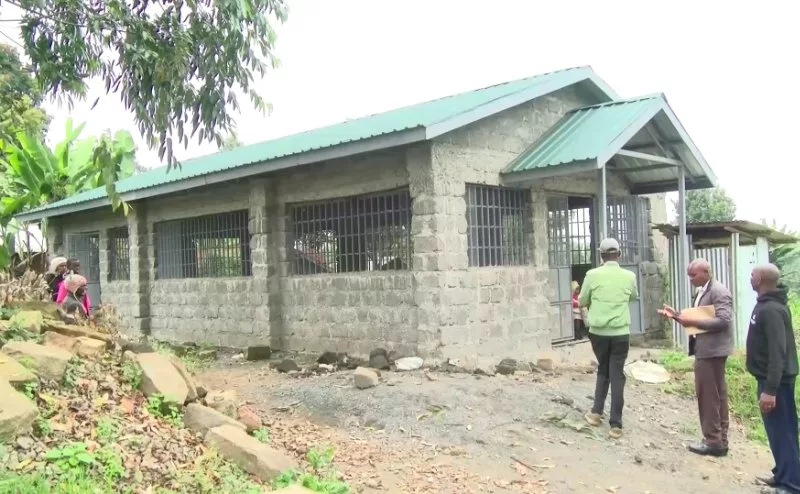
 Mubethu tea buying centre that has been newly constructed by Kirinyaga county government/ ALICE WAITHERA
Tea farmers from Kirinyaga have been reprieved after the county government constructed four new tea-buying centres to bring collection services closer to farmers.
Read Also
The project targets about 1,800 smallholder tea farmers. Two centres at Mubethu and Icere in Inoi ward are nearing completion, while Githunguri and Kimuri centres in Kerugoya ward are still under construction.
Tea-buying centres serve as collection points where green leaf is weighed, recorded and stored before being transported to tea factories.
Agriculture, Livestock and Fisheries executive John Gachara said the investment addresses one of the biggest challenges facing tea farmers, who have for years been forced to travel long distances to deliver their produce.
"This programme of improving tea-buying centres is critical because some areas have had no centres at all. Farmers have therefore been forced to travel long distances, often using boda bodas, which increases their cost of production," Gachara said.
He said tea remains one of Kirinyaga's strategic cash crops, supporting thousands of households and making a significant contribution to the county's economy.
He said investments in supporting infrastructure are therefore essential for sustaining production and improving farmers' earnings.
Tea farmers in Kirinyaga earned more than Sh7.6 billion during the last financial year, highlighting the sector's importance to the county's economy.
Gachara said the county has also been supporting tea growers through subsidised fertiliser distribution and the introduction of improved tea varieties in partnership with the Tea Research Institute at Kangaita to increase productivity.
The new buying centres are expected to reduce the time farmers spend transporting tea, minimise the exposure of green leaf to harsh weather and improve the quality of produce delivered to factories.
Fresh tea leaves require quick handling after harvesting, as prolonged exposure to heat or rain lowers quality and reduces returns to farmers.
Inoi MCA Fredrick Maina said construction of the centres was informed by residents during public participation forums, where farmers identified inadequate collection facilities as one of the major obstacles affecting tea production in the area.
"Our farmers were unable to raise enough money to construct the centres, so we allocated funds for this purpose,” Maina said.
“The new facilities will ensure farmers have a proper place to deliver and store their tea leaves as they wait for collection and transportation to the factories."
At Mubethu Tea-Buying Centre, farmers said the project has transformed tea collection by bringing the service within walking distance of their homes.
They said they had previously purchased land for the centre but lacked the resources to construct the facility until the county government stepped in.
"We are very grateful to the county government and our MCA for helping us out of the situation we were in. Now, even when you are at home, you can hear the tea truck approaching and quickly bring your tea leaves," said David Wanjohi, the centre's secretary.
He said the facility has eliminated the need for many farmers to carry heavy baskets of tea over long distances or hire motorcycles to transport the produce. It has also protected harvested leaves from adverse weather before they are collected for delivery to factories.
Farmer Nancy Muthoni said the centre has particularly benefited women, who previously bore the burden of carrying heavy loads of tea over long distances. Many also had to spend money on motorcycle transport, reducing their earnings.
"Because of the long distance, I used to hire a motorcycle, which was expensive. Now we have been saved both time and money," she said.
At the nearby Icere Tea-Buying Centre, farmers said the new facility will spare them the three-kilometre journey they previously made to Mubethu to deliver green leaf.
Centre secretary Peter Mugaa said the savings on transport would allow households to redirect money to other essential needs while improving the efficiency of tea collection in an area where tea remains the main source of income.
"The new facility will enable farmers to save on transport costs and redirect the money to other household needs," Mugaa said.
INSTANT ANALYSIS
The new tea-buying centres address a practical but often overlooked challenge in Kenya's tea value chain: the high cost and inefficiency of getting green leaf to factories.
By reducing transport distances, the project is expected to lower production costs, preserve leaf quality and improve farmers' incomes.
The initiative also demonstrates how county governments can strengthen agriculture through targeted infrastructure rather than direct subsidies alone.
Its impact is likely to be felt most by women and smallholder farmers, who bear the greatest transport burden.
The real measure of success, however, will be whether such investments translate into higher earnings and long-term sector competitiveness.