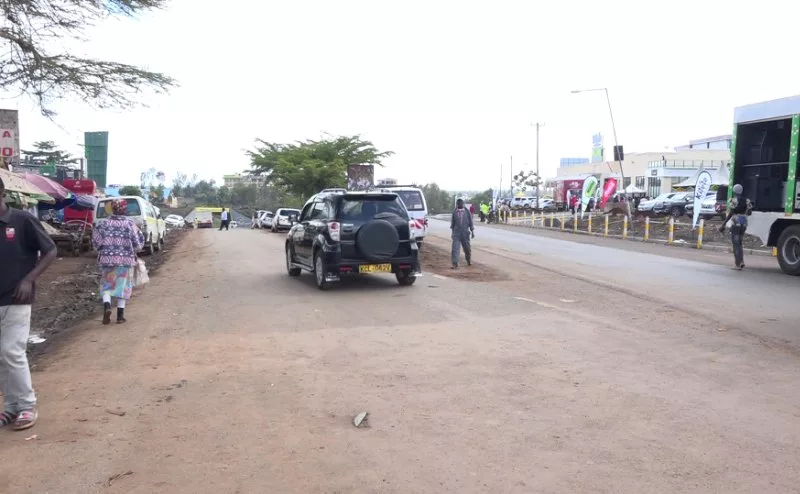
 Kenol town where the Kenol-Thika section of the highway starts/ ALICE WAITHERA
The Thika-Kenol section of the Thika Superhighway requires additional funding for pavement strengthening after deteriorating faster than other parts of the corridor, the government has said.
Roads and Transport Cabinet Secretary Davis Chirchir told the National Assembly that the section has a less robust pavement structure despite carrying traffic loads across the corridor.
Chirchir said the current maintenance contract was not sufficient to undertake repairs on all severely ravelled sections, requiring authorities to prioritise patching and regulating damaged areas.
“The road section requires additional funding for pavement strengthening,” Chirchir said in a response to Mathioya MP Edwin Mugo, who had sought an explanation over the condition of the highway.
Motorists continue to encounter potholes and damaged sections, while major rehabilitation remains dependent on funding and procurement.
The Thika-Kenol section, which forms part of the A2 road, was recarpeted in 2022, but the overlay was not sealed with surface dressing because of budgetary constraints. Heavy rainfall between October 2023 and May 2024 worsened the raveling.
Under the ongoing performance-based maintenance contract, works include drainage improvements, localised base repairs, pothole patching, surface dressing, road marking and other road furniture.
However, the CS said the contract could not accommodate an asphalt concrete overlay on all severely ravelled sections. Funds set aside for surface dressing are therefore being used for asphalt concrete regulation.
The government said the Thika-Kenol stretch has deteriorated faster because its pavement is less robust, leaving it more vulnerable to traffic and weather conditions. Comprehensive rehabilitation is planned under the Thika-Kenol-Marua Corridor upgrade.
Mugo, however, said the response had not provided clear timelines for interventions, including construction of bus bays along the highway and a climbing lane at the Blue Post section in Thika.
He said bus bays planned for Roysambu, Githurai and Witeithie would help improve traffic flow and road safety, but called for clearer timelines on completion.
The Roysambu and Githurai bus bays fall along the Nairobi-Ruiru section, while Witeithie facilities and the Blue Post climbing lane are planned along the Ruiru-Thika stretch to improve traffic flow and safety.
“These bus bays would be an important factor in decongesting the road and also managing accidents,” Mugo said.
The Nairobi-Thika section forms the S1 portion of the corridor and has undergone surface dressing, while localised repairs and pothole patching were undertaken on service lanes in 2025. Selected non-motorised transport facilities and walkways were also rehabilitated.
Chirchir said maintenance contracts for Nairobi-Ruiru and Ruiru-Thika began in June 2025 and are scheduled to run until June 2027. The Thika-Kenol contract commenced in November 2025 and ends in November 2027.
Chirchir said the government allocated Sh1.4 billion for maintenance in 2025/26 and increased the allocation to Sh1.65 billion for 2026/27. Major rehabilitation remains subject to funding.
Mugo called for street lighting and construction of footbridges at Montezuma and Kabati, to improve pedestrian safety.
He proposed the National Infrastructure Fund as a source of financing for major road repairs and strengthening the road.
KeNHA assesses the highway through road surveys and inspections to identify sections requiring intervention. Current performance-based contracts are intended to keep the road safe and motorable as longer-term rehabilitation plans are pursued.
Mugo said the government needed to provide clarity on when additional funds would be available to restore the deteriorating highway.
“We can also look at the low-hanging fruits like the street lighting on this road, which is in very poor condition,” he said.
Kikuyu MP Kimani Ichung’wah later shifted the debate to the stalled Roads Maintenance Levy Fund Bill, saying Senate’s rejection had delayed legislation on sharing road maintenance funds with county governments.
Ichung’wah argued that the proposed arrangement could help counties maintain local roads while reducing duplication in projects funded by national and county governments.
“Part of what we intended to do with this bill is to ensure that there is no duplication in allocation of funds to roads at the local level,” Ichung’wah said.
He urged members appointed to the mediation committee to support an arrangement ensuring funds allocated to national roads remain with KeNHA, while money directed to counties is used on roads under their mandate.
Instant Analysis
Chirchir confirmed that the government allocated Sh1.4 billion for maintenance in 2025/26 and increased the allocation to Sh1.65 billion for 2026/27. Major rehabilitation remains subject to funding, where available.
KeNHA assesses the highway through road surveys and inspections to identify sections requiring intervention