 Animal feeds./AGATHA NGOTHO.
 Feedlots./AGATHA NGOTHO.
  Lorna
Chesir, a laboratory technologist at the Beef Research Institute at KALRO Lanet explains about feedlot./AGATHA NGOTHO.
Lorna
Chesir, a laboratory technologist at the Beef Research Institute at KALRO Lanet explains about feedlot./AGATHA NGOTHO.Researchers at the Kenya Agricultural and Livestock Research Organization (KALRO) are working on improved feeds and pastures to help farmers raise healthier, heavier cattle that can fetch better prices in the market.
The research complements efforts to improve beef breeds, with scientists focusing on feeding systems that can help animals reach their full growth potential while improving the quality of beef produced.
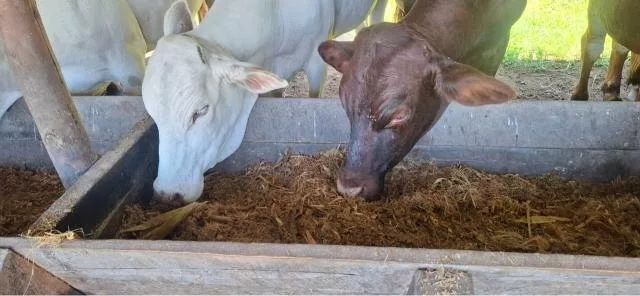
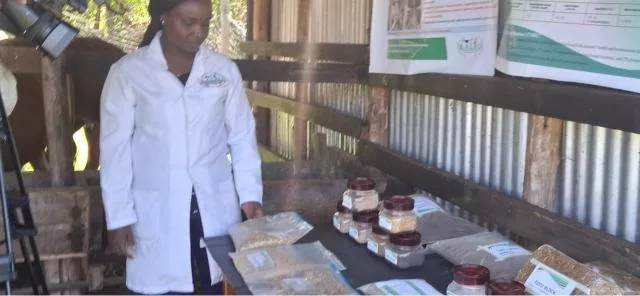
Lorna Chesir, a laboratory technologist at the Beef Research Institute at KALRO in Lanet says the feedlot is used to finish steers before they are taken to market.
“The purpose of finishing is to ensure that our steers are ready for the market,” Chesir says.
The researchers select steers aged between 24 and 30 months and place them under the feedlot system, where they are given diets rich in energy and protein. The aim is to increase body weight, muscle development and fat cover.
Before the animals are fed, the available ingredients are analysed and rations are formulated to meet their nutritional requirements. The finished feeds are then analysed again before being given to the animals.
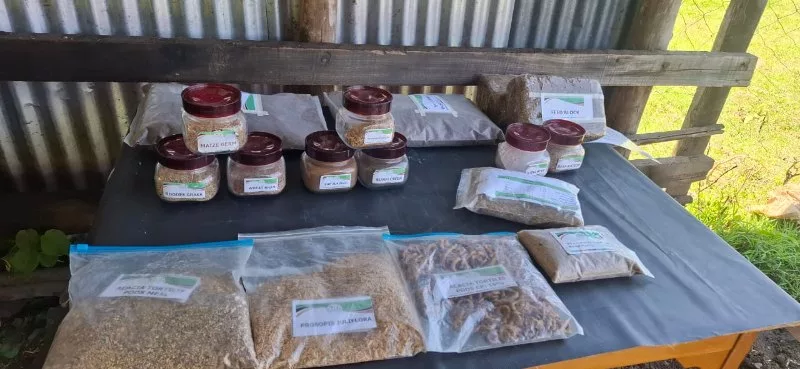
Chesir says the institute has developed both grass-based and silage-based rations. The diets use locally available ingredients, including maize germ, Rhodes grass and wheat bran as energy sources.
That is alongside protein concentrates such as canola and sunflower. Minerals are also added to produce a balanced total mixed ration.
The researchers are also exploring locally available sources of protein that farmers can use to reduce the cost of feeding livestock. These include pods from acacia and prosopis trees and other locally available plant materials.
The focus on feed is closely linked to KALRO’s pasture research, which seeks to ensure farmers have access to suitable, high-quality forage for their livestock.
Mercy Jerop, a research scientist and plant breeder at KALRO in Lanet, says researchers are working with different pasture varieties suited to different agroecological zones.
Among the grasses being researched are Napier varieties, including Banna grass and Kakamega 1, as well as Super Napier, which is currently under research.
KALRO has also developed two locally adapted Brachiaria varieties, BS1 and KS1. Jerop says the varieties perform well in medium and dry areas and mature in about three to four months.
“Brachiaria can be used in several ways. Farmers can allow animals to graze it directly, harvest it for silage or use it to make feed blocks. The grass has a crude protein content of about 12 to 13 per cent, according to the research,” says Jerop.
Other pasture options include Boma Rhodes, which performs well in medium to high altitude areas and can be harvested for hay and feed blocks. Humidicola, another type of Brachiaria, is mainly suitable for grazing but is still under research at the institute.
Jerop said they are also looking at protein-rich forages including forage potato vines, with varieties such as Wagabolige, Morocco and K158 recording protein levels of about 18 to 20 per cent. Farmers can use the vines through cut-and-carry systems or mix them with grass-based feeds.
Desmodium is another important protein source. It can be harvested and fed fresh or made into hay, allowing farmers to store it and use it during periods when fresh forage is limited.
The institute is also researching fodder trees that can provide an additional source of protein, particularly in dry areas. These include varieties such as leucaena and calliandra, which researchers say have protein levels ranging between 18 and 22 per cent.
Jerop says pasture research is increasingly being driven by climate change, with scientists seeking varieties that can perform under different agroecological conditions.
“Farmers visiting the institute are first advised according to the conditions in their respective areas. Those from wetter regions may be recommended pasture varieties such as Brachiaria, while farmers from drier areas may be directed towards suitable rangeland grasses,” she explains.
The institute also provides farmers with pure seed rather than mixed seed, enabling them to know exactly which pasture variety they are taking to their farms.
The research is aimed at ensuring that farmers have access to quality planting material and forage suited to their environments.
“For you to get meat, animals must eat. Apart from feeding our own animals, we are also advocating for animals to have quality feed so that you can have quality milk and quality meat,” Jerop says.
“Better breeds need to be supported by quality pasture, balanced nutrition and feed that is adapted to local conditions if farmers are to increase productivity and make beef production a viable business.”