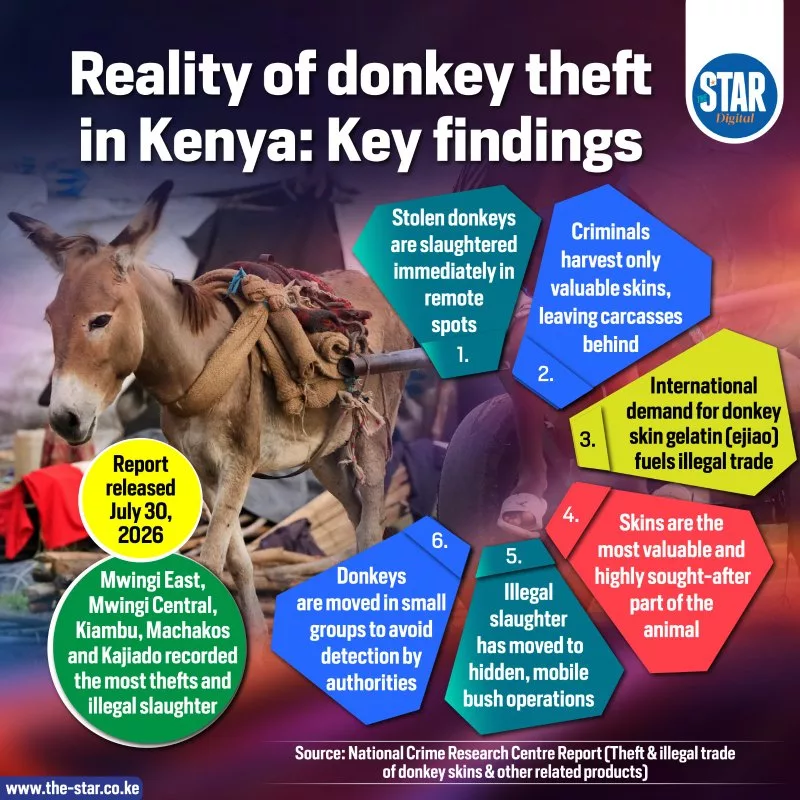
A report released on July 30, 2026 by the National Crime Research Centre has laid bare the reality of donkey theft in Kenya, showing how the crime is driven by international demand for donkey skin gelatin, commonly known as ejiao.
According to the findings, stolen donkeys are slaughtered immediately in remote locations, with criminals harvesting only the valuable skins and abandoning the carcasses.
The skins have emerged as the most sought-after part of the animal because of their use in ejiao production, which continues to fuel an illegal trade network.
To evade detection, perpetrators have shifted illegal slaughter to hidden, mobile bush operations and now move donkeys in small groups.
The report identifies Mwingi East, Mwingi Central, Kiambu, Machakos and Kajiado as the counties that recorded the highest cases of theft and illegal slaughter.
The study highlights how organized and adaptive the trade has become, leaving rural communities that depend on donkeys for transport and livelihoods increasingly vulnerable.