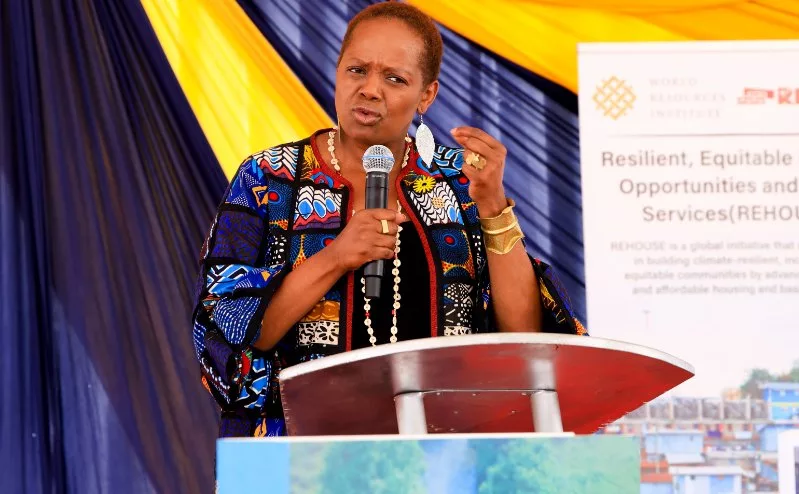
 World Resource Institute managing director for Africa and Global Partnerships Wanjira Maathai during the launch of Nairobi Rivers Nature-based Solutions Strategic Framework /HANDOUT
Poor urban planning, destruction of wetlands, inadequate drainage systems and weak enforcement of land-use regulations are among major factors worsening flooding in Nairobi, a new report by the World Resources Institute (WRI) has shown.
The report, Flooding in Nairobi's Informal Settlements: Advancing Equitable and Resilient Solutions, argues that while heavy rainfall contributes to flooding, the city's recurring disasters are largely driven by systemic governance and infrastructure failures that require long-term solutions rather than emergency response.
The study identifies Nairobi's topography, low-permeability volcanic soils, unplanned development in flood-prone areas, fragmented governance and limited investment in climate resilience as key drivers of the crisis.
The report highlights the devastating impact of recent floods. In 2024, nearly 21,000 families were displaced, more than 90km of roads and nine bridges were damaged, while over 147,000 cases of waterborne diseases were reported. Earlier this year, floods claimed 37 lives in less than three weeks.
Researchers drew their findings from flood modelling and mapping, as well as surveys and discussions with 98 households in Kibera, Mathare and Mukuru Viwandani informal settlements.
Residents reported losing livelihoods and personal belongings and pointed to inadequate early warning systems, poor preparedness and limited community involvement in flood risk management.
The report also found that women, children, older persons and persons with disabilities suffer disproportionately because they face greater barriers to accessing information, evacuation support and recovery assistance.
To address the challenge, WRI and the Nairobi Rivers Commission launched the Nairobi Rivers Nature-based Solutions Startegic Framework, which provides guidance for integrating nature-based interventions into city planning to reduce flooding, restore biodiversity, improve air quality and enhance public health.
Speaking during the launch, Nairobi Rivers commissioner John Kioli who spoke on behalf of Bishop Margaret Wanjiru said restoring Nairobi's rivers requires coordinated action and sustained investment.
"Nairobi's rivers cannot be restored through isolated projects or short-term interventions. Through this framework, the commission and its partners now have a shared, evidence-based roadmap to coordinate action across the river basin, direct investment to priority areas and track results. Our ambition is to restore river corridors that reduce flood risk, improve public health, support livelihoods and become safe, productive assets for the people of Nairobi," she said.
WRI managing director for Africa and
Global Partnerships Wanjira Maathai
said the evidence underscores the need to integrate climate resilience with
housing and essential public services.
"The evidence from Nairobi's floods is clear: climate resilience cannot be separated from housing and basic services. Safer communities require risk-informed planning, reliable drainage and sanitation, healthy rivers and wetlands, and residents who are partners in designing and stewarding solutions. This launch connects evidence, public leadership, local knowledge and finance so Nairobi can move from repeated emergency response to investable action that protects both people and nature."
The report concludes that the new issue brief, the Nature-based Solutions Strategic Framework and the partnerships provide a roadmap to help Nairobi shift from reactive disaster response to coordinated, long-term flood risk management and climate resilience.