The government is preparing to expand its smallholder irrigation programme to more parts of the country.
The move follows the success of a blended financing model piloted in Kirinyaga, which delivered higher farm productivity, stronger loan repayment rates and increased incomes for hundreds of farmers.
Irrigation PS Ephantus Kimotho said the model, which combines farmer contributions, government grants and commercial financing, has demonstrated that smallholder farmers can successfully own and sustainably manage irrigation infrastructure while treating farming as a commercial enterprise.
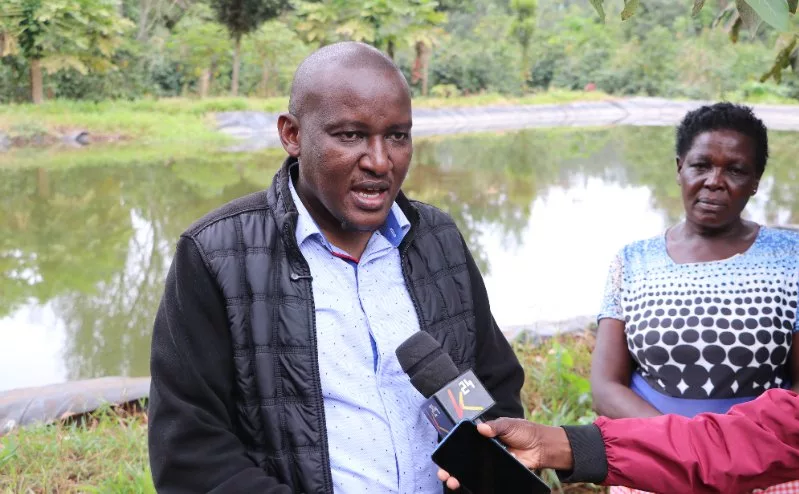
"Sustainability is key and it is maintained by the fact the farmer is able to pay for operation and maintenance," Kimotho said during a visit to the Kandeki Irrigation Scheme in Kirinyaga county on Tuesday.
The PS said the programme has attracted significant interest from other regions, with plans already underway to introduce it in Western after the government secured about Sh3 billion in grants to support irrigation infrastructure and strengthen farmers' capacity.
Under the financing arrangement, farmers contribute 10 per cent of the project cost, the government provides a 40 per cent grant, while financial institutions finance the remaining 50 per cent through loans guaranteed by development partners.
Kimotho said the model differs from conventional government-funded irrigation projects because farmers have a financial stake in the schemes, making them more committed to maintaining the infrastructure and ensuring the projects remain productive.
The Kandeki Irrigation Scheme serves about 245 farmers cultivating nearly 225 acres. The farmers have established their own management structure, employing a manager, marketers and technical staff to oversee operations, maintenance and the marketing of produce.
According to the PS, the programme goes beyond providing water, with the government working closely with county governments, financial institutions and development partners to ensure farmers have access to quality seeds, extension services and reliable markets.
"Our focus is not just on providing water but also connecting farmers to reliable markets through aggregators, contract farming and partnerships with agro-industrial parks," he said.
Kimotho said the development of County Aggregation and Industrial Parks (CAIPs) will play a critical role in guaranteeing markets for farmers, enabling them to generate enough income to meet operational costs, repay loans and expand their farming enterprises.
He said the programme has posted an impressive loan repayment rate of about 95 per cent, with some farmers clearing their loans in just three years despite repayment periods of up to seven years.
The government has invested about Sh1.3 billion in irrigation projects across the Mt Kenya region over the last five years, contributing to increased food production, improved household incomes and greater resilience to climate change.
His department, he said, first undertakes hydrological assessments and extensive public participation before introducing projects to establish whether adequate water resources exist and whether communities are willing to embrace the financing model.
"We first map the hydrology of the area before engaging the county government and the community to determine whether they are ready to adopt the model," he said.
County governments remain central to the programme's success through the deployment of extension officers, the promotion of good agricultural practices and the provision of quality seeds.
The nationwide expansion forms part of the government's target of placing 2.5 million acres under irrigation, up from the current 772,000 acres.
He said the government plans to expand irrigation through flagship projects such as the Galana-Kulalu and Bura irrigation schemes while constructing medium-sized dams to increase water availability for community irrigation projects.
Citing Kandeki, Kimotho said additional water storage infrastructure would enable the scheme to expand from its current 225 acres to benefit more than 1,000 farmers by drawing more water from the River Nyamindi.
The PS also cited the transformation of the Mwea Irrigation Scheme as proof that strategic investment in irrigation can transform local economies.
Before the completion of Thiba Dam, farmers cultivated about 25,000 acres under a single season. The project expanded irrigation to 35,000 acres and enabled double-season rice production, supporting cultivation across more than 70,000 acres annually.
"Mwea now contributes nearly half of Kenya's rice production. The country currently produces about 305,000 tonnes annually, with Mwea accounting for about 155,000 tonnes. We want to replicate that success across the country," he said.