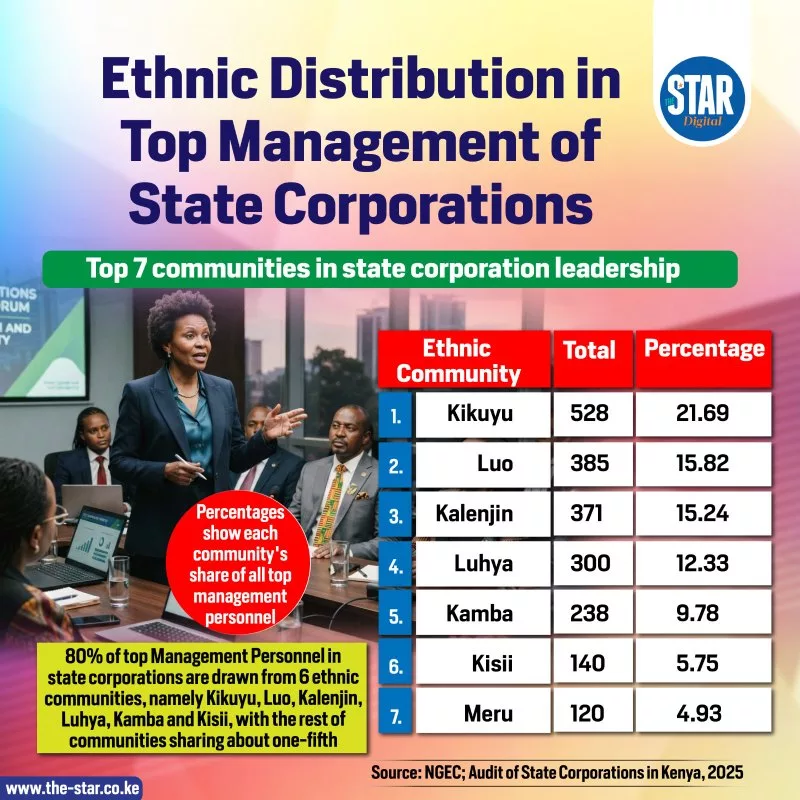
Leadership in Kenya’s state corporations remains heavily dominated by a handful of ethnic communities.
Six ethnic groups account for a striking 80 per cent of all top management positions across state enterprises.
The remaining ethnic communities share just about one-fifth of the available executive seats.
The Kikuyu community holds the largest share of executive leadership, claiming 528 top management positions, which translates to 21.69 per cent of total personnel.
The Luo community follows as the second most represented group, occupying 385 positions, or 15.82 per cent of top management roles.
Close behind, the Kalenjin community accounts for 371 executive roles, representing 15.24 per cent of corporate leadership positions.
The Luhya community sits in fourth place with 300 personnel, making up 12.33 per cent.
The Kamba and Kisii communities complete the six dominant groups driving state enterprise management. The Kamba community holds 238 top management slots, representing 9.78 per cent, while the Kisii community accounts for 140 leadership positions, translating to 5.75 per cent.
Rounding out the top seven communities in state corporation executive suites is the Meru community, which occupies 120 leadership positions, or 4.93 per cent of the executive seats.
The audit by the National Gender and Equality Commission underscores the heavy concentration of executive authority within a small subset of ethnic groups, leaving minority communities to contend for a narrow fraction of leadership appointments across public corporations.