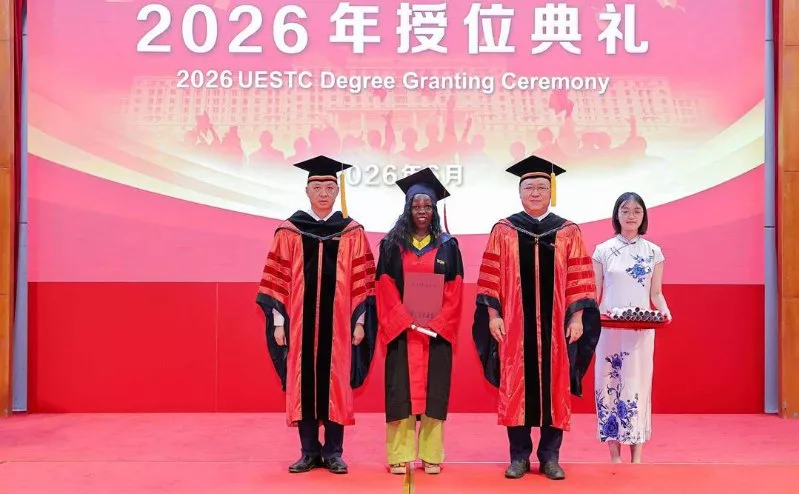
 Dr Miriam Ogunja during graduation /HANDOUT
For many Kenyan professionals, pursuing a master's degree or PhD abroad represents the promise of global exposure, world-class research, career advancement and the chance to compete on an international stage.
Yet for every success story, there are countless applications that never make it beyond the first round.
Securing a fully funded international scholarship is fiercely competitive, often requiring outstanding academic credentials, a compelling research vision and the ability to distinguish oneself among some of the country's brightest minds.
This year, Dr Mirriam Ogunja joined the growing but still select group of Kenyans who have turned that dream into reality, graduating with a Doctor of Business Administration (DBA) in Organisational Behaviour and Human Resource Management from the University of Electronic Science and Technology of China (UESTC) in Chengdu.
Her graduation marks the years of resilience, research and persistence that began in an interview room where she was the only woman among twelve candidates.
Before China, Ogunja had built a promising career in Human Resource Management, working on projects linked to PwC, KPMG and Ernst & Young before taking on an acting HR Manager role at Oshwal Academy. Then the pandemic disrupted everything.
"You think you've planned your life," she recalls. "Then something happens that reminds you how little control you actually have."
Rather than wait for the job market to recover, she widened her search beyond Kenya. In January 2021, she came across a fully funded Chinese Government Scholarship for doctoral studies.
She applied, spending weeks assembling transcripts, research proposals, medical records and supporting documents in what she describes as an exhausting process.
The paperwork, however, proved to be the easy part.
The scholarship interview brought together twelve finalists. Ogunja was the only woman in the room.
"It wasn't the kind of interview where you memorise answers," she says. "They wanted to know how you think."
For nearly an hour, the panel challenged candidates on leadership, organisational behaviour, public policy and the United Nations Sustainable Development Goals.
Every answer felt consequential. Every question carried the possibility of ending the journey before it had begun.
Weeks later, an email confirmed what the interview room never could. She had been selected for the fully funded scholarship.
Winning the scholarship was widely celebrated. Completing the doctorate turned out to be an entirely different achievement.
"A PhD is a job," she says. "People think you're just going to class. You're not. You're expected to produce research, publish papers, meet deadlines and constantly defend your ideas."
Her days became an endless cycle of reading journal articles, refining research questions, rewriting chapters and responding to supervisors' comments. Every milestone had to be earned, from comprehensive examinations to research publications and finally the dissertation itself.
"There are moments when you question yourself," she admits. "You finish writing a chapter feeling proud of it, then your supervisor sends it back covered in comments. You realise you're starting again."
Her research examined how relationships between leaders and employees influence organisational performance in Kenyan small and medium-sized enterprises, work she hopes will contribute to stronger leadership practices both in Kenya and beyond.
The years in China also produced recognition beyond the classroom. Ogunja received the Outstanding Reviewer of the Year Award from the OR Society in the United Kingdom in 2024, won first prize for academic achievement at UESTC in 2024 after earlier recognitions in 2023, and was invited to speak by the Office of the United Nations High Commissioner for Human Rights and the Asia-Pacific Network for People of African Descent following interest in her research on China-Africa cooperation.
She has also been nominated for African Woman of the Year at the Asia-Pacific Awards in Beijing.
Outside academia, she embraced life beyond the university gates. An interview on Sichuan Living, where she shared her experience adapting to life in China, became the programme's most-watched feature, opening doors to paid brand partnerships and positioning her as an informal cultural ambassador for Kenya.
"Sometimes you're the first Kenyan someone has ever interacted with," she says. "That comes with responsibility."
Despite the visibility, she never lost sight of the reason she travelled to China.
"The awards are encouraging," she says. "But they don't replace the reason I came here. My priority has always been completing my PhD."
That priority has now been fulfilled.
Her graduation is more than the awarding of a doctorate. It is the final chapter of a journey that began with unemployment, uncertainty and a competitive interview where she stood alone as the only woman among eleven men.
Looking back, Ogunja believes the biggest lesson extends well beyond academia.
"Every setback carries the possibility of another beginning," she says. "Sometimes the opportunity you're praying for is hidden inside the challenge you're trying to avoid."