Earlier this month, as the now-iconic Ol Kalou by-election drew ever nearer, I tried to explain why President William Ruto’s grip on power may be at risk, owing to the multiple pressure groups that had mounted a campaign of delegitimisation against him.
My basic point was that if such a campaign were successful, it could have a disproportionate impact on the final tally in the 2027 presidential election.
Worse still, when such a campaign is successful, it completely diminishes any potential goodwill that a candidate for high office may have generated through the kind of “development projects” which Kenyans claim to value above all else.
And of course, President Ruto is basing his entire re-election strategy on his “development record”, consisting primarily of many highly visible infrastructure projects and a complete revamping of public health and education.
I am not sure how successful I was in explaining all this, which is why I am now returning to this topic.
For if my theory in this matter was somewhat tentative before, the Ol Kalou by-election provided a flood of data to support it, and to put this perspective beyond any possibility of doubt.
Readers who spend time on social media must have seen some of those videos that show Nigerian tycoons with political aspirations delivering “goodies” to their supporters in some wide-open space: endless rows of foodstuffs, farm inputs and implements, household goods, etc. All packaged and set out in neat rows ahead of the arrival of the beneficiaries.
Some of the rows of such gifts extend so far that you have to wonder if this is not some kind of AI-generated imagery.
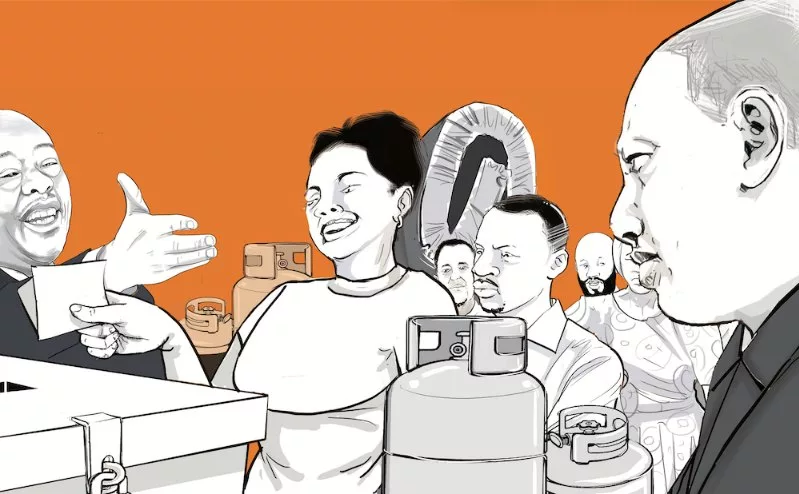
Well, Kenyans have now realised that we are not that far behind. I do not recall any previous election in Kenya where voters were incentivised with mattresses. And the mattresses were not the half of it. Openly announced in advance and visibly handed out, there were the now-infamous 20,000 gas cylinders.
I think even a Nigerian tycoon seeking elective office would respect that particular item in the long list of good things that were given out in support of the candidate running on Ruto’s UDA party ticket.
By the logic of the theory that Kenyans place a high value on “development”, the UDA strategy would have been something like this:
“Given that each household is likely to have at least two voters, if we give out 20,000 gas cookers, the grateful voters arising from this would be at least 40,000. But in any Kenyan by-election, the turnout is notoriously low – usually just about 50 per cent – and so this would come to about 20,000 votes. Add to this those who received the mattresses and other good things, and we are surely looking at 30,000 to 35,000 votes.”
Instead, it was what we must now call “the opposition candidate” from former Deputy President Rigathi Gachagua’s DCP party, who got 35,000 votes, despite not having had any “goodies” to dish out to the voters of Ol Kalou.
While the UDA candidate got only 5,000 votes, suggesting that a full 15,000 of the voters in that constituency were happy enough to receive the famous gas cookers, but had other loyalties when it came to actually casting their votes.
This is the stuff of what psychologists call “cognitive dissonance”: that voters in Kenya generally insist that all they really care about is to see “development” arising from the efforts made by those who seek to lead them; and yet somehow manage to vote on the basis of totally different ideas and values, when it comes to casting their ballots.
All in all, the Ol Kalou campaign provided verifiable and empirical evidence that the campaign of vilification and delegitimisation that the opposition leaders have waged against President Ruto is having some effect.
The only question that remains unanswered is that of how far-reaching this campaign is, and how many other regional voting blocs may yet sign on to this narrative, which totally disregards all material benefits delivered by the Ruto government.
And instead applies a laser-like focus to making him a one-term president.