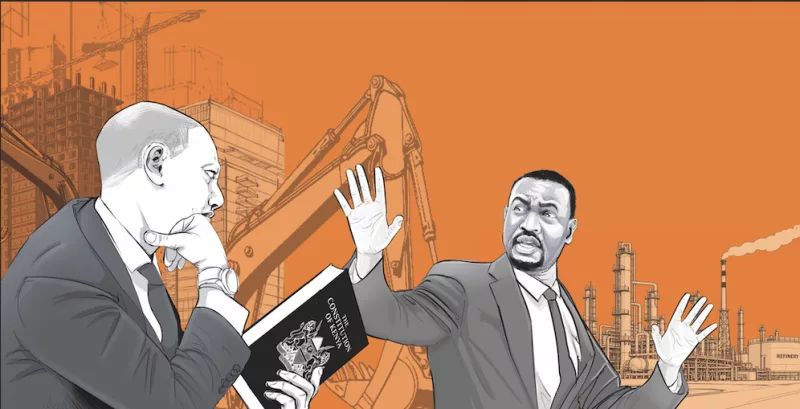
Last week I wrote about the hypocrisies of foreign investors who often start by claiming that the only way any new investment will work, is if their demands are met in every detail (e.g. in the number of expatriate managers they have to employ; tax concessions; grants of free public land; etc.)
I should have added that most investors will routinely claim that their investment is a win-win proposition, and that our country stands to reap immense benefits. But in reality, they tend to keep most of that “winning” for themselves.
I now want to apply this logic to something which President William Ruto has in his recent speeches in prominent global platforms, repeatedly emphasised.
And this is that investors coming into developing countries who have an interest in various valuable minerals, should be ready to engage in value addition within those countries. And that the era of basic extraction of such minerals as raw materials which would be then processed elsewhere, has come to an end.
There are two points I want to make at this juncture.
First is that this is not a completely new policy proposal. One country in Southeast Asia, Indonesia, had a president, Joko Widodo, who was amazingly successful in compelling investors in his country’s mining sector, to process valuable ores locally, despite initial resistance by such investors.
Changing from the Indonesian government’s previous willingness to allow for the export of unprocessed nickel and copper, this president adopted a policy some have called “resource nationalism”. And although it was not all a smooth ride, in the end it led to the setting up of many new nickel smelters in Indonesia, as well as two new copper smelting plants.
These new mineral processing plants were private sector funded: paid for by the investors who had initially shown a preference for just digging up and exporting raw minerals.
At a practical level, all this substantially increased the foreign exchange earnings of Indonesia. Though not without some negative environmental consequences.
A study by the independent Indonesian research and public policy institution, the Centre for Economic and Law Studies concluded that “The ban on nickel ore exports and increased domestic processing have raised nickel export values [for Indonesia] from USD 4 billion in 2017 to USD 34 billion in 2022, or an increase of 750 per cent. However, claims of positive impacts from nickel downstreaming often overlook the effects on environmental risks and public health”.
For current purposes, my focus is on the fact that this single policy change, and the new economic ecosystem that it created “raised nickel export values from USD 4 billion in 2017 to USD 34 billion in 2022, or an increase of 750 per cent”.
I do not think we have ever had any single policy change here in Kenya, lead to such a dramatic increase in export earnings.
So, what President Ruto is trying to do, is very much achievable. And it is just the kind of economic miracle Kenya needs.
The second point I wish to make is that President Widodo in his 10 years in office (2014 to 2024) never once attended the annual United Nations General Assembly meeting in New York City, and indeed openly expressed what one report defined as “his disdain for geopolitical theatre”.
Which is the very opposite of our own President, who seems to relish any opportunity to travel abroad and make a speech at some prestigious venue.
You might think these two things are unrelated. But they are not.
Admittedly President Ruto is by far the most driven and energetic president that Kenya has had. One day you read that he is in some foreign capital, attending a gathering of influential global leaders at some summit or other. And before you can blink, he is already back in Kenya and presiding over the launch of yet another of his major infrastructure projects.
While all these development projects are directly related to the demands of the Kenyan public, you have to wonder if it might not have been better overall if the head of state had given more attention to “resource nationalism” right from the start.