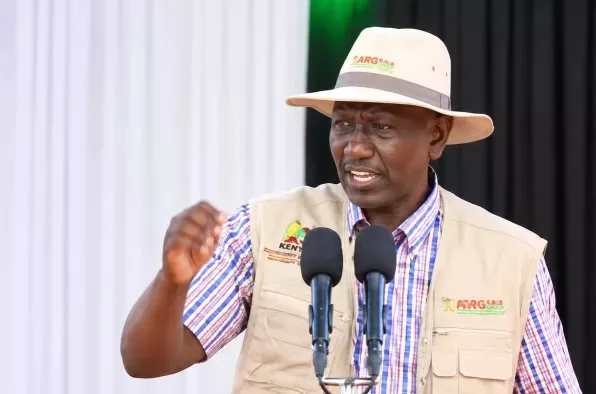
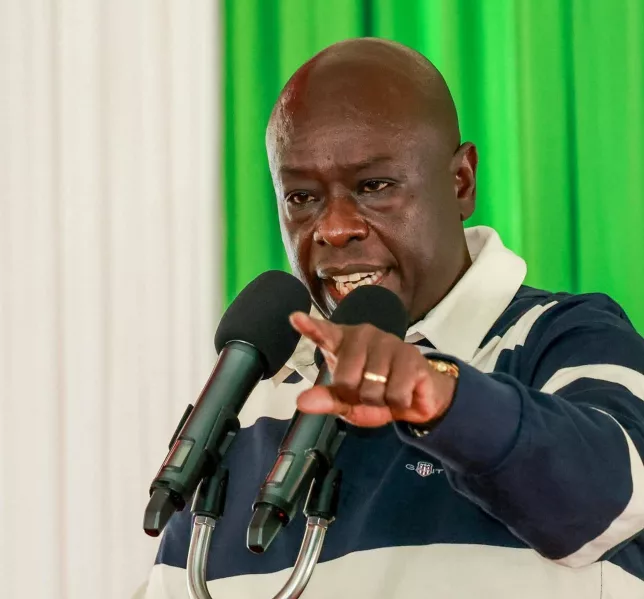
 DCP leader Rigathi Gachagua. H
It makes a leader mistake temporary influence for permanent authority, personal popularity for national legitimacy and a political constituency for ownership of the country.
History is littered with leaders who believed they could not be questioned, challenged or replaced. They eventually discovered that power, however imposing, is always temporary.
The recent political posture of former Deputy President Rigathi Gachagua offers a useful case study in this danger. Since his fallout with President William Ruto, his language has increasingly been defined by confrontation, grievance and an unmistakable confidence that he commands a political constituency that others must negotiate with on his terms.
He has spoken of Mt Kenya as having been "betrayed", declared that the region was "irretrievably lost" to Ruto, and repeatedly presented the political contest in terms of who delivered which votes and who therefore deserves what share of power.
At one point, he even argued that the President's problems were of his own making because, in his words, "he betrayed us" and "he deceived us".
More recently, the former DP has hardened his opposition. He has ruled out any political truce with the President, describing the prospect of a handshake as "nonsense", while declaring that his opposition is giving Ruto an even greater challenge than previous opposition leaders did.
He has also said that he would not reconcile with the President in exchange for "money, positions or privilege".
Such statements may energise political rallies, but they also reveal the extent to which personal political conflict has become intertwined with the national conversation.
There is nothing wrong with opposition. Indeed, democracy requires robust opposition, scrutiny and accountability. A former DP has every right to criticise the government and to seek the support of Kenyans.
The problem begins when political disagreement is reduced to ethnic arithmetic and when a leader starts speaking as though an entire community is a political estate that can be mobilised, negotiated for and delivered as a bloc.
That is where the politics of tribalism becomes both dangerous and intellectually impoverished.
Kenya is a country of many communities, each with its own history, aspirations and contribution to the national story. No single community owns the republic.
No region possesses a permanent political entitlement to the presidency. No leader has the right to suggest that a community's electoral support creates a proprietary claim over the instruments of state.
The politics of "we gave you the votes, therefore you owe us power" is ultimately a very cheap form of politics. It reduces citizenship to ethnic accounting.
It tells a young Kenyan that his or her future depends not on competence, enterprise, education or hard work, but on the numerical strength of the community into which they happened to be born. That is not a vision for a modern Kenya. It is a retreat into the politics of the past.
Gachagua has defended his advocacy for Mt Kenya unity by insisting that it should not be equated with tribalism. He has also argued that the region overwhelmingly supported Ruto despite his not being Kikuyu, presenting this as evidence of the region's nationalist character.
That is a legitimate political argument. But the continued emphasis on the region as a distinct political shareholder, particularly when tied to the language of betrayal and political debt, risks reinforcing precisely the ethnic framework he rejects.
The wider question is the historical phenomenon sometimes described as Kikuyu political hegemony. Since independence, members of the Kikuyu political and economic elite have occupied a prominent place in the country's political establishment. Jomo Kenyatta became Kenya's first president.
Mwai Kibaki later served as president. Between and around these presidencies, prominent Kikuyu politicians and technocrats occupied influential positions in successive administrations, including under Daniel arap Moi. This is a matter of historical record.
But historical prominence should not become a claim to permanent political privilege.
Indeed, the Kikuyu community has been extraordinarily influential in Kenya's political, economic and institutional life. It has produced presidents, senior public servants, business leaders, scholars and professionals who have made immense contributions to the country.
That contribution should be celebrated, not resented. But the very scale of that influence also creates a responsibility: to use national influence in the service of national unity, rather than to turn it into a perpetual political bargaining chip.
The contradiction in the current politics is therefore striking. Gachagua was himself at the centre of the Ruto administration. He served as DP, the second-highest office in the republic.
His political allies and members of the Mt Kenya community occupied influential positions across government. The community was not excluded from power. It was part of the governing coalition and, by any reasonable assessment, had substantial representation within the administration.
Yet the political narrative that emerged was increasingly one of grievance and exclusion.
That raises a fundamental question: if a community can be represented at the highest levels of government and still be mobilised around a narrative of betrayal, what exactly constitutes inclusion?
The answer cannot be that every community must permanently control a share of state power proportional to its electoral contribution.
That would turn Kenya into a permanent auction of ethnic interests, with every election becoming a negotiation over which community gets what. Such a model is neither democratic nor sustainable.
The real test of leadership is whether a politician can transcend the circumstances of his own rise. A national leader must be able to look beyond the community that propelled him into office and speak to the whole country.
He must be able to recognise that the Luo child in Kisumu, the Kalenjin farmer in Eldoret, the Somali trader in Garissa, the Luhya student in Kakamega, the Kamba entrepreneur in Kitui, the Maasai pastoralist in Narok and the Kikuyu farmer in Nyeri all have an equal claim to the Kenyan future.
This is where arrogance becomes politically fatal. The arrogant politician believes the people belong to him. The wise politician knows that he belongs to the people.
The arrogant politician believes yesterday's votes are permanently deposited in his political account. The wise politician understands that every election begins with a fresh conversation with citizens.
Gachagua's greatest political challenge, therefore, may not be President Ruto. It may be the temptation to believe that ethnic mobilisation alone can carry him to national leadership. Kenya's history suggests otherwise.
A politician may rise through the strength of a community, but to govern Kenya, he must ultimately persuade the country.
There is nothing inherently wrong with defending the interests of one's community. Every community deserves a voice. But the moment community identity becomes the principal currency of political power, the national project begins to suffer.
Kenya needs leaders who can transform diversity into strength, not those who repeatedly reopen old anxieties for political advantage.
The country has moved too far to return to a politics in which leaders count tribes before they count citizens. The future belongs to a Kenya where political legitimacy is earned through ideas, integrity, competence, delivery and the ability to unite people across their differences.
Arrogance eventually meets reality. Political power eventually changes hands. Communities eventually reconsider their loyalties.
And leaders who imagine that they have mastered the permanent mathematics of Kenyan politics often discover that the electorate is far more unpredictable than their advisers told them.
The lesson is simple: no community owns Kenya, no politician owns a community and no leader is bigger than the republic.
Kenya's future cannot be built on ethnic entitlement or political grievance. It must be built on the far more difficult, but infinitely more rewarding, work of creating a country in which every citizen feels that the Government belongs to them.
That is the politics Kenya deserves. And that is the standard by which history will ultimately judge those who seek to lead it.