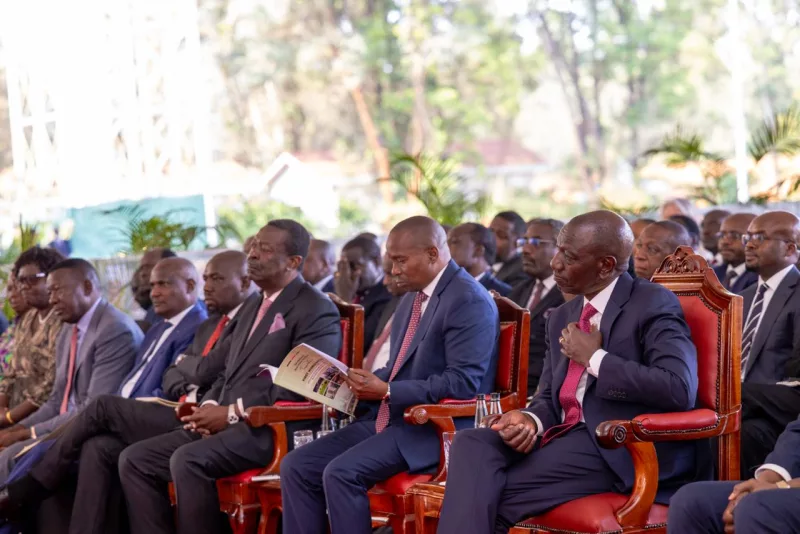
 President William Ruto with his deputy Kithure Kindiki and other leaders when he received a report on "Developing a New Vision for Kenya~Towards First World Nation” at State House, Nairobi on July 21, 2026/PCS
Kenya should anchor its Kenya ~ Towards development blueprint in law, protect it from political transitions, overhaul the public service and prioritise agriculture, manufacturing and technology if it is to attain First World status within a generation.
These are among the key recommendations contained in a new report presented to President William Ruto yesterday, outlining a roadmap for Kenya's post-Vision 2030 development agenda.
The report, Developing a New Vision for Kenya: Strategic Guidelines for Long-Term National Transformation, was prepared by a team chaired by Kisumu Governor Prof. Anyang' Nyong'o.
Other members of the working group included Prof. Michael Chege, Prof. Karuti Kanyinga, Prof. Peter Wanyande, George Omondi Okong'o and Dennis Onyango.
The blueprint argues that while Kenya has made significant progress in infrastructure, education, democratic governance and financial inclusion since independence, repeated policy shifts, governance challenges and weak implementation have prevented the country from sustaining development long enough to achieve high-income status.
To reverse this trend, the think tank proposes a new long-term national vision that would replace Vision 2030 and remain in force across successive governments regardless of political leadership.
Among the report's most far-reaching proposals is the enactment of a National Development Law to give legal backing to the country's long-term vision.
The proposed law would require all future Medium-Term Plans, county integrated development plans, annual budgets and sector strategies to align with the national vision.
It would also require political parties and presidential candidates to ensure their election manifestos advance, rather than replace, the country's long-term development priorities.
The working group says Kenya has often abandoned or altered development priorities after elections, slowing progress and weakening institutions.
To safeguard continuity, the report recommends reviving and strengthening the National Economic and Social Council (NESC) to oversee implementation of the vision.
The council would bring together representatives from the national government, counties, private sector, academia, professional bodies and development practitioners to provide strategic oversight, commission policy research, monitor implementation and recommend corrective measures where necessary.
“A dedicated Vision Delivery Secretariat should be established as the technical and administrative arm of NESC,” the Nyong’o team states.
The secretariat, it proposes, should be domiciled within the ministry for National Planning but operate with sufficient autonomy to coordinate implementation across government.
The report also calls for a fundamental transformation of the public service, saying Kenya requires a professional, ethical and merit-based bureaucracy capable of implementing long-term reforms efficiently.
It argues that constitutionalism, integrity, transparency and accountability should become defining features of public institutions if Kenya is to achieve sustained economic transformation.
The blueprint identifies agriculture as the first pillar of Kenya's transformation.
It recommends increasing productivity through expanded irrigation, revitalised agricultural extension services, stronger research institutions, climate-smart farming, improved rural infrastructure, affordable inputs and greater investment in agro-processing.
According to the report, agriculture should move beyond subsistence production to high-value commercial farming capable of increasing incomes, reducing poverty and supporting industrialisation.
County governments are urged to work closely with the national government to drive agricultural transformation.
The second pillar is industrialisation through manufacturing and value addition.
The report recommends reducing production costs, strengthening export competitiveness and positioning Kenya as a regional manufacturing and assembly hub capable of producing goods for both domestic and international markets.
Technology and innovation form the third pillar.
The team proposes increased investment in research, universities, technical education, artificial intelligence, digital transformation and innovation financing to create a competitive knowledge economy capable of generating quality jobs and higher incomes.
Beyond these sectors, the report recommends investment in education, healthcare, housing, supportive financial systems, infrastructure, environmental sustainability, climate resilience and stronger coordination between national and county governments.
The report draws heavily on the experiences of countries such as South Korea, Singapore, China, Malaysia and Vietnam, saying they achieved rapid transformation through consistent policies, capable institutions, political commitment and strategic investment in productive sectors.
Speaking after receiving the report at State House, Ruto described it as a thoughtful contribution to an important national conversation on Kenya's future.
"The report's greatest strength lies not in claiming to provide every answer, but in raising critical questions, challenging long-held assumptions, broadening perspectives and enriching national reflection on the choices that will shape Kenya's future," Ruto said.
He noted that Vision 2030 has successfully guided Kenya's development over the last two decades but said the country must now begin preparing for what comes next.
"These efforts are driven by a larger reality. For nearly two decades, Vision 2030 has provided Kenya with a shared sense of purpose and direction. It has guided reforms, inspired investment and shaped our nation's development journey," he said.
The President said Kenya has a responsibility to develop a new long-term national vision that will steer the country's next phase of development after Vision 2030 expires.
Ruto praised the team for producing what he described as an important body of work that will help shape the country's long-term planning.
"I want to commend the team and all the contributors for their scholarship, dedication and patriotism. You have produced a significant body of work that will help inform Kenya's long-term development agenda," he said.
The President said the government would study the recommendations before unveiling the next steps.
"We will go through this report, and in a short while, I will then propose a way forward on how this report can now ignite a national conversation for all of us," he said.
Ruto added that discussions on Kenya's future development should rise above politics.
"No political parties, no religious groups, no regions. This conversation must belong to all Kenyans because it is about the future of our country."
The report recommends that before the new vision is formally adopted, the government should conduct extensive public consultations involving counties, businesses, civil society, academia, religious organisations and citizens to build national ownership.
It further proposes preparation of sector-specific transformation strategies, flagship development projects and the first five-year Medium-Term Plan, with the new National Development Vision targeted for launch before the end of 2026.