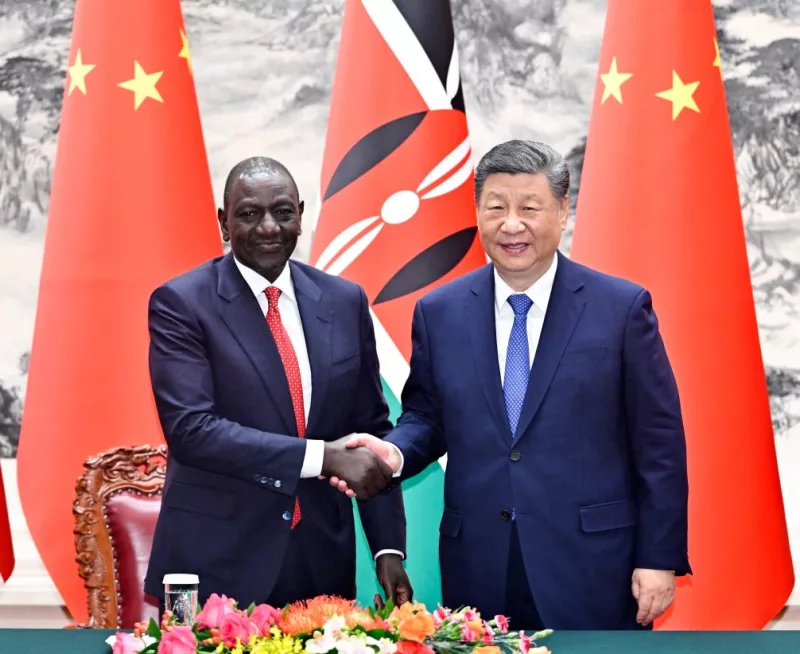
 Edwin Wanjawa, the chairperson and convener of the Pwani university Democracy Entrenchment Consortium Unit exchanges the MoU documents with Mosese ole Ladama, the CEO and secretary of the IEBC at Anniversary Towers in Nairobi /EDWIN WANJAWA
While electoral management agencies must always be held accountable, reducing the complex enterprise of
democracy to the successes or failures of one institution is both simplistic
and counterproductive.
The recent signing of a memorandum of understanding between Pwani University and the IEBC offers a refreshing departure from this narrative.
Rather than standing on the sidelines as critics, the two institutions have chosen to become partners in strengthening democracy.
The partnership should not merely be viewed as an administrative agreement. It represents a profound statement about the indispensable role of academia in nation-building and the centrality of evidence in public policy.
Democracy is neither an event nor a five-year ritual of casting ballots. It is an ecosystem. Elections are merely its most visible manifestation.
Beneath every credible election lies years of civic education, public participation, institutional development, research, legal reform, technological innovation and continuous citizen engagement. These are areas where universities possess immense comparative advantage.
Universities exist to produce knowledge. Electoral management organisations exist to administer elections. Governments formulate policy.
Civil society mobilises citizens. The media informs the public. When each institution performs its mandate in isolation, democratic progress becomes fragmented. However, when these institutions deliberately collaborate, democracy matures and thrives.
Universities generate empirical evidence that should inform public policy rather than allowing policy to be driven by political expediency or public emotion.
Research can identify why young people remain reluctant to register as voters, explain regional disparities in voter turnout, examine the roots of electoral violence, evaluate the effectiveness of civic education programmes and recommend practical interventions grounded in data rather than speculation.
The Pwani University-IEBC partnership therefore illustrates what should become the norm rather than the exception.
The agreement goes beyond voter education. It encompasses collaborative research on democracy, elections and governance, internship and experiential learning opportunities for students and joint seminars, conferences and policy dialogues.
Such engagements create an
important bridge between theory and practice. Students gain first-hand
experience of public institutions, while the electoral
agency benefits from
fresh research, innovation and critical analysis.
One of Kenya's greatest democratic challenges today is declining public confidence in institutions. Yet institutions are not strengthened through constant condemnation alone.
They are strengthened through constructive engagement, continuous improvement and shared responsibility.
It has become fashionable to blame IEBC for every electoral challenge facing the country. Certainly, like every public institution, the commission must remain transparent, accountable and open to scrutiny.
However, expecting IEBC alone to deliver democratic perfection ignores the broader reality that elections reflect the character of society itself.
Electoral violence is not created by the commission. Voter bribery is not organised by the commission. Hate speech, political intolerance, disinformation, ethnic mobilisation and electoral malpractice originate largely from political actors and, at times, from citizens willing to participate in them.
Consequently, safeguarding democracy cannot be outsourced exclusively to IEBC. Political parties must embrace internal democracy.
Religious leaders must preach peace and integrity. The media must combat misinformation while providing balanced reporting.
Civil society must continue civic education. Universities must generate research and evidence. The private sector must support democratic initiatives. Citizens must reject corruption and violence in all their forms.
The constitution deliberately distributes democratic responsibility across numerous independent institutions. This constitutional architecture recognises that democracy cannot depend upon one office or one commission.
It requires checks and balances, institutional cooperation and informed citizen participation. Indeed, the greatest guarantor of democracy is not any institution but the people themselves.
No electoral commission, regardless of its competence, can guarantee credible elections if citizens willingly sell their votes.
No legal framework can eliminate political violence if communities embrace intolerance. No technology can compensate for the absence of integrity. Democracy ultimately rests upon the everyday choices made by millions of ordinary citizens.
This is why civic education remains indispensable. Citizens must understand not only how to vote but why their vote matters, how institutions function, what constitutional rights they possess and what responsibilities accompany those rights. Democracy flourishes when citizens become active participants rather than passive spectators.
The partnership between Pwani University and IEBC offers an opportunity to cultivate precisely this informed citizenship.
By combining academic scholarship with practical electoral experience, the collaboration can produce innovative approaches to civic education, policy research, youth engagement and democratic participation that extend far beyond election seasons.
Democracy is not something that the commission delivers to citizens. Democracy is something citizens create, protect and continually improve through responsible leadership, informed participation and strong institutions.
To realise the promise of the constitution, Kenya must replace blame with partnership. Universities, constitutional commissions, policymakers, civil society, the private sector and citizens must work together to strengthen democracy.
Ultimately, democratic success depends not only on strong institutions but also on informed, responsible citizens committed to justice, fairness, the rule of law, and active civic participation.