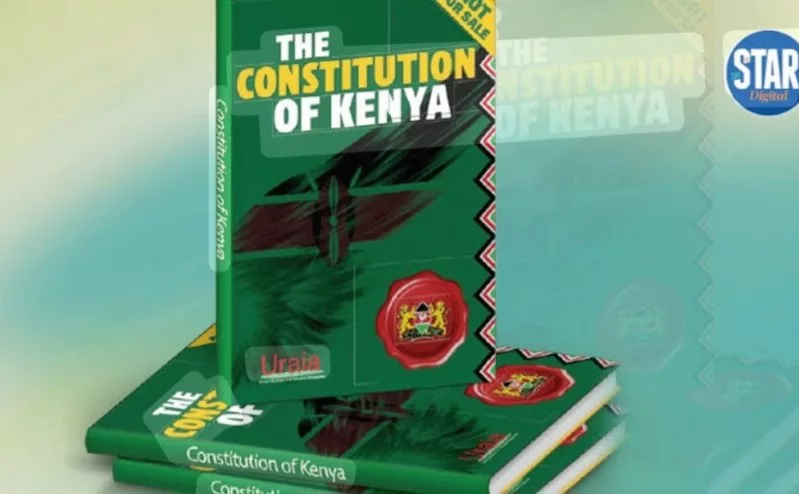
A saying goes: those who plant the tree may not be those who benefit from its shade. That rings true with the 2010 Constitution, whose fruit we are only beginning to see.
Before its promulgation – and from what the old guards say – the notable criteria for electing representatives was ‘the six-piece suit’.
To be fair, it is likely voters then worked with what they had. Not anymore.
The katiba brought a new dimension: Chapter Six.
Titled ‘Leadership and Integrity’, Chapter Six enshrines leadership as a public trust rather than personal privilege. It requires state officers to act with objectivity, impartiality and selflessness, serving solely in the public interest.
The chapter mandates an oath of office, sets conduct and financial integrity standards, and prohibits nepotism, favouritism and corruption. It also requires declaration of personal interests that may conflict with public duties.
A quick look around may have one wondering whether the chapter is not too lofty for Kenya to grasp, but don't be fooled. Despite what we see—the engagement of goons, leaders who care nothing for the people's good and the passage of laws and levies out to hurt mwananchi—it is clear we have a new crop of aspirants who are worth a try. That is one prayer answered.
Among the names that have emerged since the advent of the new constitution, a few stand out as embodiments of the Chapter Six ideal.
Martha Karua, the former Minister for Justice and Constitutional Affairs, was a principal architect of the katiba and has consistently been associated with integrity and a no-nonsense approach to governance.
In 2022, she offered herself as the Azimio la Umoja coalition's presidential running mate alongside Raila Odinga. Despite her sterling credentials and a track record of speaking truth to power, they lost to the Kenya Kwanza coalition in the 2022 polls.
Political analysts attributed the loss to a combination of factors, including the perception that the Azimio coalition was defending the status quo and the formidable organisational machinery of her opponents.
Busia Senator and advocate for public good Okiya Omtatah is another name that resonates with integrity. Known for his relentless court petitions challenging unconstitutional actions by the Executive and Parliament, Omtatah successfully contested the Busia senatorial seat in 2022 and won.
His victory proved that a candidate with a reputation for integrity can triumph when citizens rally behind a principled leader, yet it remains the exception rather than the rule.
Reuben Kigame, the renowned gospel musician and disability rights activist, offered himself for the presidency in 2022, championing leadership of integrity, accountability and the rule of law.
However, the Independent Electoral and Boundaries Commission locked him out of the August polls, citing failure to meet key requirements, including anomalies with the signatures collected to support his candidature.
Although the High Court ordered the commission to accept his nomination papers, the Court of Appeal later suspended that directive, and by then, ballot papers had already been printed.
Undeterred, Kigame has declared his intention to run for president in the 2027 general election, saying he is not merely hopeful but actively preparing to be on the ballot.
In June last year, former Chief Justice David Maraga threw his hat into the 2027 presidential race, promising to offer clean, accountable and ethical leadership. Supporters hail him as a principled and courageous figure who restored faith in the independence of Kenya's Judiciary.
He has pledged to lead a corruption-free government, insisting that his public service record speaks for itself. Whether he will succeed where other integrity candidates have faltered remains to be seen, but his entry into the race has injected a measure of hope into a political landscape often devoid of it.
Boniface Mwangi, the photojournalist and human rights activist, is another name that commands respect in integrity circles.
He vied for the Starehe constituency MP seat in the 2017 polls. However, for the 2022 general election, Mwangi announced that he would not be vying, choosing instead to campaign for the Azimio coalition.
His decision not to offer himself for elective office in 2022, despite his strong public profile and activist credentials, underscores the immense personal and financial toll that political contests exact on candidates of principle.
The list, while perhaps not as long as the “traditional career politician” queue, is formidable.
However, the fate of such aspirants has in the past underscored a painful reality: integrity is often penalised at the ballot box.
In 2022, the Red Card Campaign, run by the National Integrity Alliance, flagged more than 20 candidates with questionable integrity, yet many of them still secured clearance to vie. Of those red-carded in the 2017 election cycle, eight were not reelected—but 12 returned to office.
A new report by Transparency International Kenya shows that corruption remains entrenched and individuals with ethical questions still ascend to public office despite Chapter Six.
The study attributes this disconnect to a political system where informal power consistently overrides formal rules. Ethnic alliances and political negotiations frequently override formal integrity standards, allowing the Executive to use appointments to reward loyalists and maintain coalition stability.
Vetting processes focus on compliance—tax clearance certificates, wealth declarations and certificates of good conduct—while deeper questions about ethical conduct and accountability history often remain unexamined.
Nonetheless, across the continent, nations are demonstrating that change is possible. In Ghana, Cabinet has approved sweeping reforms to the country's decentralisation system, including plans to end the presidential appointment of metropolitan, municipal and district chief executives and replace the system with the direct election of district chief executives on a non-partisan basis.
A bill is expected to be laid before Parliament before the end of the year. This represents a shift in how citizens participate in choosing their local leaders—a shift Kenya would do well to study.
In South Africa, the Economic Freedom Fighters have proposed an Electoral Matters Amendment Bill to introduce a system of automatic voter registration, while civil society organisations have urged Parliament to act without delay to finalise its consideration of the Electoral Reform Consultation Panel's report.
The message is clear: democratic reform requires urgency, not procrastination. In Botswana, the Independent Electoral Commission has prioritised reforms regarding the laws governing the conduct and management of elections, while the Parliament has embarked on an ambitious reform agenda aimed at transforming the legislature into a truly independent, inclusive and citizen-centred institution.
As the Brookings Institution has noted, countries such as Senegal, Botswana, Mauritius, Ghana and Malawi have demonstrated notable democratic strengthening, with opposition parties successfully defeating incumbent governments in recent elections.
These are not distant dreams. They are living examples of what happens when citizens refuse to accept the status quo.
Kenya has the constitutional framework. It has the aspirants of integrity. It has the institutions—flawed but functional. What it lacks is the collective will to demand that the law mean what it says.
What, then, can we do better? We can begin by treating integrity not as a legal technicality to be ticked off, but as a political asset that enhances legitimacy and investor confidence.
We can demand that the IEBC enforce Chapter Six by conducting mandatory wealth audits for all leaders seeking office. We can hold Parliament accountable for making operational the Election Campaign Financing Act before the August 9 deadline.
We can insist that public participation cease to be a box-ticking exercise and become a genuine mechanism for accountability.
We can support the creation of a "coalition of change makers"—comprising clergy, professional bodies and civil society—to foster genuine dialogue on integrity.
"If integrity becomes associated with political credibility, economic stability and reduced appointment scandals, elite resistance decreases," the Transparency International Kenya report concludes.
The 2027 election will be decided in many ways on Chapter Six—and we now have many aspirants who embody it. The question is whether we will finally decide to enforce it.