

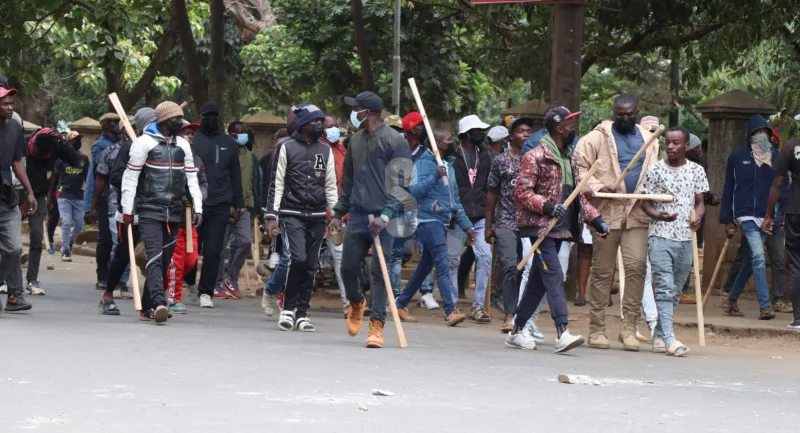
The goon culture we are witnessing in Kenya is not simply a law-and-order problem of thugs for political hire or just thuggery.
It points to a bigger geopolitical trend in which democracies are gradually yielding to the politics of intimidation, brute force and impunity.
A march by the Patriot Front, a far-right white nationalist group, through Washington, DC, on July 4 Independence Day is one sign of a broader drift.
Across the world, there is a discernible pattern of democratic backsliding, with violenceand the brutal imposition of power increasingly replacing diplomacy, respect forinstitutions and the rule of law.
Critics argue that during US President Donald Trump’s second administration this climate hasemboldened expressions of extremism, sometimes violence, around issues such as race,immigration, policing and war.
The Patriot Front march is only the latest example. Videos shared on social mediashowed members marching near the US Capitol and Union Station wearing khakitrousers, blue shirts, white face coverings and sunglasses while carrying the group’sflags and chanting “Reclaim America.”
Whether symbolic or not, the spectacle reflecteda growing confidence among groups that once occupied the political fringe.
Back home in Kenya, as election temperatures rise, the goon problem is gatheringmomentum. More worrying than the violence itself is the apparent inability — orunwillingness — of security agencies to confront it decisively. That perception alone isenough to embolden those who see violence as a viable political enterprise.
Look at the Linda Mwanachi rally in Kisii that turned embarrassing and deadly over thelast weekend. It forms a possible continuum of a trend of organised violence targetingopposition groups.
Political violence is a storied aspect of our politics and the fact that in 2026 the state seems to beegging it on is not just astonishing but also egregious.
The Kisii incident followed the July 3disruption of traffic flow along busy Thika Road by people protesting against the demolition of their houses.
The demonstrations disrupted themorning rush hour as residents blocked sections of the road, forcing motorists to endure longtraffic snarl-ups while police moved in to restore order.
A similar incident happened on June 26 along Nairobi’s Outer Ring Road aftersuspected goons staged demonstrations around Kiamaiko Bridge and the Kariobangiroundabout, disrupting movement and targeting motorists.
Witnesses said the groupbarricaded sections of the road, robbed motorists and passengers and pelted movingvehicles with stones, forcing many drivers to abandon the route.
While these may be legitimate issues to protest against ¾ the constitution guarantees theright to peaceful protest and picketing - and disrupt the normal flow of life to court attention, atrend of lawlessness and anarchy seems to be forming.
It seems that any group of people withany claim of offence can take the law into their own hands and pursue what they deem to beremedies without regard for good order.
This is particularly dangerous as political passion isticking up because groups of young unemployed men seem to be telling politicians that theirservices are available for hire.
Each incident has its own immediate context. Taken together, however, they suggestsomething more disturbing.
A culture is emerging in which groups of young men appearready to hire themselves out to politicians, while politicians increasingly see them asuseful instruments of political competition.
Once that relationship becomes entrenched,violence ceases to be an exception and becomes expected, even accepted, as another campaigntactic.
This is not to suggest that the problem began with the current administration. Politicalviolence has long been woven into Kenya’s electoral history.
During President UhuruKenyatta’s administration, opposition demonstrations were frequently met not only byheavy-handed policing but also by tolerated or even authorised civilian groups that appeared tooperate violently with remarkable freedom, while law enforcement often did not intervene.
Theanti-IEBC protests of 2016 and the violence surrounding the 2017 election remain enduringreminders of how quickly institutions can give way to coercion.
President William Ruto’s administration inherited that ugly tradition but has done little topersuade Kenyans that it intends to break from it.
The 2023 anti-government protests weremarked by allegations of excessive force, while rights organisations documented claimsthat armed civilian groups operated alongside police in some areas.
The Gen Z protests of 2024deepened those concerns through documented killings, enforced disappearances, arbitrary arrestsand attacks on journalists and activists.
The point is not that Kenya is becoming America. Rather, both countries illustrate abroader international tendency in which political polarisation weakens institutionalrestraint and normalises intimidation.
In the United States, critics argue that the politicalhandling of the January 6, 2021, attack on the Capitol, and President Trump’s subsequentpardons of many convicted participants, has reinforced the perception that accountabilityincreasingly depends on political affiliation rather than principle. Kenya faces a similar dangerwhenever violence is tolerated because its perpetrators are politically useful.
That is why monetary compensation for victims, important as it is, cannot substitute foraccountability, justice and reform.
Whether the victims are protesters killed by police or citizensattacked by hired gangs, justice requires more than financial settlements. It requires identifyingthose who organised the violence, those who executed it and those who looked away.
The greatest danger as Kenya heads into another election cycle is not simply thepresence of goons. It is the gradual acceptance of political violence as a legitimateinstrument of competition. Democracies rarely collapse in dramatic fashion.
They erodewhen institutions stop enforcing the law impartially and when intimidation becomesmore rewarding than persuasion.
We have travelled that road before, witnessing the 2007-08apocalyptic scenes of post-election violence. We should not become resigned to travelling itagain.
The writer is studying strategic communications and digital strategy at the University of Oklahoma in the US





