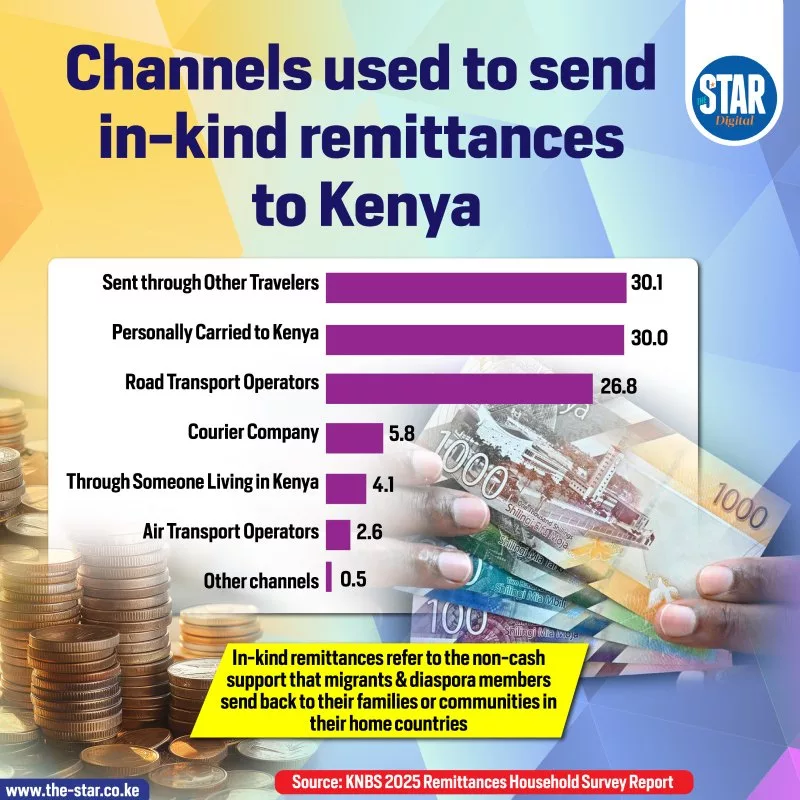
The most common method is sending goods through other travellers, which accounts for 30.1% of the total share. This is closely followed by migrants personally carrying the items to Kenya, a channel preferred by 30.0% of senders.
Road transport operators also play a massive role in moving these non-cash supports, handling 26.8% of the remittance traffic.
Together, these three movement-based methods comprise the vast majority of how in-kind support reaches Kenyan households.
In contrast, formal and commercial delivery services see significantly lower utilization. Courier companies handle 5.8% of the in-kind remittances, while goods sent through someone already living in Kenya account for 4.1%.
Air transport operators are responsible for delivering just 2.6% of the support. The remaining 0.5% of in-kind remittances are sent through other unspecified channels.
The findings underscore a strong reliance on informal networks, personal travel, and regional road transit over institutional courier and air cargo services when diaspora members send non-cash assistance to their home country.