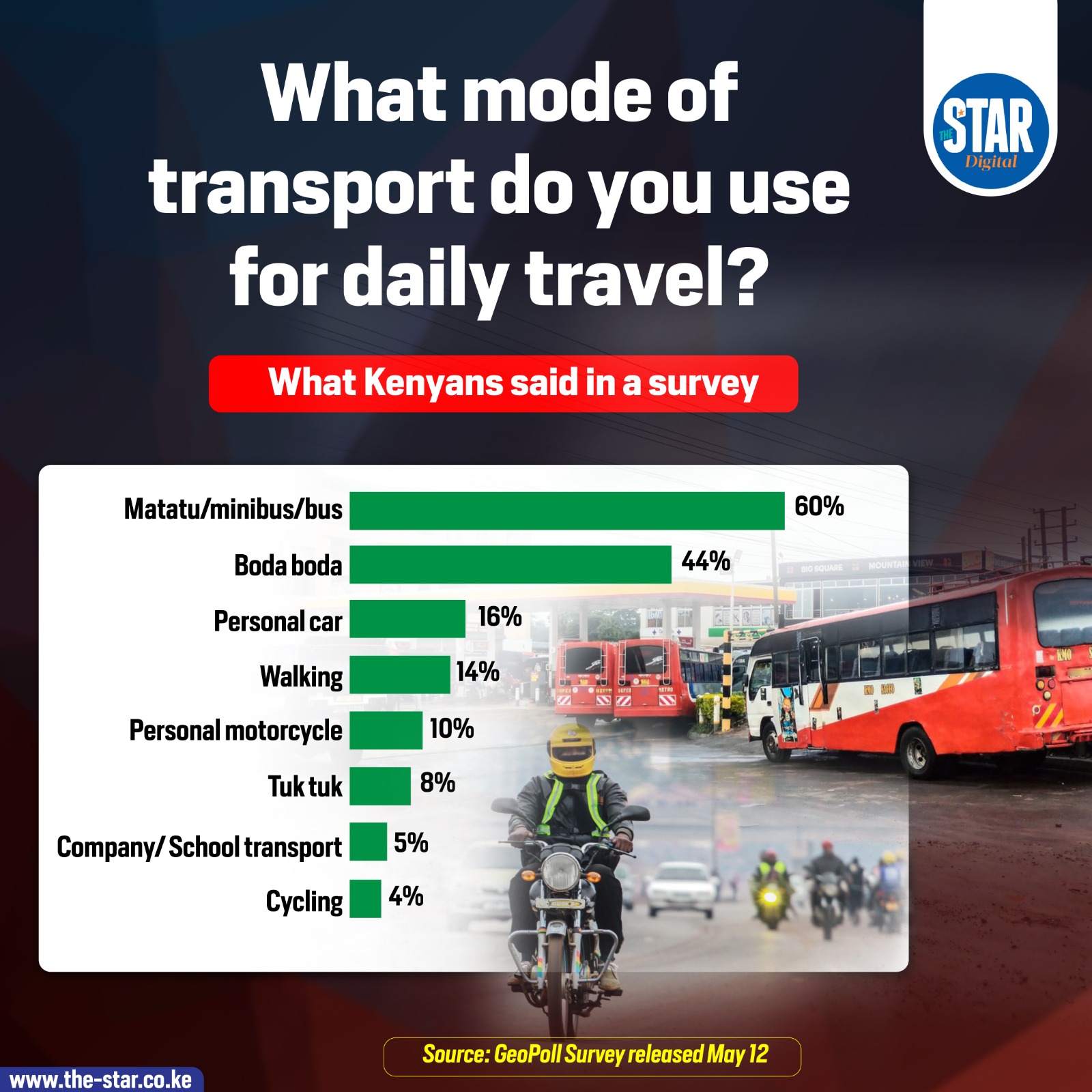
Public transport remains the backbone of daily commuting in Kenya, with a vast majority of citizens relying on shared transit options to navigate their day-to-day activities. Data from a GeoPoll survey reveals that matatus, minibuses, and larger buses are the most dominant choice, utilised by 60 per cent of commuters across the country.
The findings highlight the critical role played by the informal and formal transit sectors, but they also underscore the explosive rise of two-wheeled mobility. Boda bodas, the omnipresent motorcycle taxis, have firmly secured their spot as the second most popular mode of travel, serving 44 per cent of the population. Their ability to beat traffic gridlocks and reach remote areas makes them a vital link for nearly half of all daily travelers.
Private vehicle ownership represents a smaller fraction of daily transit. Only 16 per cent of respondents travel by personal car, while a separate 10 per cent depend on their own personal motorcycles. Meanwhile, active commuting holds a steady footprint, with 14 per cent of Kenyans relying entirely on walking to reach their destinations, and a minor four per cent choosing cycling.
Institutional travel options fill the remaining gaps in daily logistics. Company and school-provided transport systems cater to five per cent of commuters, while three-wheeled tuk-tuks provide localized mobility for eight per cent of travelers.
Cumulatively, these figures reflect a dynamic commuting ecosystem deeply anchored in public service vehicles and commercial motorcycles, mapping out exactly how the nation moves every single day.