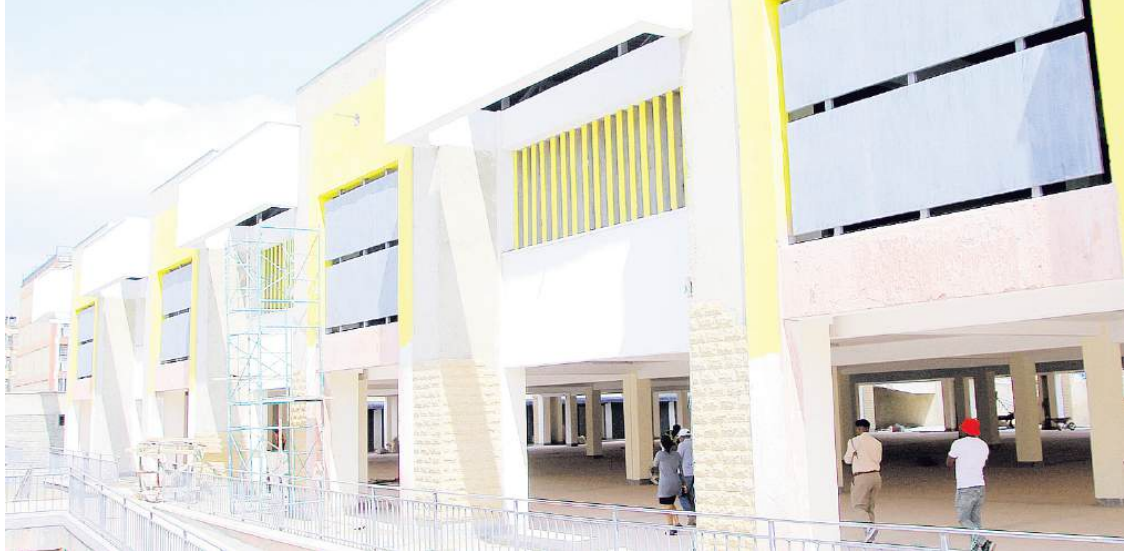
 Maji Mazuri modern market/Ezekiel Aming'a
MIRIAM Kimani runs an eatery in Kasarani, Nairobi, selling tea, mandazi and arrow roots. Sometimes she has to travel as far as Nyeri to buy the tubers.
“We had been promised for many years that a market would be built for us here. Now, we are grateful that it is almost complete,” she said.
The Sh300 million Maji Mazuri Kasarani market is 95 per cent complete and is set to be opened next month.
“As a businesswoman, the market will be a huge relief for me because I hope to get high quality arrow roots right here. I will also start preparing other dishes, like bananas,” Kimani said.
Project engineer Patrick Mutembei said they were putting final touches, including painting and electrical fittings. The market will have 1,247 stalls, cold storage for highly perishable goods, washrooms, a loading zone and offices. A social hall and an ICT hub are also planned.
Youth leader Kennedy Makhanu, alias Waiganjo, said at least 100 young people were employed at the site.
“When this project is completed, many more youths will get jobs here.”
The Kenya Kwanza administration, in collaboration with county governments, is building modern markets across the country.
The programme targets 400 markets, with 354 already under construction, according to the State Department of Housing and Urban Development spokesperson Kaplich Barsito.
Some 288 of those markets are under the Economic Stimulus Package (ESP), while 66 are modern markets.
At the same time, the government is constructing 130,000 hostel units for students in technical and vocational training institutions, colleges and universities, where a lack of adequate accommodation is a major concern for learners and parents.
About 80 markets are at various stages of construction across the Rift Valley region.
In Vihiga county, 16 markets are under construction or at planning stage. Some 28 markets will be built in Kakamega county at a cost of Sh2.8 billion. Bungoma will have 15 new markets costing Sh1.4 billion.
In Busia, the government is building 17 markets at a cost of Sh1.8 billion. In the Northeastern counties of Garissa, Wajir and Mandera, seven markets are under construction costing Sh413 million.
In Eastern region, the government is constructing nine markets in Embu at a cost of Sh1.5 billion.
Markets are more complex than mere places for buying and selling goods. They are powerful institutions for job creation, social cohesion, raising incomes and transforming the informal sector for inclusive growth.
Under Kenya Vision 2030, the development blueprint launched on June 10, 2008, by President Mwai Kibaki to transform Kenya into a vibrant, middle-income economy, markets are conceptualised as critical hubs for modern trade.
They are to be used for establishment and strengthening of informal trade associations to form Saccos for enhancing savings mobilisation to provide affordable finance.
Markets will be used to develop and institutionalise capacity building and training programmes on business skills and technology for traders.
Market-based associations and cooperatives help producers to market their produce directly, thereby shortening supply chains and eliminating brokers, achieving economies of scale and reducing consumer prices while increasing producer earnings.
Construction of modern markets is a priority for the Kenya Kwanza administration under the Bottom up Economic Transformation Agenda (Beta).
“Bottom up economics is about investing the limited capital available where it will create the most jobs – at the bottom of the pyramid. What does it mean practically?
“It means a commitment to invest Sh500 billion over the next five years in small holder agriculture and the informal sector,” the Kenya Kwanza Manifesto says.
The construction of modern markets and student hostels is designed to improve livelihoods, expand economic opportunities and restore dignity to Kenyans.
For years, traders have operated in overcrowded, muddy and unsafe environments exposed to rain, dust, theft and fire outbreaks. Modern markets are meant to provide clean and organised trading spaces, proper roofing and drainage systems, water and sanitation facilities, lighting and securityand storage areas and cold rooms.
Housing and Urban Development Principal Secretary Charles Hinga says Sh11 billion has been ring-fenced for MSMEs and jua kali in the affordable housing and markets programmes.
“Local artisans offer a range of services, including prefabricated steel doors, windows, balustrades, curtain rods, and landscaping services,” he said.
“A significant portion of AHP employment stems from Kenya’s informal sector. Jua kali artisans account for roughly 17.5 per cent of reported labour, supplying critical construction inputs such as steel doors, windows, metal fittings, timber products, cabro, furniture, and site fabrication.”
Their integration is supported by the Recognition of Prior Learning programme, which has certified more than 2,088 artisans to date (180 of them women). RPL validates existing skills, increases artisans’ eligibility for formal contracts, and positions them for higher-paying work.
It has become a powerful mechanism for transforming informal labour into structured, financially resilient livelihoods.
Alongside the affordable housing programme and markets, the government is building student hostels to address the biting shortage of accommodation due huge enrolments in higher institutions of learning.
Many students in colleges and universities struggle with expensive rent, unsafe housing, overcrowding and long distances. Modern hostels aim to provide affordable, decent and secure accommodation in or near learning institutions.
The number of students enrolled for undergraduate and postgraduate courses in public universities and constituent colleges increased by 14.3 per cent to 589,900 last year, according to the Economic Survey 2026.
Total enrolment in technical and vocational education and traininginstitutions increased by 17.3 per cent to 825,484. Students enrolled in both diploma and certificate courses increased from 57,367 in 2024 to 63,742 last year.
Albert Chesiro, the dean of students at the Kenya School of Tvet in upmarket Gigiri in Nairobi, knows firsthand the challenges of student accommodation.
“Our location means we do not have affordable accommodation for students around the institution. Students have to travel four to five kilometers to Ngara, Gachie or Ruaka,” he said.
Kenya School of Tvet can accommodate only 512 students against enrolment of 3,500. “Most students would prefer to stay in the institution because it is safe and convenient. We have had cases of students who stay outside, they get into a room with their belongings and the same day everything is stolen,” Chesiro said.
The government is constructing a seven-storey hostel at the Kenya School of Tvet.
“We are building two blocks that will accommodate 1,272 students,” project manager Monica Wangari said. “The contract is for 18 months but we intend to finish it earlier.”
Kennedy Mburu, a worker at the site from Gachie, said he was grateful to have a reliable source of income. “Every day I am assured of work and we are paid on time,” he said, adding that businesses around the area have also benefitted from the project.
“When we want supplies we go to hardware stores in Gachie and Ruaka. The food we eat here is prepared by women from this area. I can say without a shadow of doubt that the project has created employment for many people.”
New student hostels are under construction in or near all higher learning institutions in Kenya.