It is a gateway to culture, opportunity and connection, drawing thousands of Kenyan students each year.
Founded in 2008, the institute has grown from modest beginnings into a vibrant cultural and academic hub.
“The institute started in 2008, and from then on I think we have taught more than 20,000 students,” institute director Prof Zhou Xiaodong said.
“What began in a very dark room with very few classrooms and a small library has transformed into a modern facility with bright, beautiful offices and well-equipped classrooms.”
The transformation reflects not just infrastructural growth but also a deepening role in shaping cross-cultural understanding between Kenya and China.
Today, the institute serves more than 2,000 students annually across its main campus and satellite centres.
“In this campus, every year we have around 300 students,” Prof Zhou said.
“For the four classrooms every year, we have more than 1,000 students. Among the 10 teaching centres every year, we have more than 1,000 students.”
Beyond language instruction, the institute plays a key cultural role.
Through exhibitions, performances and competitions, it introduces Kenyan audiences to the richness of Chinese traditions.
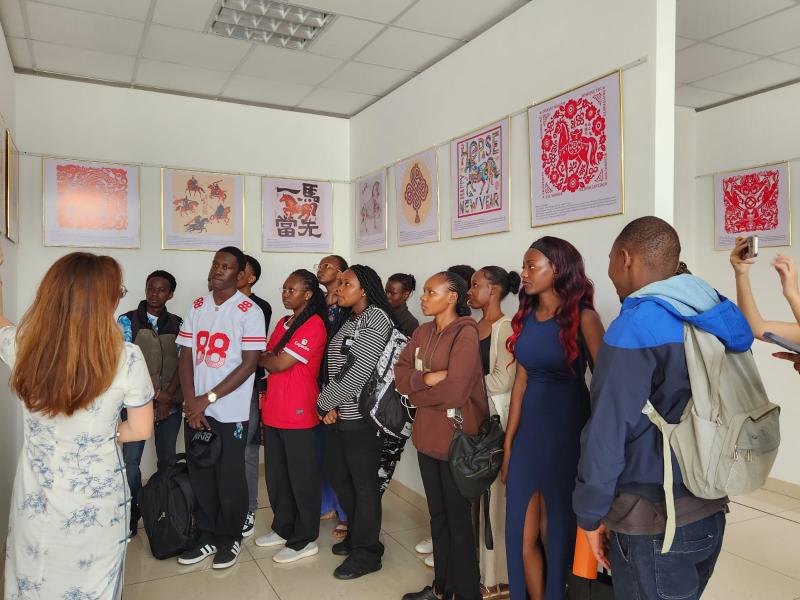
This year’s highlight is an exhibition centred on the Chinese zodiac, specifically the Year of the Horse.
“Different animals have different meanings in Chinese culture, and the zodiac of horse means strong,” Prof Zhou said.
“So this year, people will show their good wish for others to be strong and healthy.”
The exhibition is part of a broader cultural calendar that includes activities such as a Chinese singing competition held a day before the exhibition.
These events are designed not only to educate but also to immerse students in lived cultural experiences.
DYNAMIC CLASSROOMS
Inside the classrooms, learning is equally dynamic.
Chinese lecturer Hou Jiajia introduces students to the 12-animal zodiac cycle, guiding them from the first one, rat, to the last one, pig.
While the concept may initially confuse students, curiosity quickly takes over.
“After they see some videos and I introduce about that, they then get very interested,” Hou said.
The zodiac becomes more than a lesson since it turns into an interactive experience, where students do zodiac judgments on each other, blending learning with personal discovery.
Teaching methods are also tailored to accommodate different learning speeds.
“In my class, there are slow learners and fast learners. We let the fast learners assist slow learners, especially during group work sessions,” Hou said.
This collaborative approach, she said, fosters both academic progress and peer support.
For students like Angela Moraa, the journey into Chinese language learning is both personal and practical.
“The experience is good. I've been able to make new Chinese friends whom I have done many interesting activities with,” she said.
Her motivation was sparked by real world exposure. Last year, she was working in a clothing company that also had Chinese people, and that is where her curiosity for learning the language began.
Four months into her studies, Moraa is already seeing progress.
“Within these four months, I can speak with the teachers, hear some of the things they say and even read some characters,” she said.
Her goal is clear: fluency and further education.
“I'm eager to learn the language more because I want to be fluent in Chinese and then I'll be able to pursue my Master's in China,” Moraa said.
For Robinson Mugo, another student, the learning process has been challenging but rewarding since during his first class, it was difficult and he could not say any word.
He recalled seeing characters written on the whiteboard that made him want to give up.
However, persistence, guided by supportive teachers, made the difference.
“Through the lectures’ guidance and teaching, I was able to persevere, work hard and now I know some things,” he confidently said.
Now preparing for a Chinese proficiency test, Mugo said his fluency is “almost there”, and like many students, he dreams of visiting China.
“I really want to go there and practise their culture firsthand, practically,” Mugo said.
The institute actively supports such aspirations, with students given opportunities each year to travel to China.
“Every year, we bring students to visit China where they get to explore different cities,” Prof Zhou said.
The trips, he said, deepen understanding and correct misconceptions. He recalled a moment that highlighted the importance of cultural exchange.
“One student asked me if the Great Wall goes higher to heaven.”
The professor says experiences like climbing the Great Wall help replace myths with real understanding.
CULTURAL SIMILARITIES
Cultural similarities between Kenya and China also emerge as a recurring theme. Both societies value peace and kindness.
Teacher Zhang Xin echoed the sentiment, pointing to shared traditions and values.
He said the exhibition acts as a bridge to narrow differences between the two countries.
The teacher highlighted similarities in musical instruments, plus the relationship between people and nature.
“Kenyans love animals and even live with them as well as conserving the environment,” he said.
Zhang said specific cultural parallels stand out as he compared Kenya’s Maasai culture with Tibetan culture in China, noting similarities in herding practices and ways of life.
“I think the two ethnic groups are very connected to each other, and the exhibition itself reflects these shared connections through art,” he said.
Mugo the student added that the paintings depict the horse in different settings, with some riding in battle, while others carry money.
The depictions, he said, capture the symbolic depth of the horse in Chinese culture, where it represents luck and strength.
For many students, such experiences go beyond academics and add value to personal and professional growth.
“Learning this language gives me something else to add to my CV despite not being related to my course at the university,” Mugo said.
Prof Zhou emphasised the practical advantages, noting that learning Chinese can open doors to employment.
“After learning Chinese, they can find a very good job in Chinese enterprises, where graduates often earn a very high salary, much more than those who haven't learned Chinese,” he said.
Beyond career prospects, the institute’s mission is rooted in connection and understanding.
As the Year of the Horse unfolds, the message is clear: signalling strength, growth and forward movement.
At the Confucius Institute at Kenyatta University, these ideals are lived daily through language, culture and shared human experience, further strengthening ties between Kenya and China.