At the border of the Masai Mara, a quiet but significant shift is taking shape in how the country’s rarest mammal, the giant ground pangolin, is being protected.
With fewer than 30 individuals known to exist nationally, the future of this most trafficked mammal hangs in the balance.
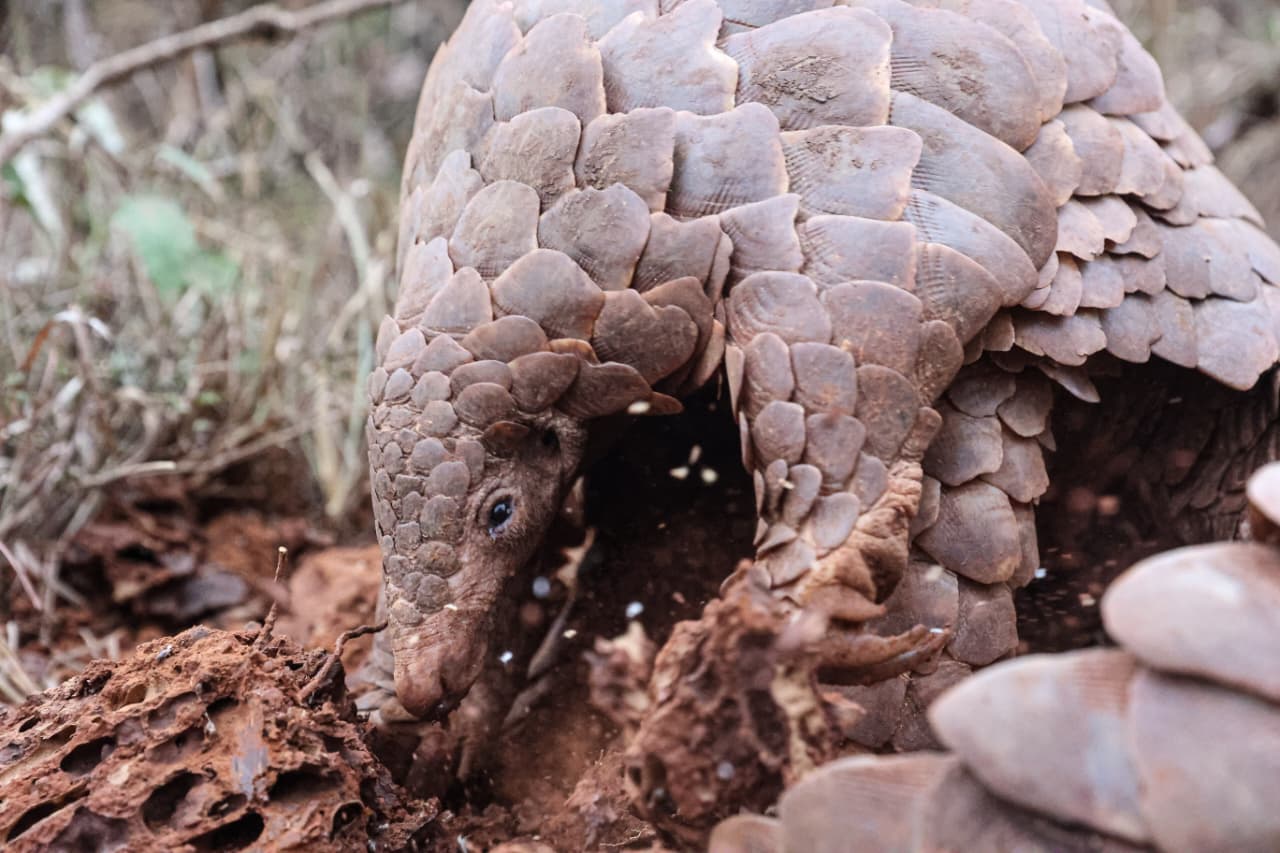
Pangolins are mammals whose bodies are covered by protective overlapping scales, giving them a reptile-like appearance.
These scales are their main protection mechanism as pangolins curl into a tight ball whenever they perceive danger.
There are eight species of pangolins globally, four of which occur in Asia and four in Africa.
Of the four African pangolins, three are found in Kenya. These are: Temminck’s pangolin Smutsia temminckii (vulnerable), giant pangolin Smutsia gigantea (endangered) and white-bellied pangolin Phataginus tricuspis (also endangered).
Pangolins are among the most threatened wildlife species due to a high demand for their scales, which drives illegal trading across the world.
Despite all the world’s eight pangolin species being listed and protected under Appendix I in the Convention on International Trade in Endangered Species of Fauna and Flora (Cites), large-scale trafficking continues globally, with more than one million pangolins estimated to have been poached from the wild and illegally trafficked during the last decade.
The Nyekweri Forest that acted as Kenya’s last refuge for the giant ground pangolin is on the brink of collapse.
Since 2010, around 80 per cent of the forest has been lost to agricultural expansion, charcoal burning and land subdivision, shrinking the pangolin’s remaining habitat to a fraction of its former size.
To combat this extinction risk, The Pangolin Project, supported by Tusk, is implementing an innovative conservation strategy to protect the giant ground pangolin from extinction.
COMMUNITY INVOLVEMENT
Pangolin Project chief programmes officer Beryl Makori says they run a number of programmes as they have ranger teams, monitoring teams and community outreach teams.
The ranger teams are concerned with patrols. The monitoring teams focus their efforts on monitoring the giant ground pangolins using camera traps. And the community teams engage with the community, informing them of what we do.
Makori says one of the most important things they do is the community work because in Nyekweri, all parcels of land are individually owned.
She said they used to work in other areas, such as Tsavo and West Pokot. They came to Nyekweri around 2020-21, when they got information of a pangolin sighting.
“Before that, we had assumed that giant pangolins were extinct in Kenya because the only other record that was there was in 1971, in Lake Victoria,” Makori said.
“So we didn't know that pangolins existed here until that photo popped up.”
They mapped out the area the community had spotted pangolins.
The problem was that the habitat was getting lost very fast. Landowners were cutting down the forest to open up the area for grazing and also to do farming.
They were also putting up electric fences to protect their land from wildlife, such as elephants.
“We didn't have a lot of time when we came here as only 10 per cent of the forest was left,” Makori said.
“We closed down everything everywhere else and focused solely on Nyekweri for the giant ground pangolins.”
Their work was focused on ensuring they secure enough space for the giant pangolins to have a viable population.
The area being a government land means, there's nothing the authorities can do once someone has a title deed as it is up to them to decide what they do with their land.
PARTNERSHIP SOLUTION
Makori says they had to engage the landowners to leave some area for conservation.
The community had to be paid something for conserving their land.
“The fee is graduated depending on the on the situation of your land. The minimum is Sh10,000 per hectare per year,” she says.
If the land has forest and the owner is living on it, the lease fee is different.
“If you're not living on your land and you have a forest, it's premium. So the fee is Sh24,000 per hectare per year,” Makori says.
The lease is paid on a monthly basis for 15 years. Landowners participate in two conservation payment schemes: a forest payment scheme under a one-year agreement, and a conservation lease under a 15-year agreement.
Under the one-year forest payment scheme, farmers are paid to keep closed-canopy forest on their land standing, meaning they must not cut trees or clear forest and must allow satellite monitoring and camera traps, while remaining free to farm non-forest areas.
Under the 15-year conservation lease, farmers are paid to lease their entire land parcel for conservation and restoration, live and farm only on about 10 per cent of it, avoid commercial crop farming on the remaining 90 per cent, stop deforestation and charcoal burning, and allow wildlife access and conservation management.
Participation is voluntary and requires formal consent and compliance.
Makori says the electric fences risk pushing the species to extinction.
By linking pangolin conservation to livelihoods and land-use planning, The Pangolin Project is showing how Kenya’s community conservancy model can protect even the most elusive
species.
The work contributes to national commitments under the 30x30 biodiversity pledge and to global goals for species recovery and sustainable land management.
The 30x30 is a worldwide initiative for governments to designate 30 per cent of Earth's land and ocean area as protected areas by 2030.
Through community partnerships and conservation leases, more than 13,000 acres are now protected, including 3,576 acres of forest.
This is the result of 191 landowners joining hands with the conservancy and The Pangolin Project and deciding to enter lease and forest payment schemes with their families.
Last year, the conservancy and The Pangolin Project held 1,152 household meetings
and 18 community meetings, engaging men, women and youth in conservation education and informing them how to protect this critically endangered species.
Already, 13,352 acres of land have been put on lease and forest payment schemes for pangolin protection, involving 191 landowners who receive monthly payments directly into their accounts.
PRIVATE LAND
The latest initiative is meant to give this species of pangolin room to roam.
The community is protecting the species not inside a national park but on privately owned community land, where forests are under intense pressure from farming, charcoal production and subdivision.
Peter Tompoy, 73, is among members of the community who have been creating more room for the giant pangolin to roam.
“I have only seen one giant pangolin in my lifetime. Unfortunately, it had died as a result of electrocution by an electric fence,” he says.
Once revered in local tradition as ‘entaboi’, a symbol of luck and sacred taboo, these elusive creatures now exist mostly in fading memories and the digital flicker of camera traps.
Tompoy, chairman of the Nyekweri Kimintet Community Forest Conservation Trust, has dedicated decades to preserving what remains of Kenya’s last refuge for the species.
The trust manages 7,000 acres, including 3,576 acres of primary forest. It has secured partnerships with 191 landowners under conservation leases that directly link wildlife protection to human livelihoods.
Tompoy has been involving some of the members with huge tracts of land to remove live wires from the lower strands.
He says the pangolin should be protected as it is a harmless animal.
Ben Sulel, 38, is another farmer who has embraced the conservation of the pangolin.
Sulel says conservation helps the community to earn a living as many are being employed as community rangers.
“I’m now 38 years and I have seen it two times. The Maasai community respects the pangolin. We do not kill it as we tend to think that it will bring bad omen,” he says.
Sulel says they also help raise awareness among the community on the need to protect and conserve the pangolin.
TRACKING WITH TECH
The Pangolin conservation officer Michael Koskei says the 18 rangers they have help them monitor the threats.
Camera traps and community reports are used to monitor pangolins in the area.
A number of pangolins have also been tagged for tracking purposes. Two are currently being tracked but one that had a tracker has been missing.
The tags are placed in the scales of the pangolin near the tail.
Koskei says they also do Geo-fence to alert the team once the animal goes near live electric fences as not all the landowners have agreed to remove power from the two lower strands.
“We have analysers that analyse the location of the pangolin in relation to those fences and send us an alert so that we dispatch the closest team members to go and protect pangolins from being electrocuted,” Koskei says.
He says from 2022, they have recorded 15 pangolin deaths, of which 14 were due to electric fence.
Over 125km of electric fences have been modified to prevent accidental electrocutions.
Eric Aduda of the Kenya Wildlife Service says this community-driven approach is the ultimate key to survival.
“Pangolin conservation is key for us as KWS because where we have pangolin is an indication of a healthy environment,” he says.
Aduda says the ongoing initiative is a plus for the service in terms of conservation.
He says the partnership between the community and conservation NGO has helped bolster conservation initiatives, adding that KWS alone cannot achieve much.
Beatrice Karanja, a trustee for Tusk, which is among The Pangolin Project’s key supporters, said the Pangolin Project’s approach is a model for effective conservation because it places the voices and lived experience of communities at its heart.
“This is what’s being replicated across Kenya, because it works,” she said.
She added that when communities co-create solutions for protecting the wildlife that lives on their land, and when they get more back for doing that, it builds genuine local ownership.
And it’s been shown time and again that these animals then stand a far greater chance of surviving and thriving, Karanja said.
“That’s the same whether we’re talking about rhinos and elephants, or pangolins, or any species,” she said.
“And it’s why Tusk champions these kinds of community-led conservation initiatives that Kenya is becoming increasingly synonymous with.”
Tusk has supported The Pangolin Project since 2020, providing critical funding and visibility
to expand its work in protecting Kenya’s endangered giant ground pangolins.
Through this partnership, Tusk helps strengthen the project’s impact across habitat conservation, community engagement, research and environmental education.
This initiative exemplifies how Kenya’s community conservancy model can effectively safeguard even the most secretive species, while simultaneously supporting local economies.