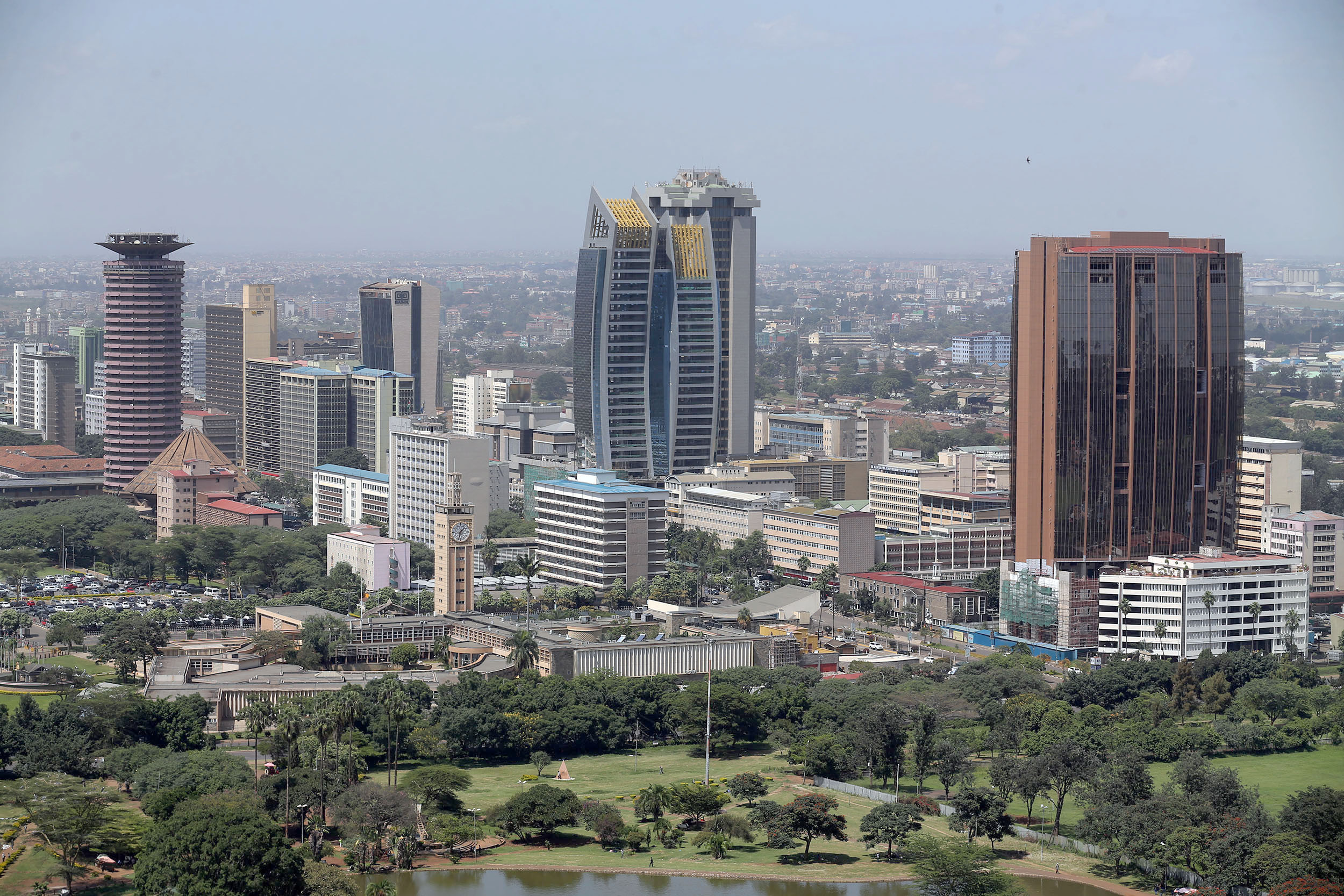
 An aerial view of the Nairobi Central Business District in /FILE
Nairobi has solidified its status as a critical metropolitan hub in Eastern Africa, ranking 11th on the continent in the newly released Global Attractiveness Index (GAI) for Emerging and Fast-Growing Cities.
The report, produced by The European House – Ambrosetti (TEHA) in partnership with DHL, positions Kenya’s capital as a continental reference point while highlighting the structural gaps that keep it globally constrained, at 56th place out of 80 cities analysed.
The index evaluates cities across economic, environmental, social, and infrastructure dimensions.
In Africa, Johannesburg (South Africa) leads, followed by Tunis (Tunisia), Rabat (Morocco), Gaborone (Botswana), and Cairo (Egypt).
Kuala Lumpur in Malaysia topped the list globally with a GAI score of 10.00, while Nairobi scored 4.32.
Nairobi’s economic performance ranks 39th globally, 9th in Africa, and 5th in Sub-Saharan Africa.
The city benefits from a diversified urban economy and relative affordability, which strengthen its competitiveness against peer cities.
However, challenges remain, including pressures on purchasing power, income levels, and housing affordability, limiting upward mobility.
On environmental sustainability, Nairobi ranks 35th globally and 5th in Africa. The city performs well in air quality, public transport coverage, and green-space availability, making its environmental profile a competitive asset.
The social index exposes Nairobi’s most serious gaps, with the city ranking 73rd globally, 21st in Africa, and 16th in Sub-Saharan Africa.
Low access to safely managed sanitation and a high prevalence of slums weigh heavily on the score.
TEHA CEO Pietro Mininni , noted that “Access to safely managed sanitation services is very low, currently at 27.9%, and 40.5% of residents live in slums, two indicators that exert the strongest downward pressure on the city’s performance.”
Targeted improvements in these areas could boost Nairobi’s social ranking by up to 14 positions.
Urban infrastructure also poses challenges. Nairobi ranks 65th globally, 18th in Africa, and 13th in Sub-Saharan Africa.
Limited access to essential services and digital connectivity constrains the city’s ability to support population growth and economic activity. The report recommends measures such as expanding electricity access to improve infrastructure performance.
Hennie Heyman, Group CEO of DHL Sub-Saharan Africa, described Nairobi’s position as “a wonderful position in terms of progress and the possibilities that lie ahead for Nairobi.”
The report highlights the city’s dual profile: competitive in some areas, yet held back by structural weaknesses that require targeted policy action.