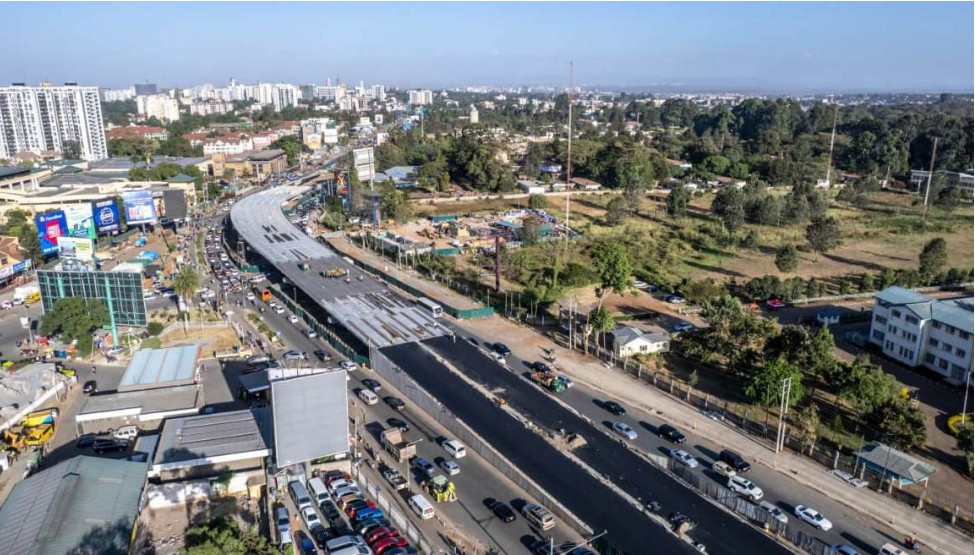
Kenya these days looks like a mega construction site. More than 271,600 housing units are under construction in all 47 counties under the Affordable Housing Programme.
Housing PS Charles Hinga told the Star last week that the government aims to realise the right to decent and adequate housing as enshrined in the constitution. This is by increasing the number of mortgages from 30,000 to 1,000,000, with favourable ownership terms, including monthly payments as low as Sh4,000. The country needs 200,000 new homes every year.
The ambitious AHP also seeks to revamp the economy by linking small businesses and the Jua Kali sector to the projects, creating cheap and stable financing and spurring the manufacturing sector by stimulating demand.
At the same time, the national and county governments are building markets nationwide to improve traders’ working conditions and boost economic recovery at the local level. Some 354 markets are under construction.
On Friday, President William Ruto launched the extension of the Standard Gauge Railway from Naivasha to Malaba on the Ugandan border, covering 369km.
Many major roads are being built. The President last month said 6,000km of roads are currently under construction. They include the 750km Isiolo–Wajir–Mandera highway, the longest road project undertaken in the country since Independence.
The 175km Rironi–Mau Summit road is being expanded into a four- to six-lane dual carriageway to ease chronic congestion, drastically reduce travel times to Rift Valley, Nyanza and Western regions, and to enhance road safety along a corridor long associated with heavy traffic and frequent accidents. President Ruto launched the upgrade on November 28, 2025.
“In addition to improving mobility, the upgrade carries profound economic significance. The corridor traverses high-production agricultural zones. Improved road infrastructure will therefore facilitate faster movement of fresh produce to Nairobi and other markets, cutting post-harvest losses and strengthening farm incomes,” Interior PS Raymond Omollo said on March 3.
The expansion of roads, railway lines, ports, airports, water and electricity is among the many promises of the Kenya Kwanza administration contained in its manifesto, “The Plan: The Bottom-up Economic Transformation Agenda”, that propelled Ruto to power in 2022.
Ruto is pushing his massive infrastructure programme as a legacy agenda and a campaign tool for his re-election next year. His heightened countrywide development tours invariably include the commissioning of completed projects, groundbreaking for new ones and promises of more, even as he accuses his opponents of endless empty rhetoric.
In Wajir, for instance, contractors are rushing to complete works ahead of Madaraka Day national celebrations, which the county will host on June 1. Flagship projects initiated by the President include the construction of Wajir National Stadium, the expansion of Wajir International Airport, the upgrading of key roads within the county to bitumen standard, and improvements to facilities that will host state functions during national celebrations.
Experts agree that the President is on course, as infrastructural expansion is critical to Kenya’s economic transformation. “On infrastructure projects, the analysis should be on short term, medium term and long term,” says James Shikwati, the director of the Inter Region Economic Network, an independent Nairobi-based think tank and consultancy that promotes free enterprise, sound public policy and innovation to drive prosperity across Africa.
“Specific infrastructure projects such as roads, railways, ports and airports are good value for money but rarely in the short term. They catalyse activities that are beneficial in the long term. What is simply needed is for the government to pair the infrastructure project with intentional support for MSMEs to deliver to regional and global markets.”
Shikwati highlights the recent offer for zero-tariff access to the 1.4 billion-person Chinese market. “Infrastructure is critical for Kenya to position itself as an export hub on behalf of the East and Central Africa regions to export to China. In our domestic context, infrastructure projects assist in lowering the cost of logistics, catalysing the expansion of markets, productivity and manufacturing.”
To reduce the country’s reliance on borrowing, Ruto signed into law the National Infrastructure Fund Act, 2026 on 9 March. The fund is expected to mobilise Sh5 trillion in the next decade to finance mega projects.
The purpose of the fund is to “scale up and accelerate development of catalytic national infrastructure including national highway and railway networks, air and seaports, electricity generation, transmission and distribution, water reservoirs, irrigation and agribusiness infrastructure.”
The fund will mobilise private capital and non-traditional sources of infrastructure finance, including domestic pension funds, collective investment schemes, sovereign wealth funds, and climate finance.
The President dismissed criticism that the fund will be riddled with corruption. “I want to assure that the National Infrastructure Fund and other commercially viable agencies will be run on the same principles as the private sector, if not higher. It will not be run by people with political connections or failed politicians but by people subjected to competitive recruitment,” Ruto said. Already, cases have been filed in court challenging the fund.
Dr Abraham Muriu, a devolution and public finance specialist, says Kenya needs infrastructure in different sectors, but this should be balanced with investment in social services for two reasons. “One, we have a relatively young population and the demand for health, water, education, housing, mobility and other services remains high. And, two, poverty rates are still high, about 39.8 per cent, according to the Kenya National Bureau of Statistics. You can’t put all your money into roads and housing when people do not have even enough to eat.”
Muriu also expressed concern over stalled projects of about Sh600 billion and pending bills owed to contractors while additional new projects are being undertaken. He suggested that the government’s focus should be on completing projects that have already started before starting new ones.
It is a concern that has been raised repeatedly by the Auditor General. For example, billions of shillings invested in stadium construction across the country have been flagged in a new audit, raising concerns about procurement procedures, stalled projects and value for money.
In her report on Sports Kenya for the year ending June 2025, Nancy Gathungu says several sports infrastructure projects exhibited procurement irregularities, weak planning and implementation challenges. The Auditor General has released similar damning reports about many other government projects.
And time is running out for the Kenya Kwanza administration, amid deepening public discontent over the slow fulfilment of its many promises. Tracking by Mzalendo Trust, a parliamentary monitoring organisation, shows the administration has achieved just 24 out of 251 of its promises. That is a paltry 9.56 per cent.
But the Government Delivery Unit (GDU) records massive transformation across all sectors in the past three years. Inflation has dropped from 9.6 per cent to 4.8 per cent. The shilling has stabilised at Sh129 against the dollar, down from Sh162. Infrastructure projects are creating thousands of jobs. The housing programme alone has created more than 640,000 jobs, the GDU says.
Some politicians have criticised the infrastructure projects as failing. Embakasi East MP Benjamin Gathiru, aka Mejjadonk, says the affordable housing programme has not achieved the impact the administration claims.
“Currently, only a limited number of suppliers appear to benefit from the materials used in construction. The ongoing demolitions to make way for these housing projects have created serious humanitarian concerns, particularly for residents in Nairobi. In many cases, those displaced along the Nairobi River and other areas received only Sh10,000 compensation, which is far from sufficient,” he said.
Democracy for the Citizens Party leader Rigathi Gachagua last month claimed that the 750km Isiolo–Wajir–Mandera highway had stalled.
“Majority of the sections have stalled for the last three months and workers have never been paid their money to continue with the construction,” he said. But Ruto toured the road the next day and expressed satisfaction with the progress.