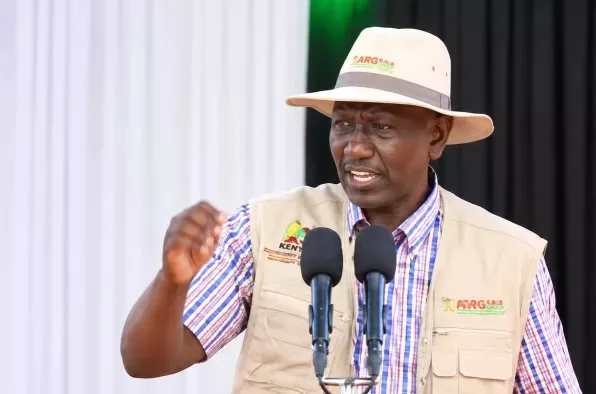
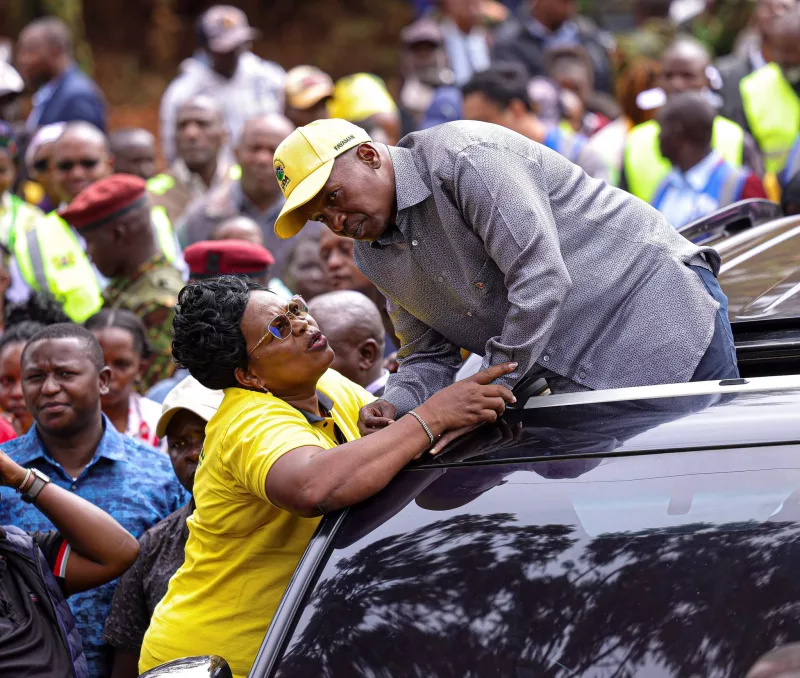
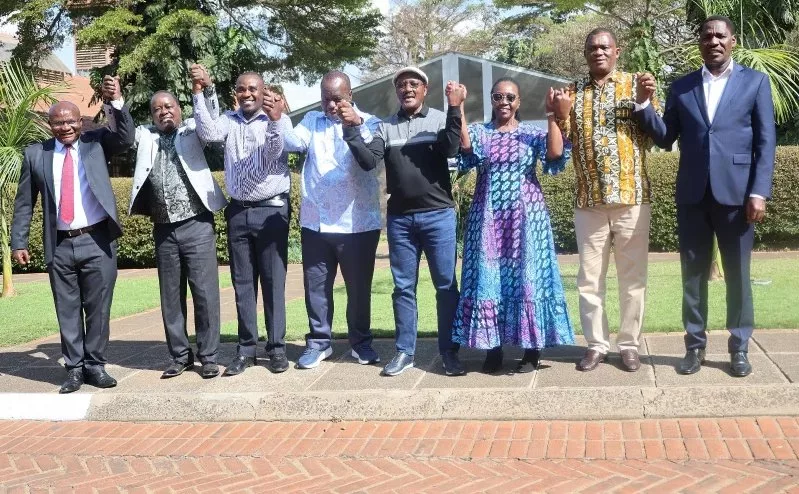
 Opposition leaders Omingo Magara, Lenny Kivuti, Cleophas Malala, Fred Matiang’i, Kalonzo Musyoka, Martha Karua, Justin Muturi and Peter Munya /HANDOUT
For decades, Kenya’s political class has wielded the Memorandum of Understanding as a tool of convenience—a piece of paper signed in hope and broken in power.
It therefore comes with little wonder that when opposition leaders executed a Personal Unity Pledge and a Coalition Unity Agreement, binding them to remain united, participate in a credible candidate-selection process, and support whoever emerges as their joint presidential flagbearer for the 2027 General Election on Monday, there was little excitement.
Even as the ink dried, the scepticism was palpable. Former UNCTAD secretary general Mukhisa Kituyi, who serves as the coalition’s spokesperson, challenged the opposition to move beyond the rhetoric of defeating President William Ruto and articulate a clear policy agenda.
And as the country hurtles towards the 2027 election, the fragility of these political pacts once again came under the microscope.
The history of Kenya’s political MoUs is a chronicle of betrayal.
Before MoUs were formalised on paper, they existed as unwritten gentleman's agreements aimed at consolidation.
After Independence, the ruling Kanu, led by Jomo Kenyatta, absorbed the opposition Kenya African Democratic Union (Kadu), led by Ronald Ngala and Daniel arap Moi.
The understanding was to create a united nationalist front, but it ultimately resulted in the creation of a de facto single-party state and the structural marginalisation of certain communities.
Following the tumultuous multi-party elections of 1992 and 1997, Raila Odinga’s National Development Party (NDP) entered into a formal cooperation agreement with Kanu. This culminated in a total merger in 2002. However, the agreement fell apart immediately when Moi bypassed Raila Odinga and unilaterally anointed Uhuru Kenyatta as his successor.
The 2002 Memorandum of Understanding is perhaps the most famous pact in Kenyan history and redefined how Kenyans view political agreements.
Signed secretly at the Serena Hotel, the National Rainbow Coalition agreement promised a 50-50 power-sharing arrangement and a new constitution within 100 days.
Instead, it was discarded immediately after Mwai Kibaki assumed the presidency, triggering a rebellion that birthed the Orange Democratic Movement and set the stage for the catastrophic 2007 post-election violence.
The fallout forced Kenya to elevate MoUs from private contracts to legally binding, public-facing governance frameworks.
The 2008 National Accord, brokered by Kofi Annan, was an exception—elevated to constitutional status to end the bloodshed. But even that success was born of crisis, not design.
The MoU between William Ruto’s United Democratic Alliance and opposition leader Raila Odinga’s ODM on March 7, 2025, tells the same story.
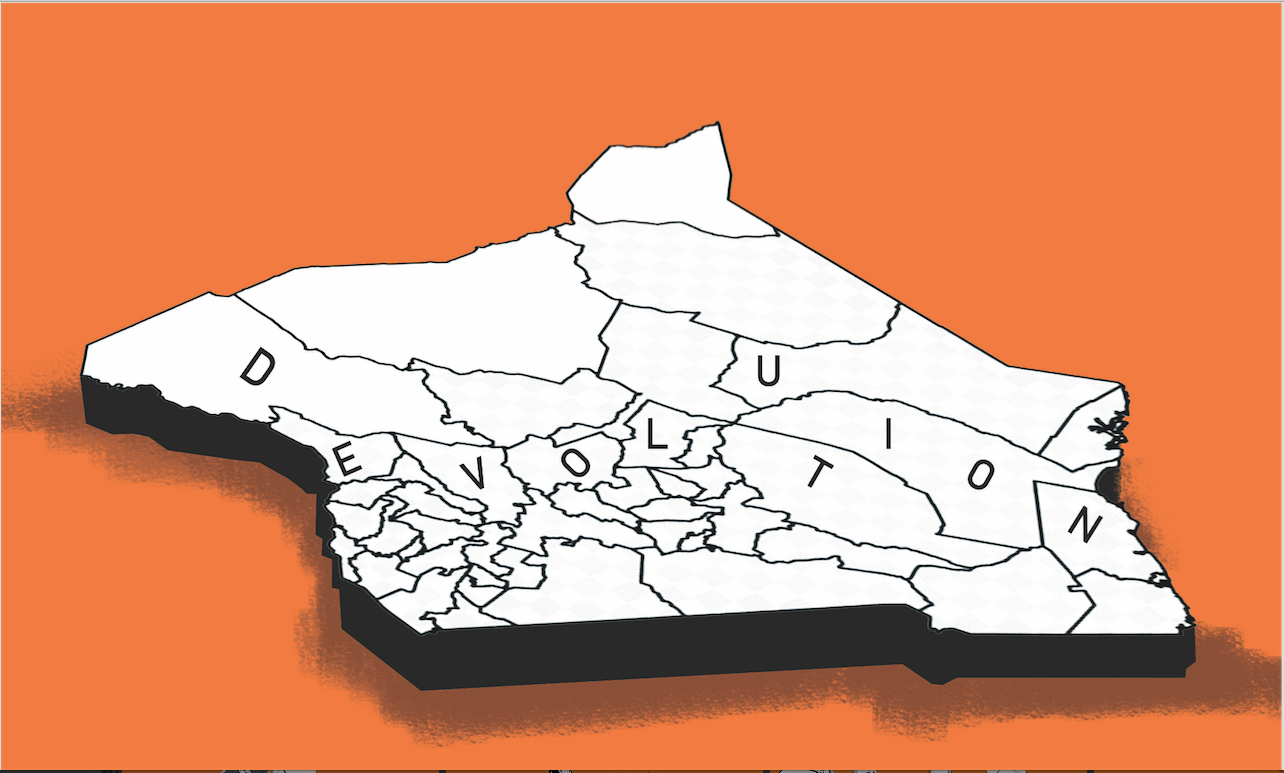
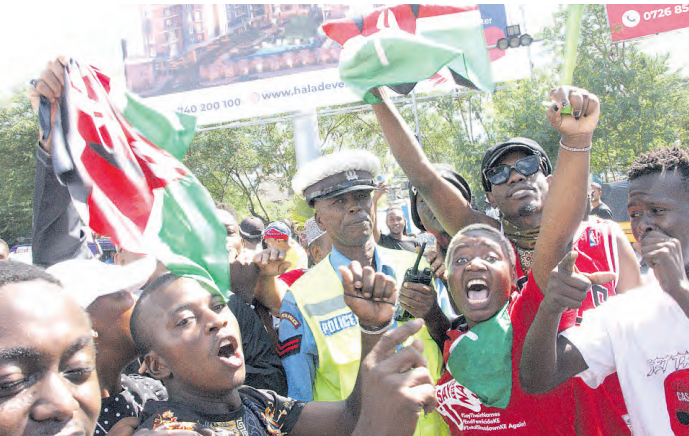
Signed at the Kenyatta International Convention Centre, the agreement was meant to stabilise the state after intense youth-led anti-tax protests in 2024. It outlined a 10-point agenda, including full implementation of the National Dialogue Committee report, protection of devolution, youth empowerment and measures against corruption. Yet by March 2026, the pact was already unravelling.
Internal friction exposed deep divisions, with ODM youth leaders warning against new pacts while old commitments remain unfulfilled. The broad-based government, hailed as a model of cooperation, now appears to be yet another casualty of Kenya’s political culture.
The Political Parties Act provides a skeletal framework; what is missing is the muscle—political will, institutional oversight and a citizenry that demands accountability.
Coalitions can be formed before or after elections. Pre-election coalitions must submit their agreements at least three months before the poll, while post-election alliances must notify the registrar within 21 days of formation.
All agreements must contain clear exit clauses. But these provisions are procedural, not substantive. They dictate when and how to register, but they do not compel compliance with the substance of the agreement.
The law recognises two types of alliances—coalitions and coalition political parties—but both are treated as contractual arrangements rather than binding governance frameworks.
As the High Court affirmed in February 2025, coalition membership is governed by the provisions of coalition agreements and the Political Parties Act. Yet the courts can only interpret; they cannot enforce political will.
For democracy to mature, MoUs must evolve from private contracts between elites into public covenants with enforceable consequences.
The 2025 UDA-ODM pact, like so many before it, has exposed the limits of goodwill. Fixed-term pacts may suit political convenience, but they do not build enduring alliances. They are transactional, not transformational.
The irony is that Kenya has the constitutional and legal architecture to do better. But until leaders treat MoUs as solemn commitments rather than strategic placeholders, the cycle of promise and betrayal will continue. And with each broken promise, democracy loses a little more of its credibility.