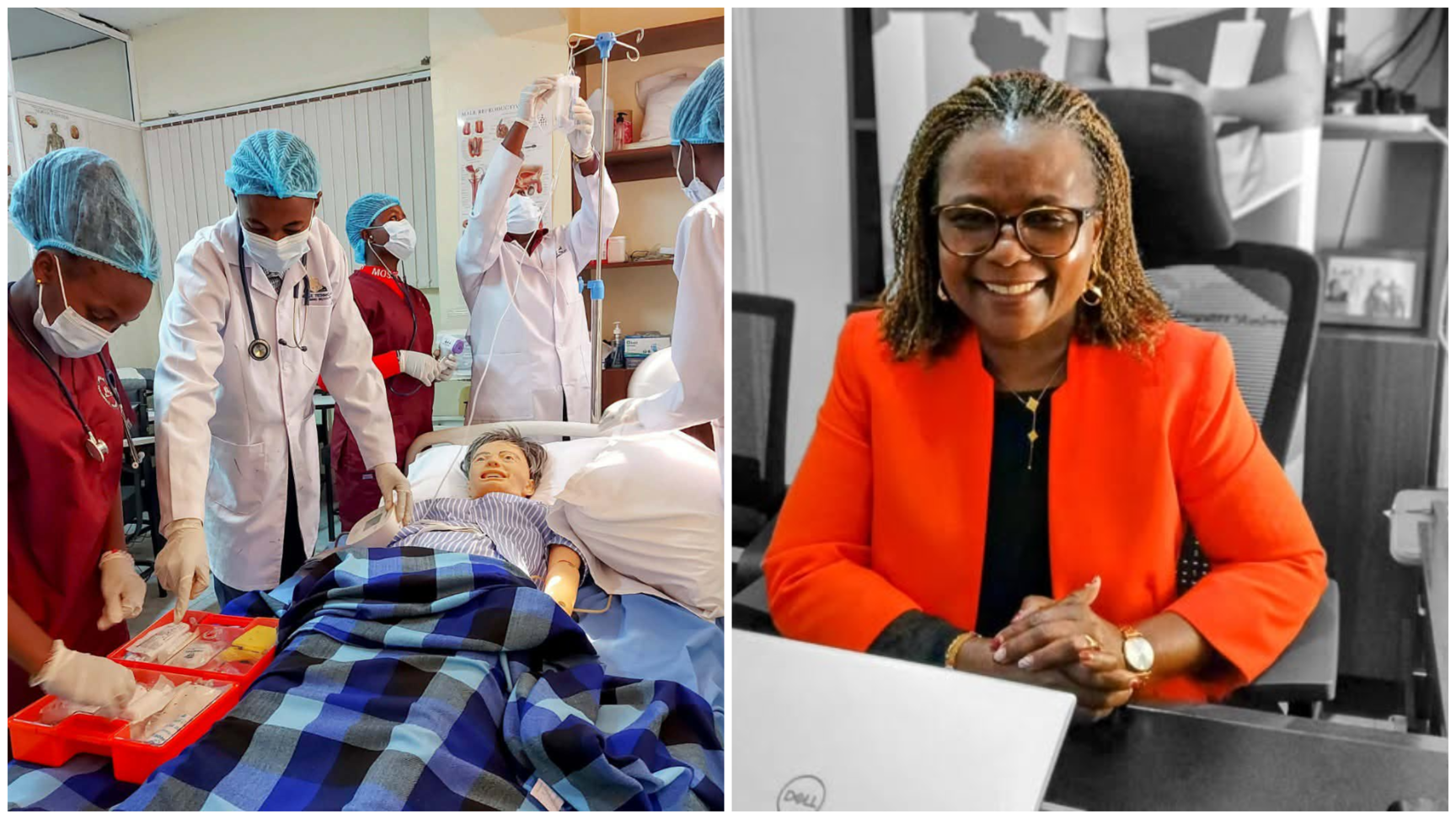
A curious trend is emerging in Kenya, where families are increasingly hiring caregivers instead of house helps.
A house help is someone who assists with household chores and tasks, often employed by a family or individual.
The tasks include cleaning, cooking, laundry and childcare.
There is no qualification for a house help. Anyone who can do these tasks can take up the job.
Caregiving, on the other hand, has traditionally entailed providing support and care to someone who needs help with daily tasks, often due to age, illness or disability.
It includes physical care, emotional support and managing daily activities.
But this definition is inadequate in the current world, says Juliana Muema, founder and managing director of Minoke Technical Training Institute.
The medical informatics professional from the University of Toronto says in yester years, it was the responsibility of children to take care of their younger siblings and elderly parents alike.
But children nowadays are less inclined to do so, so families need to be taken care of by caregivers and not house helps.
“Gen Zs and Alpha people don’t have time to take care of others,” she said.
“Their perception is that those who need to be taken care of need lots of time engagement with their agemates.”
Muema defines caregiving as the act of taking care of the vulnerable, including the sick, and nursing them back to good health.
Caregivers who work in hospitals are responsible for bathing patients, making their beds, feeding them, taking them for walks and keeping them company as they are already isolated due to their illnesses.
In homecare caregiving, elderly people, including ageing parents, are taken care of at home.
Caregivers in such set-ups ensure that the elderly persons in their care bathe, take their medicine on time and eat nutritious and balanced food.
In hospices, caregivers ensure those they take care of are comfortable and keep them company as they nurse them back to health.
CHANGING TIMES
“In previous years, we never required caregivers since we all lived with our parents. When a parent was old, for instance, his son or daughter would take care of him, or grandchildren. But, now, we are in the modern world,” Muema said.
“So, you find we have house helps who take care of our children in our absence. If a baby chokes, for instance, these house helps have no training on how to perform CPR, no knowledge on what a nutritious meal is.
“Maybe, a child is sick and she is given some medication in hospital. You bring it home and give it to a house help to administer to the child. The house help is not trained, she doesn’t have any idea of what table, half-table and teaspoons are. It’s very easy for them to administer the medicine wrongly.”
Muema said this calls for caregiving to go beyond hospital and hospices. Caregivers are now welcomed in Kenyan homes as well as in schools as matrons.
“It’s all about caregivers in Kenya now. Do you want to engage our nurses with basic things or you want to bring in caregivers to take care of their roles at home, while medics attend to serious issues like treatment, medication and analysis?”
She said a lot of people are currently looking for caregivers across the country.
There are caregivers who relieve new mothers to allow them to relax and sleep.
“Instead of the new mothers being with their babies the whole night, we supply caregivers who do that,” Muema said.
“At Minoke, we organise for you. We have caregivers. If you have just left hospital with a premature baby or you had a Caesarian, we provide you with a caregiver to take care of your baby so you can sleep.”
Eunice Kwamboka, a career woman in Nairobi, hailed their services.
“I would rather leave my grandmother somewhere where she is engaged, learning something and interacting, rather than letting her be under a house help’s watch,” she said.
“House helps have got no trainings to effectively take care of houses as well as those under their care.”
BRIDGING THE GAP
Minoke Technical Training Institute is helping to change the narrative. It’s located on the Eastern Bypass in Embakasi South, Nairobi.
Established in April 2024, it trains on healthcare service support, caregiving and Skills Development Canada (CDAK).
The caregivers it churns out are referred to as healthcare assistants by Technical and Vocational Education and Training (TVET).
Other courses include supply chain management, human resource management, sales and marketing, Kiswahili, German, English and French languages, as well as ICT, wiring, carpentry, hair dressing and ICT.
“Our main focus in our curriculum is the TVET, CDAK, where we train healthcare service support at three levels,” Muema said.
The institute takes students through levels 3 to 5 in training. Level 5 is trained for 12 months, followed by three months’ clinical rotation or clinical placement.
Muema said the institution plans and organises for its students to do clinical rotations in different medical hospitals across the country. They have agreements with various hospitals in their locality.
She said all students are exposed to practicals after they are trained on theories.
Level 4 students are taken through theory for six months and three months clinical rotation.
Level 3, which is the most basic, caters for people who never sat KCSE exams and never qualified to do either Level 4 or 5.
This is a three-month foundational course for them to proceed to other levels. They study for three months and then proceed to Level 4 immediately, from where they go for clinical attachment.
The college has also introduced Recognition of Prior Learning. In this, it’s focused on electric engineering, carpentry and welding.
The institute has graduated about 400 students since its inception. Muema said 80 per cent of the graduates have been employed.
EMPOWERING KENYANS
Muema returned to Kenya after living in Canada for more 19 years and working in all manner of hospitals. Her last workstation was Toronto General Hospital.
“I decided to come back home and empower my community, Kenyans, with the skills that I had acquired there. That birthed Minoke, whose main focus is healthcare,” she said.
The institution is accredited by TVET, Nita and Skills Development Canada (CDAK)
The Institution is affiliated to various international organisations, including Express Canada Study, an international recruitment agency based in Toronto, Canada.
Muema said their students have chances of pursuing other studies in different colleges and universities, which they are associated with once they complete their studies at Minoke.
“One needs a D minus and below to qualify for a healthcare service support level 4, D plain and above for Level 5 and Standard 8 and below for Level 3. At Level 5, you acquire your certificate as a caregiver,” she said.
“We are giving our students skills. The curriculum has got more practical training than theory. So, by the time a student concludes the course, she is a fully qualified caregiver, certified nurse assistant, which is healthcare service support.”
Muema said three of their students have secured jobs in Canada, one in Germany, two in Qatar and three in USA.