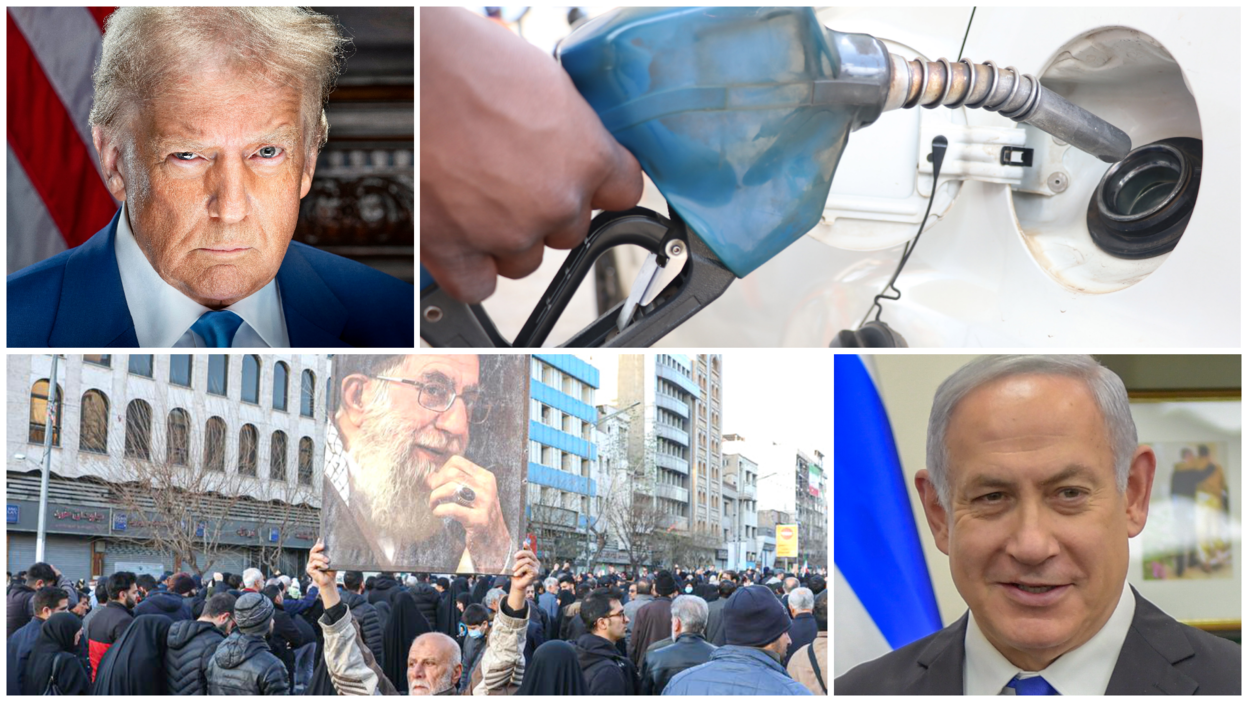
 US President Donald Trump and Israeli Prime Minister Benjamin Netanyahu led attacks that killed Ayatollah Khamenei / WIKIMEDIA AND ENOS TECHE
The war in the Middle East has left half a million Kenyans stranded in the region and sent fuel prices rising, threatening remittances and the cost of living.
The US and Israel are fighting with Iran in a conflict that has killed nearly 800 people and counting, including Iran’s spiritual leader Ayatollah Khamenei.
President William Ruto appeared to back Kenya’s strategic allies, the US and Israel, though the Foreign ministry clarified he was only against the war spreading.
Ruto condemned Iranian strikes on the UAE, Qatar, Saudi Arabia, Iraq, Oman, Kuwait, Jordan and Bahrain, without mentioning the initial joint attack on Tehran.
Meanwhile, Kenyans grounded by the conflict are feeling the pinch.
“About 500,000 Kenyans are currently in the Middle East,” Diaspora Affairs PS Roseline Njogu told NTV on Monday. She said about 100 Kenyans are in Iran and about 1,000 in Israel.
Oil prices have climbed 13 per cent from $72.87 (Sh9,400) a barrel on Friday before the war started to $82 (10,590) a barrel yesterday.
The last time such a shock hit the market was when the Russia-Ukraine war erupted, contributing to the cost-of-living crisis in Kenya in 2022.
However, Energy CS Opiyo Wandayi yesterday sought to reassure Kenyans that the country is well stocked to cover Kenya and the region.
“We have scheduled imports for delivery up to end of April 2026. And, therefore, as it stands, we are assured of security of supply,” he said in a statement.
“We are closely monitoring the fluid situation as it evolves, while engaging with our G-G suppliers for contingency planning.”
The CS added that the Energy ministry remains alert and will continue taking the necessary actions to ensure uninterrupted supply.
AFRICA VULNERABLE
As world leaders call for de-escalation, both sides of the conflict are digging in.
“Right from the beginning we projected four to five weeks, but we have the capability to go far longer than that,” US President Donald Trump told the press at the White House on Monday.
“We will not negotiate with the United States,” Ali Larijani, the head of Tehran's Supreme National Security Council, posted on X the same day.
Adding to the tensions, the US State Department yesterday issued a “depart now” alert for more than a dozen countries in the Middle East.
Governments worldwide are now scrambling to evacuate their citizens amid closed airspace and shipping lanes.
AU Commission chairman Mahmoud Ali Youssouf has warned that further escalation could worsen global instability.
In a statement, Youssouf said the escalation will have “serious implications for energy markets, food security and economic resilience — particularly in Africa, where conflict and economic pressures remain acute”.
The US-Israeli attacks on Iran and the retaliation by Tehran targeting US bases and some airports in the region have also restricted supplies from key oil- and gas-producing states.
Iran has also closed the Strait of Hormuz through which a fifth of world oil passes, and targeted vessels passing through.
At least five tankers have been damaged, two personnel killed and 3,200 ships stranded inside the Middle East Gulf as the conflict flares.
The resulting spike in international crude prices is bad news for Kenya as the country is a net importer of oil.
ECONOMY AT RISK
Treasury CS John Mbadi had on Monday told the National Assembly Committee on National Budget that the escalation of the war would heavily hit Kenya’s already hurting economy.
“It is expected that the war between the US and Israel on one side and Iran on the other side is likely to impact on us massively if it continues,” Mbadi told MPs.
“So, if the war is going to extend longer than anticipated, it will obviously have a hit on our economy, and we must think on how to manoeuvre, just like during Covid-19.”
Kenya’s former Permanent Representative to the UN Amb Martin Kimani also acknowledged this, noting that closure of the Strait of Hormuz could lead to a surge in grain, fertiliser and fuel costs across Africa.
“Remittances from millions of Africans in the Gulf drop sharply. Africa’s united Covid-19 response showed the continent can mobilise to handle global shocks; that muscle needs activating quickly,” Kimani said on his X handle.
Trade officials have also voiced concerns about the impact on Kenya’s strong trade and labour ties with Middle East states.
The officials had warned from the onset that aviation and waterway disruptions would have a direct negative impact on fresh produce and horticulture exports.
Trade CS Lee Kinyanjui said the disruptions would affect earnings for farmers and exporters.
“While we hope for a speedy resumption to normalcy, the reality of geopolitics remains unpredictable. It is for this reason that Kenya has actively pursued market diversification to cushion against overreliance on any one region,” he said in a statement.
“Market diversification creates resilience and sustainability. The Government of Kenya is consulting with critical stakeholders to ensure our trade position is not adversely affected and that alternative routes can be established to serve our markets in the interim.”
The war is also expected to derail talks on the resumption of tea exports to Iran following a trade scandal involving Iranian and Kenyan firms.
In the fraud case, low-grade tea was sold as premium, resulting in the subsequent ban.
The Kenyan firm, Cup of Joe Ltd, was found guilty of importing low-quality tea, blending it and re-exporting the product to Iran as premium Kenyan tea.
In an attempt to resume the estimated Sh4.26 billion tea exports, Kenya and Iran in August 2025 formed a joint committee to address trade concerns in 60 days.
By the time the conflict escalated, however, a deal had not been reached.
The war is also expected to affect Kenya’s meat exports to the Middle East, which stood at $11.3 million (Sh1.4 billion) in 2024.
This includes $6.37 million to Saudi Arabia, $3.77 million to Bahrain, $0.9 million to the UAE and $0.12 million to Kuwait.
Kenya is also estimated to be exporting 40 to 50 tonnes of mutton per month to Iran, with an estimated export value of $6 million (Sh773.9 million).
Foreign policy expert and Africa Policy Institute CEO Prof Peter Kagwanja further noted that the conflict will heavily hit Kenya Airways, which has indefinitely halted its flights to the Gulf region due to the airspace closures.
“Consequently, the Iran war will exact heavy losses on the national carrier,” he said.
TRAPPED IN WARZONE
Beyond trade and energy, the safety of Kenyans working and living in the Middle East has become a major concern.
Thousands of Kenyans are employed in countries such as the United Arab Emirates, Qatar, Bahrain, Saudi Arabia and Israel.
Remittances from Kenyans working in the Middle East support thousands of families across the country, meaning any disruption could have real economic and emotional consequences.
Diaspora Affairs PS Roseline Njogu on Monday said of the four million Kenyans in the diaspora, about 500,000 are in the Middle East.
Out of these, 300,000 Kenyans are based in Saudi Arabia, 70,000 in Qatar, between 60,000 and 80,000 in the UAE, another 4,000 to 5,000 in Oman and about 100 in Iran.
In Israel, there are about 1,000, mostly students. A few others are spread across Lebanon, Iraq, Syria and Afghanistan, Njogu added.
Saudi Arabia remains the number one source of remittances in the Middle East and third globally for Kenya.
According to the Central Bank of Kenya, Kenyans in Saudi sent back about $302.1 million (Sh39 billion) in remittances last year, a reduction by 25 per cent from $403.12 million (Sh52 billion) recorded in 2024.
The Ministry of Foreign and Diaspora Affairs has issued an advisory urging citizens in the region to take precautions.
“Exercise extreme caution and avoid non-essential movement, especially near high-risk areas such as military facilities and crowded public spaces. Follow and comply with guidance issued by local security authorities,” it said.
Officials said the government is monitoring the situation and remains in contact with diplomatic missions across the region.
A Kenyan at DP World in Dubai narrated to the Star how operations at Jebel Ali Port, the largest container port in the Middle East, were forced to halt after being hit by missile debris.
He added that a US navy installation at the port was targeted twice.
While not officially a military base, Jebel Ali Port serves as the US Navy’s largest port of call in the region.
The flying missiles, most of them intercepted, have created fear and anxiety among residents.
On the situation of Kenyans in the region, Prof Kagwanja, the foreign policy expert, said the government’s priority should be to secure nationals caught up in the conflict.
“In the wake of the US-Israel conflict with Iran, Kenya should focus on securing over 416,000 nationals working in Gulf countries and hundreds more stranded at airports or their businesses disrupted or homes destroyed,” he said.
The issue has drawn domestic political reactions. Opposition leaders have called on the government to act quickly to reassure families and prepare evacuation plans if necessary.
DP leader Justin Muturi said many Kenyans are anxious about the safety of their relatives abroad.
“The images and reports coming out of the Middle East are heart-breaking,” he said.
“Families are running for shelter and among them are Kenyans who left home to work, to study, to build a better future for their loved ones.”
Muturi called on the government to give clear updates and prepare emergency measures.
Edited by Tom Jalio