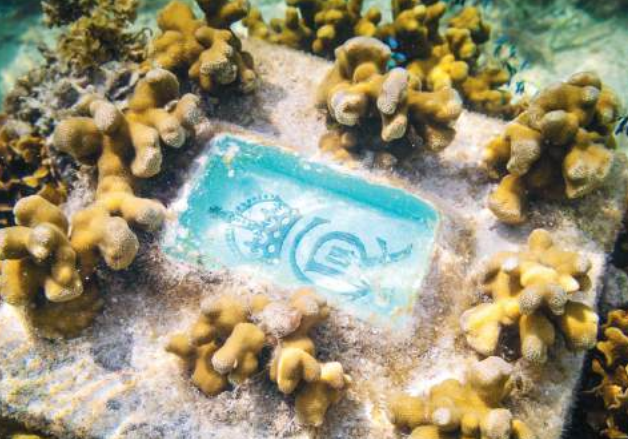
 A coral reef with King Charles III insignia at Kuruwitu beach
Along Kilifi’s north coast, a degraded coral reef is steadily coming back to life, again teeming with fish and other marine life, thanks to community efforts.
What began as a grassroots marine conservation effort in Kuruwitu in the Vipingo area has become a model for community-led reef restoration.
In November 2023, King Charles III visited Kuruwitu during his state visit to see community-led marine conservation efforts, learn about coral restoration, and launch a special coral structure where coral fragments are planted, boosting local efforts and tourism.
Coral reef restoration involves growing coral fragments in nurseries and transplanting them onto artificial structures or frames near degraded reefs to rebuild degraded habitats. The protected transplanted corals grow, flourish and attract marine life.
Since King Charles’ visit, Kuruwitu has received global attention.
When the King visited three years ago, few people would have predicted just how far the ripple effect would travel or how strong it would be. The visit was scheduled for just 30 minutes but lasted nearly one and a half hours.
“He was genuinely interested in our work,” Tilda Bowden, director of the Oceans Alive Foundation, said.
“He wanted to get into the water, but protocol did not allow that. Instead, he planted corals in a restoration structure, spoke to our children about marine protected areas, and met with our elders,” she said
Before leaving, the King blessed a specially built coral structure still standing today, bearing his insignia as a quiet marker of powerful endorsement.
“There was no financial gift,” Tilda said, “but what we received was far more valuable interest, curiosity, and global focus. The King shone a light on our work and proved that community-led marine conservation matters.”
That light shone well beyond Kenya’s North Coast; it helped put Kuruwitu firmly on the international conservation map.
It sparked new partnerships, including one with Canon Inc, the camera company that first learnt about Oceans Alive through publicity surrounding the royal visit.
The Kuruwitu story did not begin with the King.
Long before the royal spotlight, Kuruwitu was a struggling fishing village. In the late 1990s, coral bleaching, destructive fishing practices, pollution and commercial pressure had devastated local reefs.
Fish stocks plummeted. Livelihoods faltered. Families who depended on the sea for survival faced an uncertain future.
“The ocean was turning into a desert,” Des Bowden, founder and CEO of Oceans Alive, recalled.
The community refused to surrender. In 2003, guided by elders’ traditional ecological knowledge and driven by urgency, the Kuruwitu Conservation and Welfare Community-Based Organisation was formed.
Together, villagers made a bold decision; to allow part of the reef to rest. They established the region’s first community-run marine sanctuary, initially covering just 30 hectares, or 74 acres.
The impact was swift and visible, and coral began to recover. Fish biomass increased, biodiversity flourished, and reef began to breathe again and become home to marine life.
What started as a small protected patch has since grown into a 12,000-hectare (almost 30,000- acre) Collaborative Management Area, the first of its kind under Kenya’s blue economy guidelines.
Today, more than 30 community conservation initiatives along the Kenyan coast trace their inspiration back to Kuruwitu.
At the heart of this transformation are people. One leader of the coral restoration programme, Katana Ngala, was once a fisherman.
Today, he is a coral restorer and conservationist. He plants and monitors coral fragments, restoring the ecosystems he once harvested and exploited.
“We’re working from the inside out,” Ngala told the Star. “We’re not telling people what to do. We sit together and ask how can we create balance between land and sea,” Tilda said.
Women have become central to maintaining that balance. Through the Coral Guardians programme, local Mama Karangas — fish traders — have ventured under water, many of them for the first time.
“Some had never swum before. When they saw the coral with their own eyes and understand how it supports their livelihoods, something shifted,” Tilda said.
Oceans Alive now employs 38 staff directly and works with nearly 500 community members, impacting more than 2,000 households along Kenya’s North Coast.
Conservation education reaches thousands of schoolchildren, some of them proudly explaining reef science to visiting international guests.
“When the children begin teaching others about the ocean, you know you’ve done something right,” Tilda said.
Unlike many conservation projects, Kuruwitu is not a temporary intervention; it is permanent and ongoing.
“We are place-based. We’re from here, and we’re staying here,” she explained.
Instead of exporting a ready-made solution, Oceans Alive invites other coastal communities to visit Kuruwitu — its “living classroom” — to learn, adapt, and replicate the model to fit their own contexts.
The revival of Kuruwitu’s reef comes at a time when coral ecosystems worldwide are under severe threat.
Coral reefs cover less than one per cent of the ocean floor but support nearly 25 percent of marine life.
More than half of the world’s reefs have disappeared in the past three decades due to rising sea temperatures, pollution, overfishing and disease.
In Kenya, reefs underpin approximately 95 per cent of marine fish catch and support tourism that contributes more than seven per cent of the country’s GDP.
Scientific studies show, however, that between 50 and 90 per cent of shallow reefs have already suffered damage.
Against that backdrop, Kuruwitu’s recovery is more than a local success, it is a signal of hope.
That hope is now being amplified through a partnership with Canon under its World Unseen 2.0 initiative.
Somesh Adukia, managing director of Canon Central and North Africa, admitted his own understanding shifted after visiting Kuruwitu.
“In the Seychelles, I learnt about coral restoration in theory. Here in Kuruwitu, I placed coral fragments myself and swam over a restored section. I saw a living world full of colour and balance. That changed something in me,” he said.
Canon is bringing advanced imaging technology, underwater cameras and scientific monitoring tools to support reef restoration.
Through the Canon Academy, youth and community members will be trained in underwater photography and environmental storytelling.
The goal is not only to restore reefs, but also to make their recovery visible.
“When people truly see the ocean, they value it, and when they value it, they protect it,” Des Bowden said.
Today, Kuruwitu is both symbol and solution.
It is a testament to resilience that former fishermen are now reef guardians, women are marine advocates, and schoolchildren are conservation ambassadors.
It is proof that community-led conservation works.