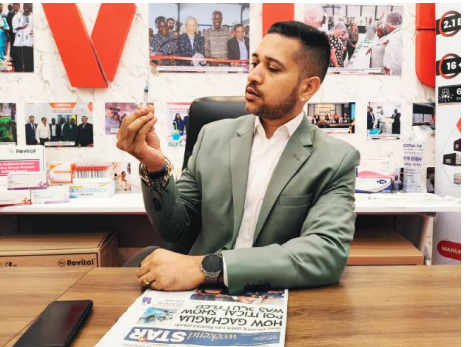
Roneek Vora likes to joke that he should have been born in
Mombasa – if not for tradition.
Born in Nairobi in 1989, Roneek’s birthplace was dictated by Indian custom, which requires that the first child is born where the father hails from, the second where the mother is from, and the others can be born anywhere.
His father was from Mombasa, his mother from Nairobi. His elder sister was born in Mombasa; Roneek, therefore, had to be born in Nairobi.
“If my mum was from Egypt, they would have gone all the way to Egypt for me to be born,” he tells the Star, laughing.
That mix of tradition and pragmatism would define his life. His maternal family valued education, pushing him toward academic success. But young Roneek quickly discovered that his talents lay elsewhere.
“Since I was young, I was not book smart. My grades were Cs and Ds. When I brought home a B, my family would celebrate,” he recalls. “I was always street smart. I used to think outside the box.”
The resilience came from his father. In the 1960s, Roneek’s grandfather arrived from India with little more than savings of Sh60,000. He handed the money to his three sons – Roneek’s father and two uncles – to start a retail shop at Markiti in Mombasa.
Each brother took on a role: marketing, logistics and management. The shop grew, instilling in the family a sense of responsibility and shared purpose.
That spirit of enterprise was passed down to the next generation.
Roneek began schooling at Coast Academy in Mombasa, where he and
his 10 siblings would squeeze into the family Peugeot 206 for the ride to and
from school.
With so many children, the family negotiated school fee discounts.
The youngest, Hashni Vora – now head of legal at Revital Healthcare EPZ Ltd –
studied free until graduation.
In 2000, the family relocated to Tanzania to establish a sweets factory, 2000 Industries Ltd.
Eleven-year-old Roneek transferred to the International School of Tanganyika, which adopted an American curriculum. He did not spend holidays abroad, as did many of his classmates. Instead, his father sent him to the sweets factory.
“My parents were too busy for vacations. So my dad insisted I go
to the factory rather than idle at home,” he says.
His first assignment was counting sugar bags – a task he bungled repeatedly until a deal with the patient supervisor earned him some time.
He quickly made friends with the production manager, quality controller and technicians. His fascination with the machinery grew.
He would sit for hours watching their movements until he learned to operate them himself. By the time he was a teenager, he understood the inner workings of the entire plant.
That was when his passion for manufacturing and marketing began to take root.
In 2006, at age 17, Roneek moved to California to live with his aunt Anju. He enrolled at Foothill College, then transferred to San Jose State University in the San Francisco Bay Area to study business administration and marketing.
Life in America was not easy. Sharing a three-bedroom house with 10 other youths, he was suddenly responsible for chores he had never done before. “For the first time, I was washing bathrooms. I had never done that in my life,” he says.
The independence was jarring. At one point, overwhelmed, he phoned his father in tears, threatening to return to Tanzania. His father told him to stay put.
His initial complacency at university nearly derailed his education. Convinced he could always fall back on the family business, he let his grades slide. A warning from the counsellor’s office that poor performance could lead to deportation jolted him awake.
Meanwhile, back in Tanzania, the sweets factory collapsed in 2013, forcing the family to return to Mombasa.
Even while abroad, Roneek was testing his instincts. As a teenager, he had stumbled upon reels of unused cable wires gathering dust in the family store in Mombasa. Curious, he posted photos and videos on eBay. Within 30 minutes, an American buyer reached out.
“He actually flew to Mombasa to see them,” Roneek recalls. “We didn’t know their value. Something we bought for $20 a reel, I sold for $75. That was my first deal at age 19.”
That was the moment he knew he was destined for business, not medicine, like some of his brothers.
Before returning home in 2014, he completed an internship at Yahoo in Silicon Valley, polishing his corporate skills. Soon afterward, he joined Revital Healthcare EPZ Ltd – the family’s Mombasa manufacturing business founded by his uncle, Rajni Vora.
Today, as director of sales and marketing, Roneek has helped Revital expand into a global player. The company manufactures more than 50 different medical devices, from single-use auto-disable syringes to rapid test kits, exporting to more than 40 countries.
Roneek believes Africa remains the continent of opportunity. “Africa, as was perceived in the 1930s, is still the biggest hub of trading in the world – and by 2050, it will be unmatched,” he says.
From a Nairobi birth shaped by tradition, to counting sugar bags
in Tanzania, to closing his first eBay deal in California, Roneek’s journey is
a story of resilience, reinvention and relentless drive.
Instant analysis:
Roneek Vora’s story is a study in seizing the moment, adaptability and generational entrepreneurship. Born into tradition but shaped by experience, he turned average academic performance into an asset by relying on street smarts, curiosity and a strong work ethic. Early exposure to family business, from retail in Mombasa to manufacturing in Tanzania, gave him a practical foundation in trade and leadership. His stint in the US toughened his independence and sharpened his marketing skills. Today, as a director at Revital Healthcare, he has expanded the family enterprise into a global exporter of medical devices – embodying Africa’s growing business potential.