There is a Swahili saying that goes
‘Chema chajiuza, kibaya chajitembeza’, which loosely translates to ‘Quality attracts, mediocrity forces itself’
This could not ring truer than in Ali Robby's career as a hijama therapist.
Hijama therapy is a form of alternative medicine that involves creating suction on the skin with cups and then making incisions to draw out a small quantity of blood.
Also known as cupping therapy, hijama aims to alleviate conditions including chronic pain, inflammation and autoimmune disorders. However, scientific evidence supporting its effectiveness is limited.
Ali Doctor, as he is widely referred, does not advertise his work, which he has done for about 12 years now, but has built a sizeable clientele.
The master of hijama has worked with the famous and influential in Mombasa, Nairobi, Malindi and even Tanzania to alleviate their physical pain.
But Robby never envisioned a career in therapy.
Born Robert Chinama in Majengo, Mvita subcounty, he had a passion for sports, in which he participated while at Ziwani Primary and later, Tudor Day Secondary schools.
“By then, I wasn’t much of a fitness enthusiast. I just trained hard because I loved sports and had no choice but to train and be fit,” he says.
He showed great mastery in football, cycling, swimming and hiking, among others.
After sitting his KCSE in 1999, Robby began to hustle until he fell ill.
For three years, he suffered an ailment he could not explain.
“Doctors told me my brain was exhibiting signs of trauma, as if something had hit me on the head yet I was never hit. It was something like epilepsy,” he said.
“I could be normal one moment and then suddenly lose consciousness and fall down the next.”
After years of medics trying to establish what was wrong—including sessions with a psychiatrist—Robby saw body fitness from a new perspective.
“Although I had that issue during the three years, it dawned on me that I need to start taking my physical exercises seriously because that was the advice from most medical practitioners,” he said.
Robby quickly became a fitness enthusiast, while at the same time attending to sportsmen who came to him for help to get better.
“One day a French friend of mine, Dr Daud, called me to Malindi and asked me to help manage one of his patients. He knew I like massaging people.
“He told me he would like to train me on acupuncture, acupressure and other alternative medicine techniques because he had never seen someone so dedicated to physical therapy even without pay like I was,” Robby said.
He moved to Malindi and underwent six months of training, with a three-month break in between.
The training covered techniques such as deep tissue massage, cupping, acupressure and acupuncture.
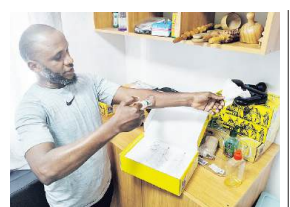
“I became good at deep tissue massage and hijama therapy. Today, everybody in Mombasa knows who to look for for deep tissue massages and hijama therapy,” he told the writer after a hijama session.
“The name Ali Doctor, which came after Ali Robby, was because I used to treat people, mostly sports people, whenever they were injured and needed physical therapy.”
Apart from helping athletes get better Robby also engaged children to help keep them off social evils.
“There was a time when Majengo was really bad. Many children were involved in all manner of ills including smoking weed, gang fighting, robbery and violent extremism, amongst others,” he said.
“Since I wanted to make a difference, I thought I would gather the children and start making them spend that extra energy they had that they channelled to the wrong places.”
His first “clients” were four boys, whom he thought were quickly becoming wayward.
“I started introducing them to running first, swimming, cycling, dancing and rope jumping while slowly talking them out of their old vices,” he said.
Gradually, the group grew bigger and soon, large groups of women, old men and children joined in and participated in the physical exercises religiously.
“It got to a point where more than 170 people were doing physical exercises. Word had spread and people came from other areas like Makande, Tudor, Kizingo, Old Town and Tononoka.”
He paired the physical exercises with frequent life talks, where he advised the youth on lifestyle issues and to stay away from crime.
“I am happy some reformed and turned their lives around. Some got good jobs after refocusing on their education because they had quit school because of peer influence, yet they were bright.
“Many travelled abroad, something most could not even think of, owing to the nature of their character before,” he said.
But some did not reform and have since been jailed, or worse, killed. He has also seen many of his friends—whom he tried to help, but to no avail—fall to the same menace.
“There is no joy in burying a young person for avoidable reasons. Young people should use their energies the right way and try and help their parents, who suffer a lot,” Robby said.
Nonetheless, after registering many successes in helping others turn their lives around, Robby went further.
He formed a triathlon team after the converts raised their interest in pursuing gainful sports.
They won several trophies in Mombasa, Ukunda, Vipingo, among others, which totalled five titles.
Their progress generated more interest and demand for more participation in tournaments grew, but as Robby was the sole financier, it became an unsustainable venture.
Enrolment into a triathlon competition costs about Sh50,000 for a team of three, in addition to the required bicycle that costs about Sh100,000.
“Then there are other associated costs like transportation, accommodation, meals and other issues that needed attention. We could not afford all that without support from leaders and other places,” Robby explained.
The financial constraints curtailed the team’s progress.
“That is one of the greatest regrets - having to drop out of competitions because of lack of funding and having to disband the triathlon team. The boys were so disappointed. It pains me to date,” he said.
“I am still hopeful that we can get back to where we were. I have not completely lost hope. Like the other day, we were hiking in Naivasha. We just need support.”
Robby believes this disappointment caused some of the youngsters to relapse. He urged politicians and other leaders to refrain from dishing out handouts and instead, hand the youth a lifeline by offering them resources that are useful in building their lives.
All the same, the therapist is happy, thanks to an old friend—now deceased—to have ventured into this career choice, which he began while still in high school.
“He was the trigger. He used to massage people when they got hurt. But he would call me to help him from time to time and saw that I did not complain or ask for money in return. I was always there whenever he needed me,” he said.
Today, he charges between Sh1,000 and Sh4,000 for a session, depending on the type of discomfort a client has.
“I have done this work for about 12 years but as a profession, I have done it for like eight years. It has helped me build my house. Sometimes, I do it for free,” he said, noting he weighs the circumstances.
Robby’s trade requires him to listen to a client’s symptoms before suggesting the best course of treatment.
“Not every ailment requires deep tissue massage or hijama therapy. Some require just the normal massage.
He also has some special considerations for the job: social propriety is key, and Robby said he only massages men, while his wife, whom he has taught the techniques, takes the female clients.
He also considers the number of clients he can see in a day—reducing these to four from the 10 he used to attend to when he started the job.
“I limited the number because professionally, I like to follow up on my clients to make sure they are completely healed. If I do more than four people in a day, I would not effectively follow up on my clients.”