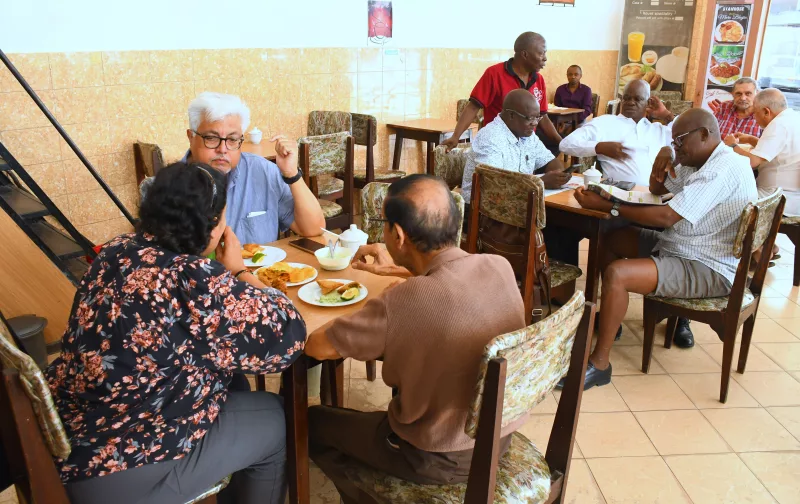
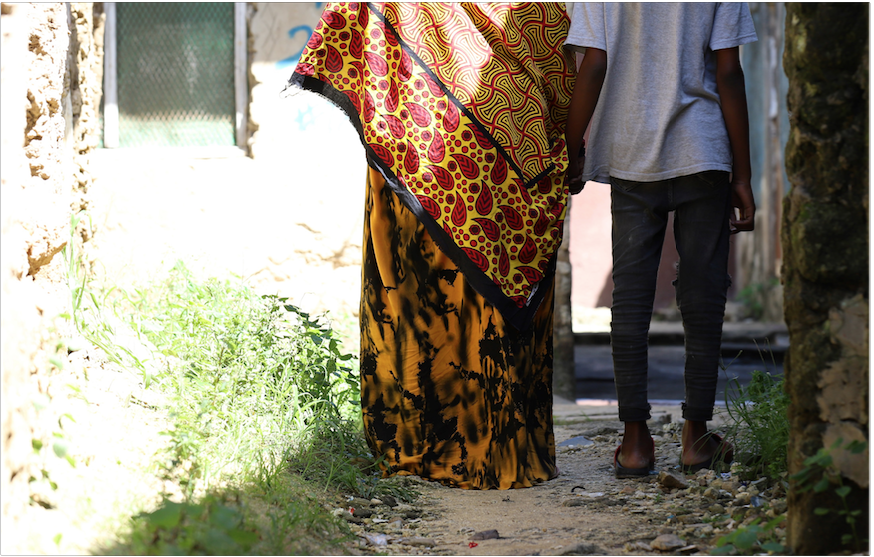
 A woman with one of her sons, who was lured into homosexual intercourse in Bakarani. The case has been in court for three years / BRIAN OTIENO
Walking down narrow paths made of uneven stones and red sand, AHB leads the way through Vichangalaweni, a little village in Shimoni, Kwale county.
AHB is a bitter woman, but her veil hides the pain she has endured since November 10, 2024.
It was the date she discovered that her seven-year-old niece, MA, had been defiled repeatedly by her neighbour, a man who commands respect and fear at the same time, because of the nature of his work.
The neighbour, 55, is a traditional doctor, whose work takes him abroad, as far as South Africa, where some of his clients are.
“That day, I saw MA sit outside the house, deep in thought. I knew she was not okay. Something was bothering her. But she denied it until I threatened to cane her,” AHB says.
Before they got any further with the conversation, MA passed urine uncontrollably.
This shocked AHB because it was not normal for MA to urinate on herself, and in broad daylight.
It turned out MA had lost control of her urinary muscles because of the constant defilement by the traditional doctor neighbour.
MA explained to AHM that whenever they went to Madrassa with her friend, CT, in the afternoon, they usually met CT’s father, the traditional doctor, who insisted that she remain with him at his home.
“The traditional doctor then used to take MA into his bedroom, remove her clothes and penetrate her. MA could not scream because he covered her mouth,” AHB narrates as Kenya Human Rights Commission officers Ernest Cornel and Robert Waweru take notes.
Afterwards, he would wipe MA’s private parts with a cloth and tell her to go back home, having given her some juice to drink or Sh10 to buy something to eat.
He used to threaten her with dire consequences if she ever told anyone about it. Even more harrowing, AHB says, was that the abuse had been going on for quite a while.
MA told AHM she could not tell the adults because she feared her parents would beat her, plus the traditional doctor’s threats also lingered on her mind.
This affected MA. She would not talk to anyone at school.
Her teachers noticed something was wrong, but they could not convince her to talk, forcing them to call her parents.
They reported that MA usually urinated on herself, and as a result, the classroom stank. “It was traumatising for her as she suffered in silence for quite some time,” AHM says.
She says MA has developed breasts as a result of the defilement despite her tender age.
Her father, AK, a fisherman, upon getting the news, confronted the traditional doctor, wanting to beat him up, but he was restrained.
He could not go to sea for almost a week because he was red with anger, not thinking straight.
They reported the matter to the Msambweni children’s officer, who advised them to take MA to hospital first before reporting at Shimoni police station.
The hospital tests showed MA had been defiled, and not once or twice.
The traditional doctor was then arrested, after which he tried to settle the matter out of court by offering the family five acres of land and Sh2 million, an offer MA’s family refused.
However, in court, the traditional doctor denied the charges and was released on Sh350,000 bond.
“I just pray for justice for my daughter,” AK, MA’s father, says. Shahame Makame, the Kenya Pemba Community chairman, says such cases are common in Shimoni but most go unreported.
Makame says this is because most of them are settled at home, where parents are lured by money to sweep the cases under the carpet or look the other way.
The Pemba community chair fears MA will not get justice because the traditional doctor is a man of means and wealth.
He says the few that end up in court are eventually dismissed because witnesses develop cold feet and shy away, thus weakening the cases.
“Some of the cases also flop because along the way during the period in which the case is active, the victim’s parents are approached by the perpetrator through proxies, offered money and land, and they cease coming to court to bear witness,” Makame says.
“Had we agreed to take the Sh2 million and five acres of land, this case would have been a foregone thing. But we thought of the consequences of our action and the impact it would have on this child when she grows up and we are no longer on earth, and decided against it,” Makame says.
Neighbours say the traditional doctor might have defiled MA as part of rituals for his trade.
At Bakarani in Nyali subcounty, Mombasa county, MWA is facing a similar predicament.
Her daughter, LH, was 10 years old and in Std 7 when she encountered a predator at school, almost five years ago.
“The headteacher of the private school in our neighbourhood is his brother. The headteacher had travelled and left the school under the care of his brother,” MWA narrates to the Star and the KHRC officers Cornel and Waweru.
The school caretaker lured LH to his office by asking her to go for a receipt after her mother had paid school fees.
That was when he defiled her.
In subsequent times, LH refused, but the teacher tried to persuade her by telling her he would make her pass all her exams and top her class every time.
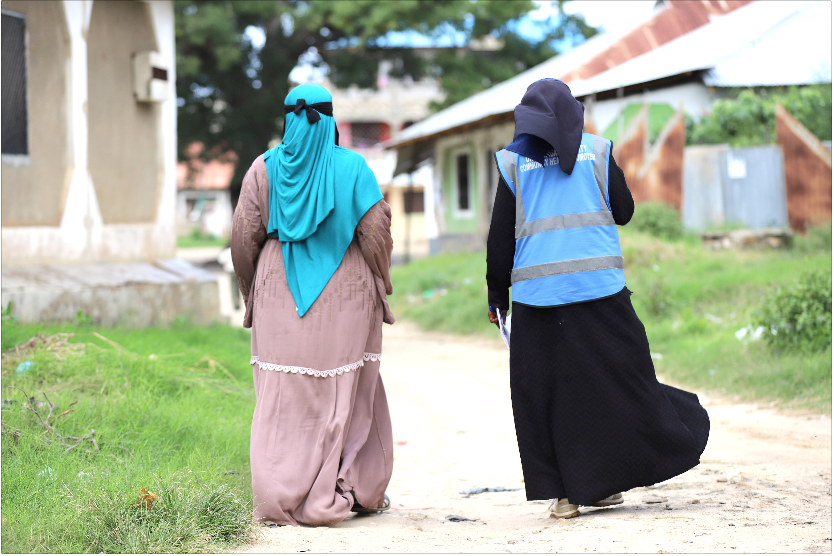
Indeed, MWA says, she noticed that her daughter had caught up with her school work and was getting good grades all of a sudden in first term.
In the second term, in 2021, her grades fell back to her usual ones.
MWA says they first suspected something was up because LH refused to go to school and stayed at home for three days straight.
“When I probed why, she kept on insisting that I remove her from that school and find another one for her. This puzzled me because she was doing well at school. This sudden change of heart baffled me,” she says.
LH one evening went to Madrassa and explained the situation to her Madrassa teacher, who called LH’s parents and told them.
They informed child protection volunteer, paralegal officer and village elder Jamila Hassan, popularly known as Auntie Jay, who has been guiding them on the legal process.
They then went to hospital where the girl was checked and the doctor confirmed that she had been defiled.
The case has dragged on in court for five years now, and at some point stalled, ostensibly because the suspect could not be found. He had vanished.
The suspect, who was living in Bakarani, has since moved out of the neighbourhood, but MWA says she has seen him once or twice in Mtopanga, where he is believed to have moved to.
“One day, he sent emissaries to me asking that we settle the matter out of court. I refused,” she says.
According to LH, she was not the only girl being defiled.
“There were like seven girls, but their parents refused to report the matter for fear of the shame their families would face. Only one other girl reported,” MWA says.
“The justice system disappointed me. I feel justice is not being served because they have refused to arrest the suspect to be produced in court. You cannot tell me the whole government cannot trace a teacher,” MWA says.
LH, the firstborn in a family of four children, is now in Form 3 and her dream is to become a nurse.
“I am glad it seems she is forgetting the incident because it took her almost two years to go back to her normal self. She became aloof and quiet, refusing to participate in group activities,” MWA says.
The case is pending in court.
Auntie Jay says some officers in some police stations are the first hurdle in such cases because they collude with the perpetrators to defeat justice.
“Sometimes when these officers receive these cases, it is like they have got a money-minting avenue, especially if the perpetrator is someone of means,” Auntie Jay says.
She says in some cases, some police stations ask victims to buy files and P3 forms.
“The timing is also a challenge. For instance, at Coast General Teaching and Referral Hospital, P3 forms are filled on Mondays and Thursdays only,” she says.
“So what happens when a victim comes on Friday? They have to wait till Monday to have the forms filled. This delays justice.”
There is a 72-hour window within which cases of rape and defilement should be acted upon to preserve the integrity of evidence and to prevent diseases and unwanted pregnancies, Auntie Jay says.
“The P3 form should be filled out any day and not specific days. In fact, on those Mondays and Thursdays, it is not a guarantee that the filling doctor will be available. You might go to CGTRH for almost a month without finding the doctor,” she says.
Calls and texts to health executive Swabah Ahmed and director of communication in the health department Richard Chacha went unanswered.
Auntie Jay says police who collude with perpetrators to defeat justice usually do not give information to the victim’s side.
“They will not give you the case number, and if you are not sharp and only trust their word, you will jeopardise your case. They will not inform you of the next court date, which then passes with you not showing up in court,” she says.
Auntie Jay advises caregivers and victims to always know the case file number and the next date of hearing.
“Do not rely on police officers to give you those details. Sometimes the police officers themselves advise victims and their families to settle the matter out of court,” she says.
“The justice system also disappoints. Sometimes the cases drag on for long, about four years, five years. This demoralises the victims and their families, who sometimes give up, especially those who struggle financially. They say they leave everything to God.”
Parents of victims, Auntie Jay says, sometimes also collude with the perpetrators, quickly seeking out-of-court settlements to avoid embarrassment for the family or to get a financial ‘breakthrough’ because of their poverty.
“In such cases, the victims do not heal because they do not get psychosocial support, which is important. If they do not heal, it will disturb them in adulthood,” she says.
“Sometimes, without healing, with time you find the victim’s behaviour changes and in most cases for the worst.”
KHRC’s Cornel says another case in Bakarani involved a woman who lured young boys aged between seven and 10 into having homosexual sex while she filmed and uploaded the videos on pornographic websites.
The woman was known to the boys, who included three brothers and two friends. The case is still going on in court, three years later.
In 2024, the KHRC identified the top 10 counties with the highest rates of defilement and teenage pregnancies among girls aged 15–19.
The list included Kwale and Lamu counties at the Coast, where the numbers were alarming.
In Lamu, for instance, at least 1,073 cases of teenage pregnancy were recorded between 2024 and mid-2025.
This was according to a report submitted by the county’s gender sector working group to the Presidential Technical Working Group on Gender-Based Violence and Femicide.
Of these, 789 cases were reported in 2024, with an additional 284 recorded between January and May 2025.
According to Muslims for Human Rights, who also submitted a report to the task force, many of these pregnancies resulted from rape and defilement, as well as early marriage.
Alarmingly, another report by the National Syndemic Disease Control Council found that an average of 696 adolescent girls were impregnated every day in 2023.
In response, the KHRC issued “red cards” to the Health Cabinet secretary and governors of the most affected counties, symbolically declaring them unfit for public office due to their failure to protect vulnerable girls and ensure their return to school.
These symbolic actions were followed by formal letters to the Senate, National Assembly and Council of Governors in 2024 and 2025.
The letters called for urgent interventions, including the KHRC’s earlier petition to the Senate to summon governors of the most affected counties to explain measures being taken to combat teenage pregnancy.
The KHRC wants the National Assembly to summon the Health Cabinet secretary to clarify existing policies and Kenya’s commitment to the Eastern and Southern Africa Commitment on comprehensive sexuality education.
The Education CS, the KHRC says, should outline strategies to ensure that pregnant girls are re-admitted to school without conditions and provided with psychosocial support.
The commission says the Council of Governors should lead efforts to address the root causes of defilement and teenage pregnancy through community health promoters.
“Despite these efforts, neither MPs, senators, nor governors have responded or taken the necessary actions to safeguard young girls.
“This inaction leaves them vulnerable to sexual violence, without access to critical sexual and reproductive health services, and unable to complete their education,” the KHRC says.
The situation in Lamu, the commission says, is a sobering example of systemic failure.
Kenyans, especially those in affected counties, must demand accountability from elected leaders who have failed to uphold their duties, the commission says.
“As the next general election approaches, citizens must evaluate the performance of MCAs, MPs, senators, governors and the national government based on how they have protected—or failed to protect—our sexual and reproductive health rights,” it says.
“Those who stood by as our young girls’ futures were destroyed do not deserve our votes. They should be sent home.”