
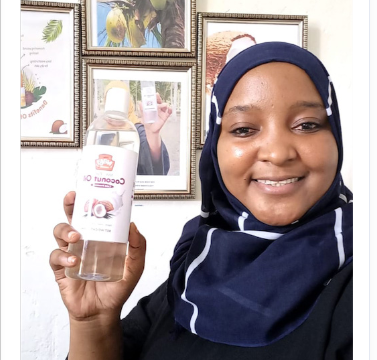
When Subira Zingizi decided to turn her passion for coconut into a business in 2019, she had no idea how far the journey would take her.
What began as a side hustle—an experiment fuelled by curiosity and her coastal roots—has today grown into a recognised agro-processing venture, Nala Foods Africa Limited, with a diverse product line, a processing facility in Kwale, and aspirations for the global market.
“I had worked in the financial sector for 10 years. But I kept thinking— why are we importing coconut oil when we are surrounded by coconut trees here in the Coast,” she said.
Subira’s entrepreneurial light bulb flickered on when she noticed that most of the coconut oil products on supermarket shelves in Mombasa were imported.
“Coast region is full of coconut palms, yet local value addition was minimal,” she said.
Sensing an opportunity and driven by her desire to bring healthier oil options to Kenyan kitchens, Subira began researching how to produce coconut oil.
STARTING NALA FOODS
In 2021, she quit her job and decided to go into the coconut value addition business, and that curiosity gave birth to Nala Foods in 2022.
Her goal was to create premium, food-grade coconut products made by residents, for residents, using raw materials sourced from the community, she says.
In its initial days, Nala Foods was nothing more than a repackaging venture run from Subira’s kitchen— buying coconut oil, repackaging it and selling it under her label.
But her vision demanded more: a fully-fledged production process that controlled quality from start to finish. “There was very little information out there on how to make premium coconut oil,” Subira recalls.
“We had to find partners, attend trainings and learn how to stabilise the product and meet food-grade standards.”
Financing was another uphill battle. The business was entirely self-funded, and coconut oil production, as she soon learned, is highly labour-intensive.
Producing just one litre requires up to 30 coconuts—and in her case, the early methods depended on natural fermentation and sun drying, which limited output and consistency.
“Yet, the obstacles never dimmed my determination,” she says. Subira’s big breakthrough came last year when Nala Foods secured donor funding, which enabled her to set up the first coconut processing facility in Kwale.
With machines, solar dryers and upgraded graters, she went from processing a few litres per week to handling up to 60 coconuts per hour.
“From grating coconut oil, from grating coconut shreds one by one to now we have a machine and be able to do a capacity of between 60 coconuts per hour. That was my aha moment, a dream come true,” she says.
“People thought I was crazy to leave a stable banking job to ‘play with coconuts,’ but I knew I was building something greater.”
Beyond product development, Nala Foods is deeply entrenched in community impact. Coconuts are sourced directly from farmers in Kwale and Kilifi, ensuring fair trade and reducing middlemen. In production, Subira employs local women with generations of coconut handling experience—a model that’s both efficient and empowering.
Currently, Nala has six permanent employees and engages 10 to 12 casual workers monthly during peak production times.
“We are proud to economically empower women who have worked with coconut their entire lives,” Subira shares.
BUSINESS SUSTAINABILITY
The business also prides itself on sustainability, using solar energy for drying coconut, which reduces environmental impact and operational costs.
Nala’s product range is designed for versatility and wellness. The virgin coconut oil is multipurpose—perfect for cooking, skincare and as base oil for other products.
The coconut body butter is a favourite among beauty enthusiasts, prized for its moisturising and nourishing qualities. But the real innovation, Subira says, lies in Nala’s infused coconut oils. Infused with spices and herbs, they are designed for consumers who find the natural coconut aroma too strong.
“You can cook with it, garnish your food, or stir it into soup. It retains nutrients while offering a burst of flavour,” she explains. The brand also offers a taste of the Coast through coconut biscuits.
Nala Foods products are now available across major cities in Kenya, including Mombasa, Nairobi and Kisumu. According to Subira, it’s more than just the oil. It’s about intentional craftsmanship—combining traditional knowledge, rigorous training and local sourcing to create a product that people trust.
“Our oil is carefully extracted from coconut milk, not just boiled from copra,” she says. “We prioritise food safety, authenticity and supporting our community.”
As Nala Foods turns the page from start-up to scale-up, Subira’s ambitions are global.
“In five years, we want to enter the
export market. We believe there’s
a growing international appetite
for clean, ethically made, natural
products—and Nala coconut oil is
ready for that stage,” she says.