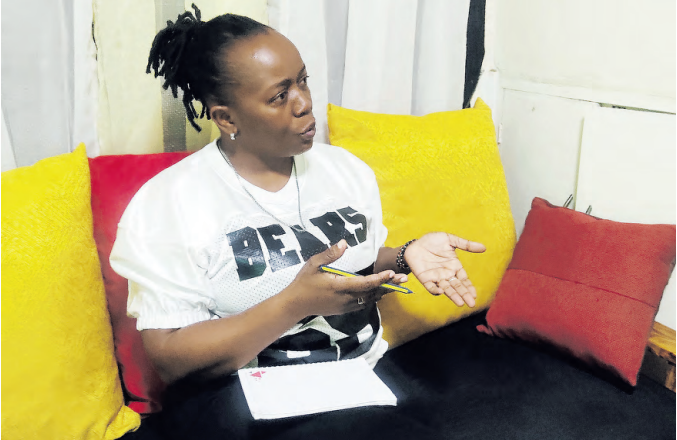
She is a stickler for time, which is evidenced by her arrival for our meeting. For Juliana Olayo, time wasted is an abandoned child sleeping on the cold floors of a police station or a raped girl lacking justice.
“My job is to clean the streets of rapists and all manner of violators,” she says.
Olayo’s passion to fight for the less privileged in society did not start yesterday. Her mother, Josephine Olayo, exposed her to social work at a very early age.
Having grown up in Nairobi’s Kariobangi estate near the infamous, crime-infested Dandora dumpsite, she brushed shoulders with crime almost every day.
When she was not dodging bullets during a gunfire exchange between police officers and thugs on her way to school, she was seated with juvenile criminals, discussing their thug life in class.
Her, mother being a primary school teacher, interacted with these children a lot. Her bid to rescue them saw her take them to her home for rehabilitation.
“My mother worked so hard to protect us from crime, but in the process, she would also bring home children who were exposed to crime and counsel them. I didn’t understand why these children were in our home until later on in life,” Olayo said.
Many years later, during the Covid-19 pandemic, Olayo would follow the footsteps of her mother, except she would do the bulk of her humanitarian work on social media.
“When the pandemic struck, all hell broke loose. People did not have food to eat, children were being sexually molested during the lockdown and infants were abandoned by their teenage mothers or parents, who were too poor to provide,” she says.
“I started receiving calls from police stations and some social workers who were familiar with my job. Having, the heart of my mother, I couldn’t ignore the calls and moved into action. I picked infants from police stations and distributed food to the hungry until I had nothing more to give.”
GOING ONLINE
After running out of cash and utilities, an idea struck Olayo. What if she made an appeal on social media? “You see, social media is a global village to people in New York. Plus I had pretty many followers on Facebook following my campaigns and leadership at the National Youth Council. So I told myself, why not?”
she says. To her shock, many people responded positively to her appeals. Through social media, she was able to solve many cases, but more came up.
Later, she would change her tactic and start sharing specific cases and appealing for specific needs to avoid wastage.
“Remember I rescue abandoned children, too. So sometimes I need diapers, formula milk and baby clothes, things many people would imagine donating,” she says.
With time, she realised that not everybody needed material help. Some of the people who messaged her were well off and only needed counselling.
“This gave birth to the idea of opening threads on social media for conversations. In these posts, people opened up about depression, being abandoned by their rich parents and coming from broken homes,” she says.
And that is how Open Talk CBO, a space for counselling and healing, was birthed.
ENTER THE HATERS
While her social work has been largely successful, one of the challenges Olayo faced was trolls and bullies, who would infiltrate the conversations.
Some people also demanded to see the faces of the victims they are contributing to, which was a challenge because most of the victims were either minors or very vulnerable people who needed protection.
“Social media connects you to the entire world, but it is also a space where we chill with rapists, thugs, bullies and all sorts of people. So knowing persons with good intentions might be difficult,” Olayo says.
While Olayo might not have faced physical threats on her life based on her job, Rachel Mwikali, an activist and one of the conveners of the #EndFemicideKE, had to go on exile after receiving threats on her via social media.
“My woes started when I took on former police spokesperson Charles Owino during an interview on national TV,” she said in a past interview.
It was a panel discussion, where Mwikali and Owino were discussing how the police handled investigations into the mysterious death of a human rights defender.
“I was defending a fellow activist when I bravely told Owino live on TV to stop profiling us. His colleagues in the service were clearly not happy with my actions,” she said.
The next morning, Mwikali woke up to her photos splashed on a Facebook page known as Nairobi CrimeFree.
The page, which has been brought down several times by Facebook, is known for profiling criminals, giving them warnings before they are shot dead.
This, however, did not deter her from coming back into the country and leading one of the most powerful campaigns on sexual and gender-based violence.
TAKING TO THE STREETS
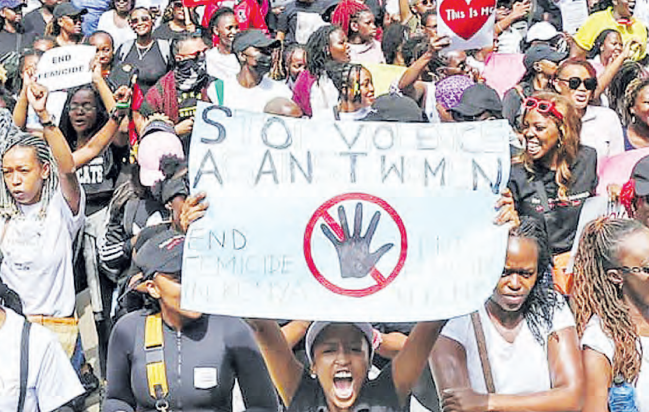
To mark the success of this campaign, was the #EndFemicideKE protests organised on December 10, in which a number of them were arrested and teargassed.
Days before the protests, Mwikali and colleagues created posters with messages on venue and time for the protests and shared them on social media.
“We appeal to everyone to kindly post this on your WhatsApp status and social platforms. We want as many people as possible to come for the march,” the posters read.
And true to their words, the march made an impact. Despite being teargassed and some arrested, the conversations were picked by people in authority and action taken on the aggressors.
Olayo’s and Mwikali’s experiences are some of the examples of how women have used social media for a positive impact.
Njeri Migwi, through her Facebook platform Usikimye, has also been agitating for women’s rights and calling for action against gender-based violence perpetrators.
Before them, there was the #MyDressMyChoice campaign, which fought against sexual harassment of women based on their dressing. The successful organisation on social media culminated in a successful street protest that was attended by Nairobi Woman Representative Esther Passaris.
Apart from the gender campaigns, Kenyans made a mark worldwide with the GenZ protests that were successfully organised online.
They forced President William Ruto to drop the controversial Finance Bill. A 2018 iHub said online attacks on women resulted in self-censorship following emotional trauma and the glaring intimidation extended on the affected women, curtailing their freedom.
This made many online activists to stop posting their personal pictures as their looks are often personalised and scrutinised where a controversial opinion is involved.
According to the report, incidents of cyberbullying are almost endemic, with some having their social media accounts hacked, forcing them out of the social media platforms.
A 2023 report by Kictanet shows online gender-based violence is prevalent in urban and rural areas of Kenya.
The report, conducted across 28 towns, says 63 per cent of the respondents experienced OGBV in urban areas and 37 per cent in rural.
Jenipher Awilo, a programme officer at Online Alliance, says there is a significant knowledge gap on digital rights and online threats faced by women.
She says many women lack awareness on laws and policies on digital rights. While many understand the various risks and threats women face, many do not report them.
Awilo says there is a need to advocate for safe online spaces to enable more women to make money online and contribute to public discourses.
“Safe digital platforms mean more women are confident to use the different platforms to contribute to public interest discourses, conduct businesses, entertain and campaign for political seats without fear of being targeted for abuse and violence,” she says.
“By including all voices, societies, therefore, stand to enhance their democracies, governance and economies.”
Some of the security tips these online activists can use include having strong passwords, turning on the two-step verification and installing the safest and newest apps.
Luckily for Olayo, her strong working relationship with police officers has helped her attain some cyber security training. This, coupled with her strong personality, has helped her conduct her online activism effectively.
“I’ve learned not giving so many details of the victims and not sharing my work in real time,” she said. “The unit has also showed me how to strengthen my password to avoid hacking.”