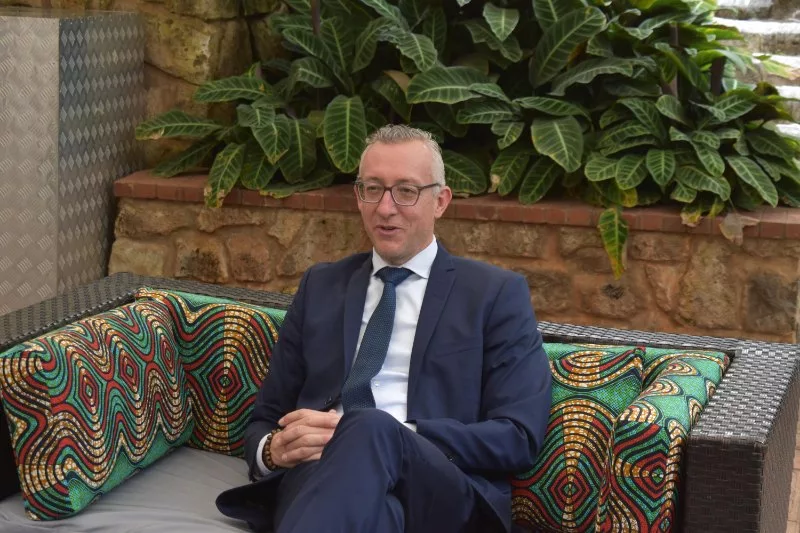
When German Ambassador Sebastian Groth takes to the stage with his Kenyan bandmates, diplomatic titles take a back seat.
There are no formal speeches, protocol officers or carefully negotiated statements. Instead, there are musical instruments, infectious rhythms and four musicians finding their groove.
Speaking to the Star in an interview, Groth says he has found a second home in Nairobi’s jazz scene, performing alongside three Kenyan musicians.
“For me, it is the best music that I have ever played. Whenever we play together, I think we feel a certain magic. It's a joy for the four of us, on a musical level, but also on a personal level. That influenced me musically, but also as a person very much,” he says.
One of his bandmates is a friend he first met when he arrived in the country nearly 25 years ago.
Their friendship has grown into a musical partnership that has taken them beyond Kenya. They have performed in Kampala and at the Madagascar Jazz Festival, developing their own introductions, endings and rhythm patterns along the way.
The connection goes beyond performing together. It has given Groth a deeper appreciation of Kenya, its people and cultural diversity.
“Music is a universal language and it incites curiosity,” he says. “You hear different rhythms, different energy, different styles of music. It can be an important tool of cultural diplomacy and of public diplomacy.”
This is an approach to diplomacy that extends beyond the concert stage and into the work of the German Embassy.
Groth recalls Kenya's participation in 2024 as the guest country at the German Federal President's annual summer garden party. It was the first time a non-European country had received the honour.
Kenya used the occasion to showcase its music, dance, fashion, food and drinks.
For Groth, the exchange demonstrated why cultural diplomacy should never be a one-sided affair.
“Culture is never a one-way street. It's always a two-way street,” he says.
But there is another side to Groth's relationship with Kenya. Beyond music and cultural exchanges, he is pursuing a broader ambition: to transform the relationship between the two countries into one increasingly driven by shared political and economic interests.
It is an ambition shaped by his long association with Kenya, which began long before he became ambassador.
RETURN TO KENYA
Groth returned to Nairobi in August 2022 as Germany's ambassador, nearly two decades after his first posting in the country.
Between 2001 and 2004, he served at the German Embassy, handling press, culture and regional peace processes.
Now 53, he is experiencing Kenya with a diplomat's accumulated experience, but also with memories of the country he first encountered at 27.
His interest in Africa began early in his diplomatic career.
“When they asked me at the Foreign Service Academy where I wanted to go or what idea I had to start my career, without hesitation, I said, ‘Why not Africa?’” he recalls.
Kenya offered an early introduction to the complexities of regional diplomacy.
At the time, Nairobi was hosting peace negotiations involving Somalia and Sudan, including processes that led to the Comprehensive Peace Agreement.
Groth remembers working alongside Kenyan diplomats involved in the negotiations, among them the late Bethuel Kiplagat.
“He is an important influence during my early years. I learned a lot from him,” he says.
Those early experiences helped shape his understanding of Kenya's place in regional diplomacy.
Returning more than two decades later, he found a country that had changed considerably.
He points to infrastructure development, urbanisation, private sector growth and the expansion of the digital economy. The 2010 Constitution also transformed governance by giving counties greater responsibilities.
Yet some things have remained familiar, including Kenya's strategic importance in East Africa and its relationships with countries across the region.
“Germany was the first country to recognise independent Kenya in 1963,” Groth says proudly, pointing to the embassy's diplomatic vehicle registration as a reminder of the historic connection.
He describes the bilateral relationship as traditionally friendly, supported by strong political and people-to-people ties.
“I think, as the President also says in his speeches, we are moving more and more from a development-oriented relationship to a political relationship based on mutual interests,” he says.
For Groth, Kenya's growing economy, strategic position in East Africa and international influence make it an increasingly important partner for Germany.
He sees opportunities to deepen cooperation in trade, investment, technology and wealth creation.
BEYOND AID
Renewable energy is among the established areas of cooperation between the two countries.
Germany has supported Kenya's energy sector through financing, technology and technical expertise.
Groth says Kenya produces about 93 per cent of its electricity from sustainable sources, including hydro, geothermal, solar and wind.
Germany, he says, has supported the development of the sector from its early stages. The two countries are now exploring further cooperation in areas such as green hydrogen and electricity grid expansion.
Technical and vocational education and training is another important pillar of the relationship.
“Since 2019, the partnership has grown from seven centres of excellence in and around Nairobi and Thika, to more than 50 TVET institutions,” Groth says.
“More than 20,000 Kenyan students are now studying in German-supported institutions.”
The programmes are designed to equip young people with practical skills that can help them secure employment.
The same focus on skills and opportunities informs Germany's interest in recruiting skilled Kenyan workers.
A labour migration agreement is intended to facilitate movement from Kenya to Germany. But Groth says the process must be managed responsibly to protect workers from exploitation.
He warns against recruitment agencies that take advantage of young Kenyans seeking opportunities abroad through misleading promises and costly schemes.
“Some of them only want to make fast money and really lure young ambitious Kenyans into schemes that are not okay,” he says.
Germany is working with Kenya to promote ethical recruitment and prepare workers for employment abroad.
Language training is a particularly important part of that preparation.
The Goethe-Institut has expanded its reach beyond Nairobi through arrangements in Kisumu and Mombasa. The embassy is also encouraging more Kenyans to train as German language teachers.
“There are three Kenyan universities training German language teachers, and increasing their numbers would help address the growing demand for lessons,” he says.
For Groth, preparing workers for life in Germany involves more than helping them secure employment.
Moving to a new country can be difficult, particularly for young Kenyans arriving in smaller towns without established support networks.
“They might miss their nyama choma or their Tusker,” Groth says, adding that they need support as they settle into a different society.
REGIONAL DIPLOMACY
Beyond economic cooperation, Groth sees Kenya as an important partner in promoting peace and stability in the Greater Horn of Africa.
He points to the country's regional relationships and experience in hosting dialogue.
Nairobi's international connectivity, accommodation facilities and experienced diplomatic service make it an attractive location for peace negotiations, he says.
“Germany is interested in supporting Kenya’s mediation efforts, including strengthening the mediation capacity of the Ministry of Foreign Affairs,” he says.
He also believes Kenya has an opportunity to amplify its voice in international discussions on climate change, African Union reforms and global financial institutions.
But for the relationship to deliver greater economic benefits, he says, investor confidence must be strengthened.
Predictable regulations, reduced bureaucracy, transparency and respect for the rule of law are among the factors he identifies as important in attracting investment.
He also wants German businesses to take calculated risks in African markets.
The embassy is encouraging more German companies to explore opportunities in Kenya and connecting them with potential local partners.
For Groth, the transition from development assistance to a relationship based on mutual interests requires both governments and businesses to recognise the opportunities available.
A DIPLOMAT AT HOME
Away from the demands of international relations, Groth has developed a personal appreciation of Kenya's music, food and lifestyle.
His musical interests are not limited to jazz. He enjoys Congolese rumba, Benga, Lingala, coastal music and Luo sounds.
Asked to choose between German and Kenyan music, he opts for both.
Octopizzo has also caught his attention, although the two are yet to collaborate.
Food has provided another opportunity to explore the country's culture.
Asked about his favourite Kenyan meal, Groth is particularly receptive to mutura, which he describes as a perfect blend of Kenya's nyama choma culture and German sausages.
Nairobi's weather has also won him over.
“In Germany, between October and March, it's really tough. It's very grey,” he says, contrasting the long European winter with Kenya's sunshine and vibrant surroundings.
These personal experiences have helped shape his relationship with the country he now represents Germany in.
They have also influenced how he approaches his diplomatic responsibilities, particularly the importance of understanding people and building relationships beyond official engagements.
As he looks towards the remainder of his tenure, Groth has two ambitions.
“I want to leave behind a stronger Kenya-Germany relationship, one built increasingly on shared interests, political engagement and economic opportunities rather than development assistance alone,” he says.
He also wants to change how Kenyans perceive Germany and its diplomats.
It is perhaps on the bandstand, rather than at a diplomatic reception, that Groth's philosophy is most easily understood.
There, the ambassador is simply one of four musicians, sharing rhythms, ideas and experiences with his Kenyan friends.
He wants Kenyans to see a modern Germany and understand that its diplomats are not confined to formal meetings and official functions.
“We can be relaxed, friendly, probably even funny,” he says. “And we play music.”