At Gedi National Monument, on the edge of Arabuko-Sokoke forest, the monkeys draw the crowds. Tourists arrive with bananas, and the monkeys play hide-and-seek around them, darting between trees in search of an easy meal.
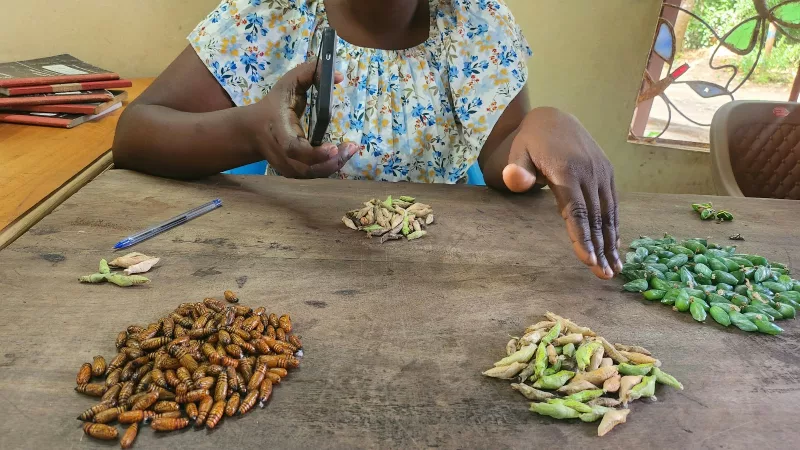
But while that game plays out, something quieter happens within the same grounds. Every Thursday, farmers stream in, each carrying small, delicate containers of pupae, butterflies that have not yet taken flight.
This precious cargo is delivered to the Kipepeo Butterfly Project, where staff record each species and repackage the pupae for shipment.
Kipepeo is a community-based enterprise that supports people living around Arabuko-Sokoke, the largest coastal forest fragment. It enables farmers to raise butterflies at home from wild parent stock caught in the forest.
The project in Gedi receives pupae from about 872 registered farmers organised across 26 community groups
Once the adult butterflies lay eggs, the caterpillars hatch, feed and form pupae. Farmers harvest them at that stage and supply them for export to insect parks around the world. The idea is to link conservation and livelihood, so that the forest gives the people living around it a reason to protect it.
Yet a pupa is fragile, and one infection can wipe out an entire batch. For the rearers, survival comes down to hygiene.
REARING OF BUTTERFLIES
Tumaini Mbogo, 55, is one of the rearers. She began rearing butterflies in 2009 after travelling to Tanzania to learn how to rear them for export.
There, she learnt how to keep butterflies in cages, identify different species and understand the trees on which they thrive.
At her home, each species has its own host tree, a tree whose leaves they like feeding on. The adult butterflies lay eggs, which she collects and places in containers. Once the eggs hatch, the caterpillars feed and develop before forming pupae, which she supplies to the Kipepeo Butterfly Project.
“I have made sure that each butterfly has its own host tree in my home,” she says.
Hygiene, Mbogo says, can determine whether the pupae survive. Before handling them, she washes her hands and makes sure she has not applied oil, which she says can harm them.
“When handling pupae, one should avoid oil at all costs. This means your hands should be clean without any oil or fragrance before you touch them,” she says.
The same goes for the containers. If a container is dirty, the pupae can be infected with disease.
“Initially, we never used to observe hygiene as strictly as we do now. We were taught about handling these insects to avoid contaminating them,” she says.
Once pupae develop bacterial infections, they die in large numbers.
“I stay far away but I carry the pupa in a container. The journey from egg to pupa and eventually to butterfly therefore depends not only on the right host tree and enough food, but also on how carefully the insects are handled and how clean their environment is kept,” she says.
To a butterfly farmer, these losses are costly, because every pupa is a butterfly that has already survived several stages of development.
THE JOURNEY
For 45-year-old Mwanjoki Yaa*, protecting the pupae begins even before she gets close to the rearing cages.
As part of her work as a butterfly rearer, Yaa spends time in the forest, collecting and tending to the insects at different stages of their life cycle.
The work means moving through vegetation where plants and trees can scratch or cut the skin, leaving her with what she describes as ‘scars’ by the time she returns to the rearing site.
That contact with the forest is one reason hygiene matters before she handles the pupae.
After returning from the forest, Yaa showers to clean her body, but she also has to ensure that anything she has applied to her skin does not interfere with the delicate insects.
“If you want to touch the pupa, you have to wash your hands,” she says.
The rearers are also advised to be careful about the kind of lotions, oils and perfumes they use.
“You also have to restrict the use of oils because they do not want strong smells and oils,” she says. “If you must do that, you must wait for some hours before going closer to them.”
For the butterfly rearers in Gedi, such precautions have become part of the delicate work of shepherding an insect through some of the most vulnerable stages of its life.
But keeping the insects alive is becoming increasingly complicated.
Nature Kenya species and sites manager Paul Gacheru says emphasis on hygiene is rooted in the biology of the butterfly itself, particularly during the pupa stage.
“It is basically cleanliness for anything, especially at the pupa stage,” Gacheru says, adding that the pupa is among the most delicate stages of the butterfly’s development.
Bacteria introduced through handling can multiply and put the developing insect at risk.
“If you touch it and your hands are not clean, you do not know which bacteria will affect the pupa,” he says.
Gacheru says rearers must sanitise their hands before handling the pupae and ensure that the materials used in their containers are clean.
“They also sanitise the cotton wool in the containers where they will be placed, because the fungus, bacteria grow on them and kill them,” he says as he gestures.
The precautions continue when the pupae leave the farmers’ homes.
“When you get into your cage, you take the pupae and put them in a sanitised container and carry them to the office. Then they are placed here in a sanitised container,” Gacheru says.
The careful handling matters because a pupa is not only a stage in the butterfly’s life cycle but also a source of income for the farmer.
“This is revenue transferred to the butterfly farmer. If you do not maintain hygiene, you are affecting the whole business,” he says.
Once a pupa reaches the market, there is an expectation that it will emerge as a butterfly. If it dies before then, the farmer loses the value of the insect and risks losing future business.
Entomologist and integrated pest management specialist Sunday Ekesi calls for precautions.
“All insect-rearing facilities must have high standards of hygiene to minimise the risk of pathogens contamination,” he says.
Pathogens that affect insects include bacteria, viruses, fungi and nematodes, he says, making cleanliness important throughout the rearing process, not only when farmers handle pupae.
Ekesi recommends disinfecting cage covers, frames and all containers used to hold eggs, larvae and pupae before they are reused. He says they can be treated with 0.2 per cent sodium hypochlorite and then thoroughly rinsed with fresh water, preferably three times, before being put back into use.
Benches should also be cleaned regularly with water or wiped down with 75 per cent ethyl alcohol to reduce the risk of pathogens being carried from one batch of insects to another.
NOT THE ONLY FACTOR
While disease is a possible cause of the deaths reported by farmers, Ekesi cautions against assuming that every dead caterpillar or pupa has succumbed to infection.
“It is hard to say without verifying the samples of the dead insects,” he says.
Large-scale deaths could be linked to disease or pathogen infection, but overcrowding is another possible explanation.
Establishing the cause, he says, requires examining the insects rather than simply observing that they have died.
Ekesi says scientists can investigate whether disease is responsible by systematically examining dead insects if they are taken to the International Centre of Insect Physiology and Ecology.
“The process can involve isolating the dead insects, disinfecting them, allowing the cadavers to dry, isolating spores from the dead insect and culturing them on selective media before carrying out a diagnosis to determine which pathogen may have caused the death,” he says.
That distinction is becoming increasingly important as butterfly farmers contend with changing environmental conditions.
“Climatic variables threaten all insect survival, including butterflies, by disrupting their life cycle, reducing food sources and causing extreme heat stress,” Ekesi says.
Rising temperatures, for example, can trigger early emergence, potentially bringing the insects into stages of development that coincide with increased disease incidence.
The temperatures can also cause insects to burn through their fat reserves much faster, which can reduce their chances of survival and, in some species, affect their ability to migrate.
Kipepeo Project assistant manager Mathias Ngonyo says the project has repeatedly received reports of caterpillars dying in large numbers.
“Climate change has affected the butterfly business,” he says. “Farmers also report that the butterfly caterpillars die in large numbers as they breed.”
Ngonyo says farmers have also reported difficulties during colder conditions, suggesting that the increasingly unpredictable weather may be affecting butterflies at different stages of their development.
“Sometimes they say pupa cannot survive in the cold. If we look closely, the weather patterns have been shifting rapidly and are very unpredictable,” Ngonyo says.
For naturalist and butterfly enthusiast Benrad Koros, however, the threats facing butterflies extend beyond the conditions inside rearing facilities.
He considers habitat loss caused by development and alternative land uses to be one of the biggest threats to butterflies and the ecosystems on which they depend.
“The biggest threat, in my opinion, is habitat loss to development and alternative land uses in areas where butterflies and other related flora and fauna have thrived for centuries,” he says.
Butterflies are part of an interwoven and interdependent ecosystem, he says, relying on a variety of plants, including trees, shrubs and herbs, for their life cycles, while also providing important ecological services as pollinators.
“Destruction or loss of these habitats directly affects their survival and that of successive generations,” he says.
The communities that depend on butterfly rearing, Benrad says, should, therefore, have a central role in protecting existing habitats and creating more favourable ones for the insects.
“The communities that depend on butterfly rearing should be at the forefront in protecting these habitats and even creating more favourable habitats for the butterflies,” he says.