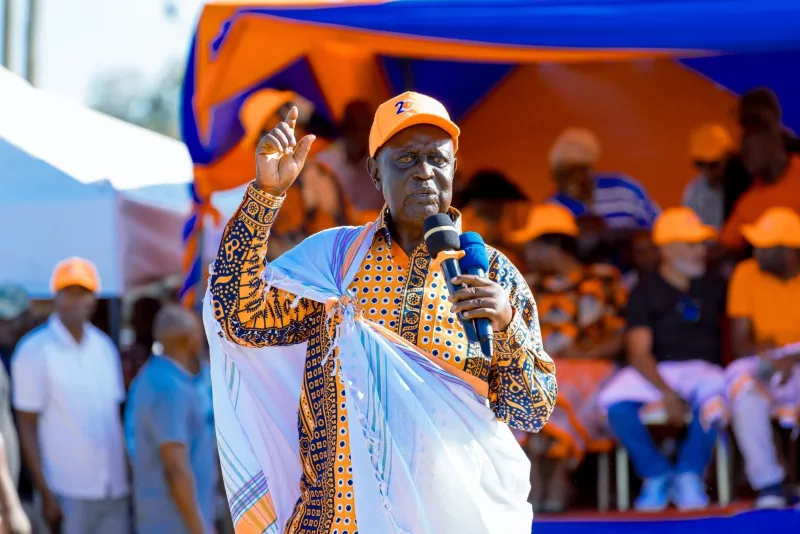
Edwin Sifuna’s presidential ambitions are exposing a central dilemma in the opposition’s search for a candidate to challenge President William Ruto in 2027.
Winning the Presidency is just half the battle, with the harder task being assembling the parliamentary numbers needed to govern thew country.
And even as Sifuna increasingly features in conversations about the opposition’s presidential succession, his Linda Mwananchi political vehicle is yet to demonstrate that it can attract a big number of parliamentary candidates capable of translating his political appeal into seats in the National Assembly and the Senate.
The emerging gap between his presidential ambitions and the reach of his political machinery raises questions about the balance of power within a possible opposition administration, where parties backing a joint candidate could still retain control of their own parliamentary blocs.
Unlike a presidential contest, in which candidates compete for a national majority, parliamentary elections are fought across individual constituencies and counties.
A candidate may therefore secure the presidency without commanding a dependable bloc of lawmakers, leaving the administration reliant on negotiations with parties whose leaders have separate political interests.
For Sifuna, the challenge is particularly significant because the opposition brings together established political figures with their own parties, regional support bases and ambitions. If he becomes the coalition’s presidential candidate, the strength of those partners in Parliament could determine how much room he has to pursue his agenda.
So far, Sifuna has attracted a handful of sitting lawmakers, most of them concentrated in Western Kenya.
Those who have indicated they intend to defend their seats on his political vehicle include MPs Jack Wamboka (Bumula), Timothy Wanyonyi (Westlands), Wilberforce Oundo (Funyula), Majimbo Kalasinga (Kabuchai) and Suba South's Caroli Omondi.
The list also includes Vihiga Senator Godfrey Osotsi and his Kakamega counterpart Boni Khalwale.
Other lawmakers who have backed Sifuna are pursuing their political ambitions through different parties. Embakasi East MP Babu Owino has his own Mwananchi Party, while Kitutu Chache South MP Antony Kibagendi, Kitutu Masaba MP Clive Gisairo, Bomachoge Borabu MP Obadiah Barongo and Senator Richard Onyonka have indicated they intend to contest on former Interior Cabinet Secretary Fred Matiang’i’s Jubilee Party ticket. Kaiti MP Joshua Kimilu is seeking re-election on the Wiper Patriotic Front ticket.
The distinction matters because political support for a presidential candidate does not automatically translate into loyalty to his party in Parliament. Lawmakers elected on other party tickets may support a coalition government, but their party leaders could retain considerable influence over how they vote on legislation, budgets and other government business.
Governance expert Javas Bigambo said the political landscape was unlikely to produce a single party with overwhelming control of Parliament in 2027.
“The reality is that we lack one homogeneous party that gives overwhelming numbers. We are likely to see two or three dominant parties in 2027. For instance, DCP controlling Mt Kenya, UDA sweeping across Rift Valley and North Eastern and Sifuna bagging Western if he is made the candidate,” Bigambo told the Star.
His assessment points to a possible outcome in which regional political strongholds remain under different party structures even if their leaders agree to support one presidential candidate.
For Sifuna, such an arrangement would create a distinction between leading a coalition campaign and controlling the government that emerges from it. His partners could help him secure the presidency while retaining the parliamentary strength to negotiate the terms of cooperation and influence the direction of the administration.
Kakamega Deputy Governor Ayub Savula said Sifuna’s current political reach was too limited to guarantee a substantial parliamentary bloc.
“There is no wave, he (Sifuna) is majorly controlling Bungoma and Trans Nzoia counties. From sitting MPs, in Western, he is controlling a handful out of the 32 elected,” Savula told the Star by phone.
“Out of five senators he has two, and out of five governors he only has George Natembeya.”
The former Lugari MP argued that Linda Mwananchi would be fortunate to win more than 50 parliamentary seats nationally.
“Across the country, not more than 50 MPs across the country will be elected on Linda Mwananchi,” he said.
The projection remains Savula’s assessment, but it highlights the organisational challenge confronting a movement seeking to turn a presidential campaign into a nationwide electoral operation. Beyond attracting prominent political figures, the movement would need competitive candidates across constituencies and counties, as well as the local structures to mobilise voters and sustain campaigns.
Political analyst Alfred Kasembeli said a president without sufficient parliamentary support could struggle to advance legislation, secure approval for government spending and implement parts of his policy agenda.
“Without sufficient support among legislators, his administration could face difficulties advancing key legislation, securing approval for government spending and implementing parts of his policy agenda,” Kasembeli said.
He warned that dependence on coalition partners could expose an administration to political pressure and disagreements, particularly if the parties differed over appointments, budgets or policy priorities. In an extreme scenario, he said, hostile political manoeuvres could include attempts to impeach the president.
A weak parliamentary base would not automatically make a president powerless. The extent of the difficulty would depend on the distribution of seats, the cohesion of the governing coalition and the administration’s ability to negotiate support across party lines. However, it could make policy implementation more vulnerable to shifting alliances and disagreements among coalition leaders.
Political commentator Caleb Burudi said the timing of Sifuna’s party formation could complicate efforts to build a broader electoral presence ahead of the 2027 election.
“This could present a challenge as the party seeks to translate presidential support into a broader electoral presence in 2027,” Burudi said.
He argued that DCP leader Rigathi Gachagua and Wiper leader Kalonzo Musyoka could gain considerable leverage if their parties attracted strong candidates and secured substantial representation in the National Assembly and the Senate.
“Their ability to build broad alliances and field competitive parliamentary aspirants could determine whether they secure substantial numbers of seats in the National Assembly and Senate, giving them greater leverage in shaping legislation, budgets and the broader direction of government,” he said.
Gachagua has already outlined an ambitious parliamentary strategy for DCP. In July, he said the party was targeting at least 130 MPs, 20 senators, 20 governors and 720 Members of County Assemblies.
“As DCP, we must emerge with at least 130 MPs, 720 MCAs, 20 governors and 20 senators. It is doable,” he said.
The target illustrates the importance political parties attach to building their own electoral bases, even as opposition leaders explore the possibility of a joint presidential campaign. A party that delivers a substantial number of legislators could enter coalition negotiations with greater bargaining power over policy, appointments and the distribution of political influence.
Sifuna’s allies are now seeking to expand Linda Mwananchi’s reach, beginning with the launch of its headquarters in Nairobi’s Lavington area. The facility, along Jipe Close off Kabarsiran Avenue, is expected to house the movement’s national secretariat and coordinate political mobilisation and organisational planning ahead of the 2027 general election.
The movement is also planning rallies to attract potential aspirants and strengthen its presence beyond its existing support base.
Wamboka has urged supporters to elect leaders on Sifuna’s ticket, arguing that the senator would need allies at every level of government.
“How will it be that Sifuna is president but his area MCA is from a different party? Anybody who wants votes here must contest and stand on Sifuna’s party,” Wamboka said.
The movement is scheduled to hold a rally in Kwale on Saturday before travelling to Turkana.
The rallies will offer an opportunity to assess whether Sifuna’s growing presidential profile can be converted into a broader electoral organisation.
Ultimately, his challenge is not simply to secure the opposition’s backing, but to build a political base strong enough to give him negotiating power within the coalition and, should he win, the parliamentary support required to govern.