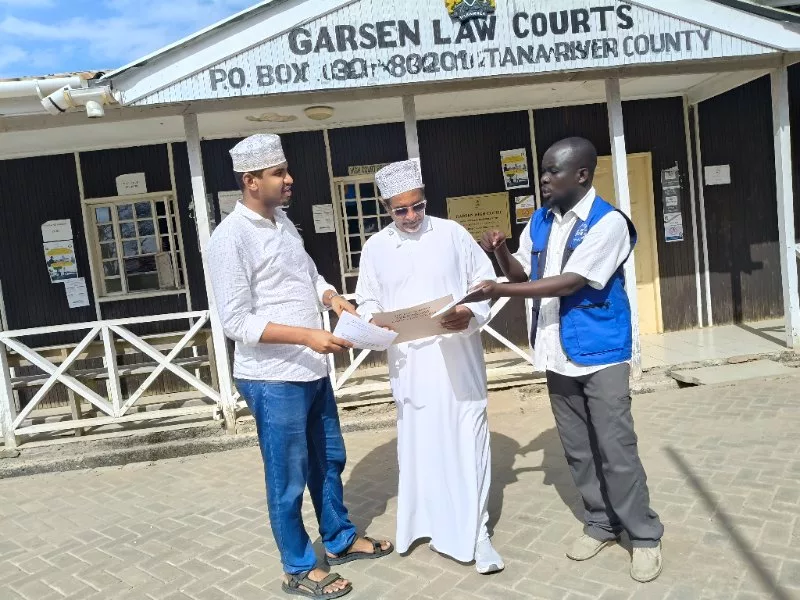
Human rights lobby group Muslims for Human Rights (Muhuri) has echoed the Judiciary’s calls for more funds to prepare for potential electoral disputes independently, fairly and expeditiously.
Muhuri rapid response officer Francis Auma on Thursday said a lot is at stake in the elections.
“It is a matter of life and death for Kenyans. Judiciary must be given enough resources to discharge its constitutional mandate," he said.
“It will be very expensive to move, do research and facilitate logistics. Sometimes we blame the Judiciary for not expensing justice in time, but they are hand-tied by the other arms of government that are supposed to allocate them the resources they need,” Auma told the Star on the phone.
He spoke a day after Chief Justice Martha Koome said they need more funds to train more than 400 judges, judicial officers and relevant Judiciary personnel in preparation for the 2027 general elections.
Speaking in Mombasa, Koome said the Judiciary, through the Kenya Judiciary Academy and the Judiciary Committee on Elections, is embarking on a rollout of phased Election Dispute Resolution (EDR) training programme targeting the judicial officers.
“Our responsibility is to ensure that the courts have the institutional capacity, professional competence and operational systems necessary to administer electoral justice effectively,“ she said.
The ongoing EDR training for High Court judges follows the successful completion of a specialised Training of Trainers programme involving 40 participants, who will support the wider rollout of the training.
“The programme is designed to strengthen the capacity of our courts to resolve electoral disputes competently, consistently, impartially and within the timelines prescribed by law,” Koome said.
She noted that particular attention is being given to digital evidence, electoral technology, active case management, and professional ethics.
On Thursday, Auma said the Judiciary has been the victim of sabotage by the other two arms of government.
“We strongly suspect that sometimes the other arms of government do this on purpose because of their own interests," he said.
“We have seen before instances where the Judiciary appears to be at loggerheads with the Executive and the Legislature because the two arms do not like the decision of the Judiciary.”
This comes as President William Ruto’s administration has proposed a major increase in security spending ahead of next year’s General Election.
Defence, police and intelligence services are among the biggest beneficiaries of a Sh354 billion expansion in ministerial budgets for the next spending cycle.
The National Treasury, according to the latest disclosures, proposes an additional Sh42 billion for Defence, Sh10 billion for the National Police Service, Sh3 billion for Internal Security and Sh4 billion for the National Intelligence Service.
The increases come as the government prepares for an election year when security agencies will be expected to maintain law and order during campaigns, protect voters and polling stations and respond to potential violence.
Security is a critical part of the electoral process, with the conduct of campaigns, the safety of voters and the credibility of polling dependent partly on the ability of state agencies to prevent intimidation, contain unrest and protect election officials.
Defence is projected to receive Sh294 billion, up from Sh252 billion, while the National Police Service allocation rises from Sh147 billion to Sh157 billion.
On Wednesday, CJ Koome said the Judiciary recognises the importance of early preparation given that electoral disputes are governed by strict constitutional and statutory timelines and often involve complex questions of law, evidence and electoral processes.
She said beyond professional training, the judiciary is undertaking broader institutional preparations to strengthen the Judiciary's operational readiness.
These preparations focus on ensuring that the courts and registries have the necessary personnel, administrative systems, technological infrastructure and logistical support to manage electoral disputes efficiently.
“First, we are prioritising effective case management. Electoral disputes must be resolved within strict legal timelines.
“We will, therefore, focus on strengthening registry operations, filing and records management, scheduling of hearings and timely preparation and delivery of judgments,” Koome said.
Human rights activist Auma said sometimes, the Judiciary becomes overwhelmed by caseloads because of insufficient personnel.
“Parliament must be proactive and allocate adequate resources so that Kenyans can get justice in time. Justice delayed is justice denied,” he said on the phone.
Her said other stakeholders must also chip in to support the Judiciary in whatever form necessary.
He called on donor countries to help the Judiciary with its financial needs that help it meet its constitutional obligations.
“For a country to be peaceful and stable, governance issues must be treated with utmost seriousness and professionalism,” Auma said.