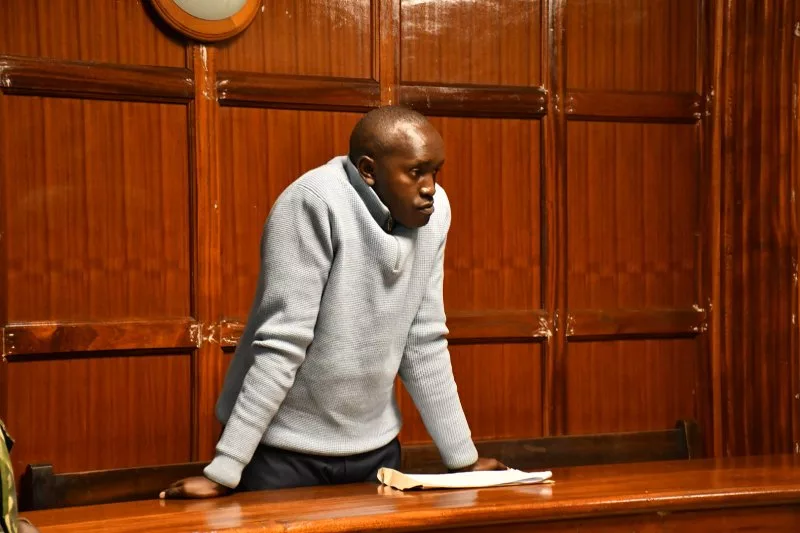
The extradition proceedings against Brian Kiprop Kiplagat–the man accused of murdering his girlfriend in the UK–returned to the Milimani Law Courts on Thursday.
Kiplagat, who is wanted in the United Kingdom over the death of his girlfriend, Citibank executive Maryanne Nduta Kilonzo, appeared for directions before Principal Magistrate Carolyne Mugo.
The court heard submissions on the retention of the suspect's mobile phone, which the state argues is subject to a mutual legal assistance (MLA) request from British authorities and forms part of the evidence in the UK proceedings.
The prosecution argued that the extradition court’s role is limited to confirming the subject’s identity and determining whether the request is political, and that it should not assess the evidence or merits of the murder allegations.
It asked the court to order surrender to the United Kingdom, asserting that the subject is accused of murdering a fellow Kenyan and returned to Kenya after the alleged crime.
“It should be borne in mind that the subject is facing allegations of murder of a fellow Kenyan. And after the crime was committed, the subject escaped back to Kenya,” the prosecution submitted.
The prosecution also said the subject’s phone is being retained as evidence in connection with a mutual legal assistance request.
The court also heard that Kiplagat's constitutional rights and healthcare are protected and non-evidentiary property will be returned.
“We therefore pray that we reiterate our earlier submissions on the surrender and that the applicant has produced enough reasons to warrant his surrender to the United Kingdom to face the murder charges.”
Kiplagat, appearing unrepresented, contested that position.
He told the court that his review of the extradition file transmitted by the requesting state disclosed no request for Kenya to investigate the device or hold it pending the UK trial.
“Having gone through the extradition file from the requesting state, I've not seen anywhere where they requested Kenya to do an investigation of my phone, or rather hold my phone, Your Honour,” Kiplagat told the court.
He challenged the phone’s retention, stating that the UK extradition file contains no request for Kenya to investigate or hold it. He also asked to be taken to collect his identity card.
Magistrate Mugo also addressed a practical matter concerning Kiplagat's identity card.
The court directed the investigating officer (IO) to independently confirm that the ID card is ready, after which arrangements can be made for its collection, including an escort if an in-person visit is required.
However, the magistrate declined to authorise an immediate visit, directing instead that the investigating officer independently verify the card's readiness before any arrangements are made, including the possibility of an escorted collection.
“Once it has been confirmed, then we'll give directions in respect to the collection,” the magistrate directed.
Today's proceedings follow the earlier endorsement of two arrest warrants issued by Westminster Court, a step that formally activated the extradition process under Kenyan law.
Chief Magistrate Bosibori Nyangema allowed that application and the prosecution subsequently secured an order denying Kiplagat bail on the grounds that he posed a significant flight risk.
Kiplagat was arrested on June 10, 2026, at the Namanga border post while attempting to cross into Tanzania using a temporary travel permit.
Prosecutors told the court at an earlier hearing that he had no fixed address in Kenya and had been moving between locations, and that he was found in possession of multiple travel documents, some suspected to have been fraudulently obtained.
The underlying case concerns the death of Kilonzo, a 43-year-old Kenyan who had worked at Citibank for more than 18 years before transferring to London in 2023.
Her body was discovered at her flat in Woolwich, south-east London, on January 17, 2025, after concerns were raised for her welfare. A postmortem examination concluded that she died from blunt force trauma to the head.
The United Kingdom is seeking Kiplagat's surrender to face charges of murder, manslaughter, perverting the course of justice and fraud by false representation.
The prosecution has argued that the extradition court's function is confined to the statutory threshold and that it should not examine the merits of the murder allegations.
The matter is expected to return to court for further directions, with written submissions from both sides anticipated ahead of the substantive extradition hearing.
Under Kenya's extradition framework, the final decision on surrender rests with the relevant authorities following the court's determination.