Artificial intelligence is increasingly finding its way into professional services, and the legal sector is no exception. From assisting with document preparation to summarising lengthy judgments and identifying relevant case law, AI-powered tools are changing how legal professionals approach research and manage their workloads.
For advocates and law firms in Kenya, the technology presents an opportunity to make legal research more efficient. However, it also introduces an important challenge: determining whether the information generated by AI is accurate, relevant and supported by actual legal authorities.
One of the concerns surrounding general-purpose AI tools is their tendency to generate convincing but inaccurate information, including case names, legal citations and judicial decisions that may not exist. In legal practice, where arguments and submissions depend on established authorities, such errors can have serious professional consequences.
This has increased attention on legal technology platforms designed specifically around the demands of legal research, particularly those that incorporate citation verification and access to established legal databases.
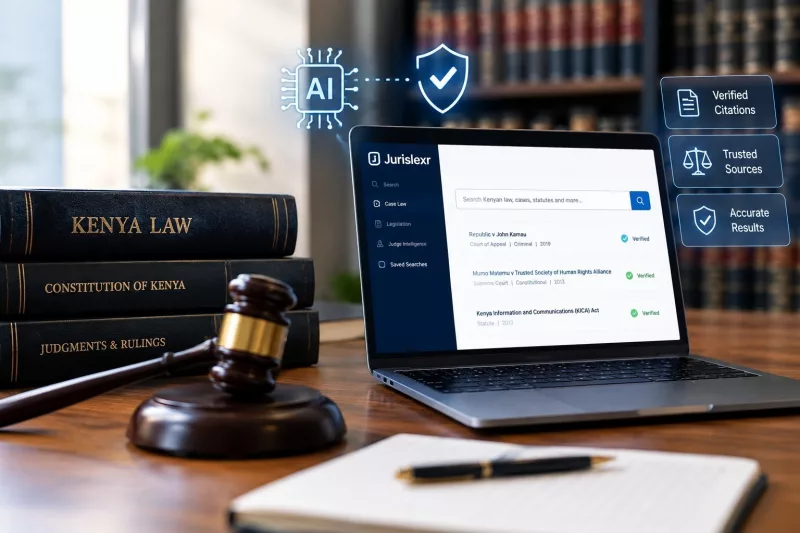
One such platform is Jurislexr, a legal research and verification platform developed with Kenyan legal practice in mind. It is designed to help advocates, law firms, researchers and law students navigate Kenyan jurisprudence through an AI-assisted research environment.
The platform draws from the Kenya Law database, which contains more than 275,000 legal documents. According to its published platform information, its research system checks case citations against the underlying legal corpus before presenting results. It also provides confidence scores to help users assess the relevance of retrieved authorities.
Beyond conventional case searches, the platform incorporates a Judge Intelligence feature that allows users to explore judicial ruling histories, areas of law and patterns in previous decisions. This introduces another dimension to legal research by making judicial information more accessible for professional and academic analysis.
The broader development points to an important distinction in the use of AI in law: generating information is not the same as verifying it. A tool may produce a well-structured legal argument, but the underlying authorities still need to be examined and their relevance established.
Technology, therefore, is unlikely to eliminate the role of professional legal judgment. Rather, its value lies in supporting the research process, reducing repetitive tasks and helping legal professionals access information more efficiently while retaining responsibility for the work they produce.
As Kenya's legal sector continues to engage with emerging technologies, questions around accuracy, confidentiality, accountability and responsible AI adoption will become increasingly important.
The next phase of legal technology may not simply be about how quickly AI can produce an answer, but how reliably that answer can be traced to an actual legal authority.