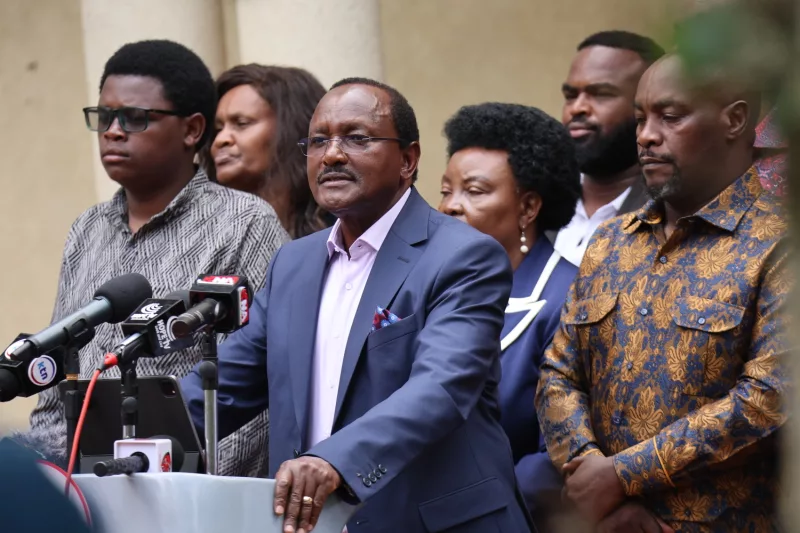
Wiper leader Kalonzo Musyoka will next week take his presidential ambitions to Homa Bay and Migori counties, seeking to expand his support in a region where the late Raila Odinga built one of Kenya’s strongest political bases.
However, political analysts warn that Kalonzo faces an uphill task winning over Luo Nyanza, where the Orange Democratic Movement retains considerable influence. This is despite internal divisions and its cooperation arrangement with President William Ruto’s United Democratic Alliance.
Kalonzo declared on Monday that he could defeat Ruto in Luo Nyanza if handed the United Opposition’s presidential candidate flag for the 2027 election.
The planned tour, initially scheduled for midweek before being postponed following consultations, will test whether his longstanding association with Raila can translate into personal support in a region that overwhelmingly backed the former ODM leader in successive presidential elections.
Kalonzo served as Raila’s running mate in the 2013 and 2017, but was dropped for Martha Karua in 2022 elections, although he still backed him.
Political analyst and Maseno University don Charles Nyambuga argues that Kalonzo Musyoka doesn’r seem to have a lot of support in the region.
“Kalonzo doesn’t seem to have hit the campaign mode. He hasn’t hit the road, so he is not seen as a big threat. He doesn’t have much support in Nyanza,” he told the Star.
“The greatest opponent of Ruto in Nyanza is Linda Mwananchi. They have a chunk of the vote, but if Linda Mwananchi is not united and hitting the road properly, then Ruto will have no problem.”
Political analyst Geoffrey Mboya has also spoken about the Kalonzo-Raila relationship and its factor in Nyanza support.
“The emerging coalition calculations revolve around how to combine different regional bases without alienating leaders who have their own presidential ambitions. Kalonzo’s push into Nyanza and Western Kenya is part of that wider national equation,” Mboya told the Daily Nation.
He added, “His association with the late Raila gives him an established history with voters in the two regions, but the current political environment is different from the three elections in which the two worked together.”
With Raila no longer in the political contest, Kalonzo must now convince voters that he can carry forward the opposition agenda, while offering his own leadership credentials.
ODM’s enduring influence is, however, likely to be a major hurdle. Despite disagreements over its cooperation with UDA, the party retains an established grassroots network and political identity that could complicate Kalonzo’s efforts to position himself as the region’s preferred candidate.
The broad-based arrangement has created opportunities for the United Opposition to court voters opposed to Ruto, but it has also left the opposition competing with a party whose support in Nyanza remains significant.
Kalonzo will, therefore, need to distinguish between dissatisfaction with ODM’s political direction and an actual willingness among its supporters to back a presidential candidate from outside the party.
The emergence of Linda Mwananchi, associated with Nairobi Senator Edwin Sifuna, Embakasi East MP Babu Owino and Siaya Governor James Orengo, adds another dimension to the contest for political influence in the region.
The movement has provided a rallying point for ODM leaders opposed to the party’s cooperation with UDA, creating a potential opening for them to reach voters uncomfortable with the arrangement.
But the movement’s growing profile does not automatically translate into support for Kalonzo. Its leaders have their own political constituencies and ambitions, and their eventual position in the 2027 presidential contest could shape how far the Wiper leader penetrates the region.
The movement’s influence could weaken ODM’s hold on sections of its traditional support base, but it could also create a competing centre of mobilisation that Kalonzo will have to engage.
Beyond the competing political formations, Kalonzo faces the challenge of building a stronger network of local leaders who can mobilise support for his candidacy.
His national profile and years in opposition politics may help him attract attention, but securing the backing of elected leaders, aspirants and grassroots organisers will be crucial if he hopes to turn his regional visits into electoral gains.
Kalonzo must also navigate competition within the United Opposition, where leaders, including Jubilee Party leader Fred Matiang’i and PLP’s leader Martha Karua — who also worked with Raila — have their own political ambitions