Indonesia’s decision to adopt a language spoken by neither its largest nor second-largest linguistic group offers a lesson in how countries can build national unity without allowing ethnic arithmetic to determine national identity.
Speaking about his country’s experience, Indonesian Ambassador Witjaksono Adji on Thursday said Indonesia deliberately chose a minority language as its national language to avoid potential conflict among its many ethnic and linguistic communities.
The decision, he explained, was central to forging a common identity after centuries of Dutch colonial rule and helped unite a country characterised by extraordinary ethnic and linguistic diversity.
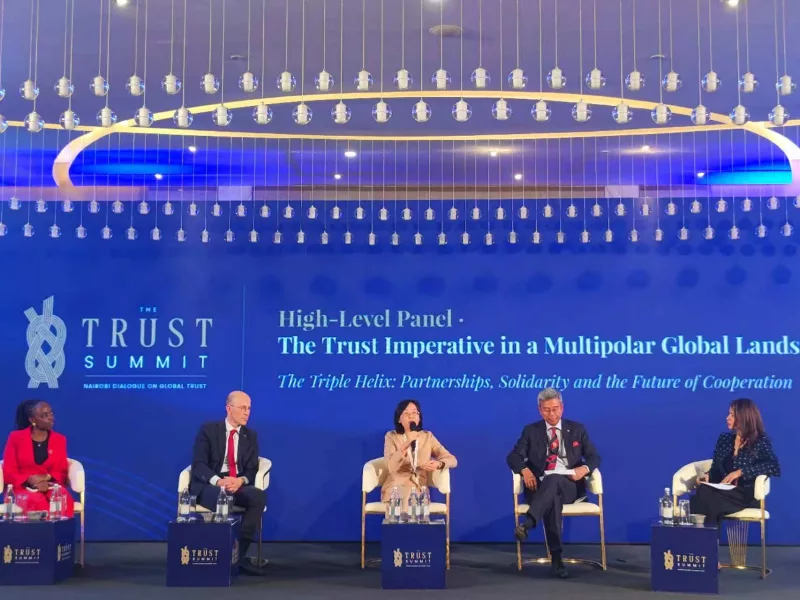
“We wanted to forge our own identity. And there comes the importance of the language,” Amb Adji said at the Global Trust Summit in Nairobi.
“Among the thousands of languages we have, we chose not the majority or the second majority language, but a minority language as our national language. It avoids the conflict that might arise among these large language groups.”
The choice was significant in a country where the Javanese constitute the largest ethnic group. Rather than elevate their language above those spoken by other communities, Indonesia adopted Bahasa Indonesia, based on Malay, as its national language.
The approach offered a way of building a shared national identity without making the language of the largest ethnic group the defining feature of the state.
“There was a commitment to speak one national language — Bahasa Indonesia. This made Indonesians feel that they belonged to one nation because they shared a common language,” the envoy said.
“That has helped foster national unity in a country made up of so many ethnic and linguistic groups. The lesson is that forging unity through consensus builds a stronger national identity.”
Kenya already has Kiswahili as its national language, with Kiswahili and English recognised as official languages under the Constitution.
However, the shared language has not prevented ethnicity from remaining a powerful organising force in electoral competition.
The World Bank’s Kenya Systematic Country Diagnostic identified Kenya’s high ethnic and linguistic diversity, combined with the absence of a single dominant ethnic group, as a factor shaping political competition.
The report found that at least five ethnic groups each account for more than 10 per cent of the population, but none is large enough to dominate all the others. This encourages political elites to mobilise ethnic constituencies and form alliances to compete in presidential elections.
Under the first-past-the-post electoral or plurality system, the report argues, losing coalitions can find themselves largely excluded from power, prompting political leaders to begin assembling new alliances almost immediately after an election. It also links this pattern to political instability and threats of electoral violence.
The implications are visible in Kenya’s recurring coalition politics, where presidential contenders seek support from communities with substantial voting numbers and running-mate choices often carry regional and ethnic calculations.
Indonesia’s experience provides a key lesson for Kenya on how the country can ensure no community feels it must belong to the winning ethnic coalition to enjoy the full benefits of citizenship.
However, Kenyans don’t lack a sense of national belonging. An Afrobarometer study published in 2021 found that 93 per cent of Kenyans identified at least as strongly with their nation as with their ethnic group. The survey also found that 82 per cent believed societies comprising different ethnic groups, races and religions were stronger than more homogeneous ones.
But 19 per cent said their ethnic group was often or always treated unfairly by the government, while another 29 per cent said this happened sometimes.
The findings pointed to a gap between citizens’ willingness to embrace a common national identity and concerns about whether the State treats communities fairly.
That is where Indonesia’s experience becomes relevant. National identity must be supported by institutions and public policies that belong equally to everyone.
Indonesia’s national language project had roots in the 1928 Youth Pledge, through which nationalist youth declared one motherland, one nation and one language. By independence in 1945, Bahasa Indonesia had become an important instrument of nation-building.
Adji said Indonesia’s experience demonstrated that national unity could emerge from consensus among diverse communities.
“The lesson is forging unity through consensus builds stronger national identity,” he said.