
Kenya’s call for global leaders to rebuild public trust is colliding with an uncomfortable domestic reality, with a recent survey showing none of the country’s major public institutions commands the confidence of even 40 per cent of Kenyans.
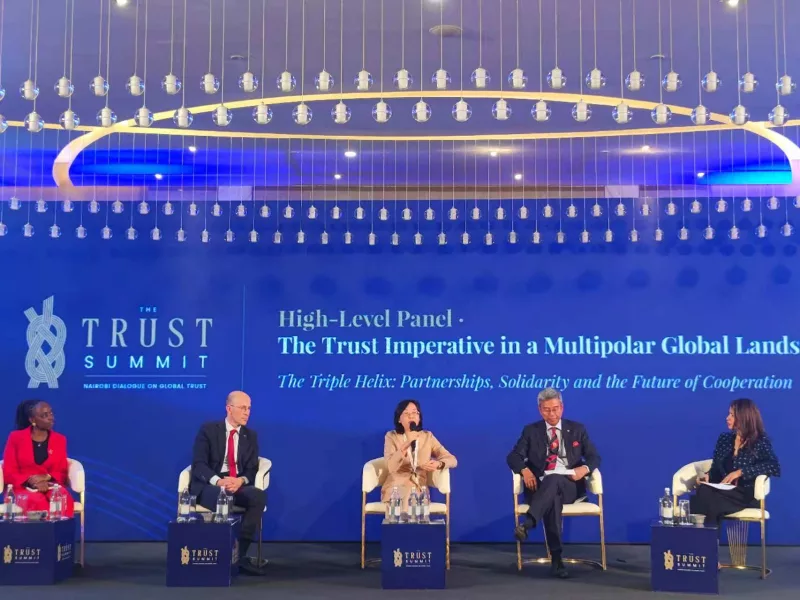
The findings by TIFA Research cast a spotlight on the challenge facing the government as Nairobi hosted the Global Trust Summit from Wednesday to Friday.
Political leaders, civil society organisations, diplomats, private sector executives and institutional heads called for greater accountability, transparency and meaningful public participation.
Prime CS Musalia Mudavadi, who officially opened the Nairobi Dialogue on Global Trust on Thursday, said leaders could not demand public confidence without demonstrating integrity and accountability through their actions.
“We cannot demand that people believe us; we must give them reasons to do so,” Mudavadi said, challenging participants to move beyond speeches and declarations to measurable commitments.
But the TIFA survey, conducted between June 13 and 22 among 2,048 respondents across the country, illustrates the scale of the challenge facing Kenya’s own institutions.
The Judiciary recorded the highest trust rating at 36 per cent, followed by county government leadership at 31 per cent, the Independent Electoral and Boundaries Commission at 30 per cent, the Presidency and National Police Service at 29 per cent each, and Parliament at 27 per cent.
The findings come as Kenya prepares for the 2027 election, placing public confidence in the electoral commission, security agencies and Parliament under renewed scrutiny.
The poll also found that 76 per cent of Kenyans believed the country was moving in the wrong direction, while 65 per cent said their household economic circumstances had deteriorated since President William Ruto took office in 2022.
The findings show the crisis of confidence extends beyond individual institutions to broader concerns about governance, economic conditions and the country's direction.
At the summit, several speakers appeared to describe the very shortcomings reflected in the survey, warning that constitutional guarantees and official promises mean little if citizens cannot see them translated into practice.
Former Chief Justice Willy Mutunga called for political will to fulfil the promise of Kenya’s Constitution.
“Our Constitution is very progressive. But as long as those who are in power find it inconvenient, they are not willing to breathe life into it, and that includes institutions themselves,” he said, bringing to the fore the question of public trust in Kenya’s constitutional framework.
The challenge, speakers argued, is not necessarily the absence of laws or formal mechanisms, but the gap between what institutions promise and what citizens experience.
Dr Andrews Atta-Asamoah of International Institute for Democracy and Electoral Assistance said restoring public confidence required more than better communication.
“It is not just about messaging; it’s also about change of process, change of people and change of direction,” he said.
Transparency International Kenya executive director Sheila Masinde said greater openness could also help reduce the barriers citizens face when seeking information from public institutions.
“We don’t have to go to court if access to information is given more proactively,” she said.
Even in courts, questions to delegates on how much they trust the Judiciary were met with negative responses. Likewise with government procurement and payment processes.
Masinde spoke on the importance of transparency as a practical tool for accountability, rather than an abstract commitment that institutions invoke when seeking public confidence.
She challenged leaders to change their approach to public participation, warning against treating citizens’ involvement in decision-making as an inconvenience.
“When I vote for you, I trust that you will deliver on the mandate you are seeking,” she said.
Mzalendo Trust executive director Caroline Gaita similarly warned that public participation risks becoming a box-ticking exercise when authorities fail to explain what happens to citizens’ contributions.
“Participation without a feedback loop is not engagement; it’s attendance,” she said.
Mudavadi cautioned against treating public confidence as a substitute for accountability.
Citing an Afrobarometer working paper covering 37 African countries, he argued that trust must be supported by institutions that remain transparent, answerable and open to scrutiny.
He also called for reforms to global governance structures, particularly the United Nations Security Council, where Africa continues to lack a permanent seat.
He argued that international institutions must demonstrate fairness, inclusivity and tangible results if they are to retain their legitimacy.
However, the domestic trust deficit presents Kenya with a parallel challenge of demonstrating that the accountability and representation it advocates internationally are reflected in the conduct of its own institutions.