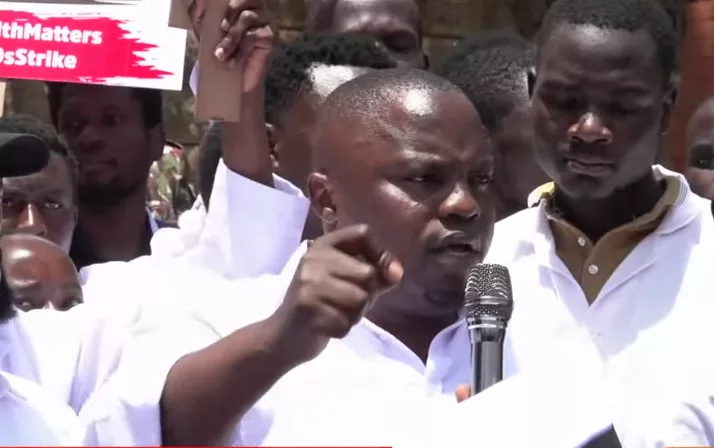
Public health officers on Wednesday took to the streets of Nairobi to protest what they termed government neglect, as their nationwide strike entered its 92nd day without a resolution.
The workers, marching under the Kenya Environmental Health and Public Health Practitioners Union (KEHPHPU), staged demonstrations in the city, demanding urgent intervention by the Ministry of Health to address their grievances and end the prolonged industrial action.
The protesters carried placards calling for the employment of additional public health officers, the signing of their Collective Bargaining Agreement (CBA) and improved terms of service.
They warned that the continued absence of public health officers from their regular duties was weakening disease surveillance and preventive healthcare services at a time when the country faces risks from outbreaks such as Ebola.
KEHPHPU national secretary general and Chief Executive Officer Brown Ashira accused the Ministry of Health of ignoring the striking workers despite the prolonged dispute.
He expressed concern over what he described as inadequate government action to strengthen disease prevention and response measures, particularly amid concerns about Ebola.
“We have been seeing a lot of risks, including Ebola, but we do not see aggressive moves to contain the disease,” he said.
Ashira further accused the ministry of failing to engage the union to find a lasting solution to the dispute, despite the strike having lasted more than three months.
“We are on strike, but we have not seen anybody from the Ministry of Health come to address us,” he said.
The workers said their demands were not limited to their welfare but also concerned the safety of Kenyans, arguing that public health officers play a critical role in preventing disease outbreaks before they overwhelm healthcare facilities.
KEHPHPU deputy secretary general Carol Macharia said the union would not abandon its demands until the government addressed the issues raised by its members.
She maintained that the dispute extended beyond the interests of public health officers to the protection of the wider population from preventable health threats.
“This fight is not for public health officials only; it is for Kenyans. We do not want Kenyans to get exposed,” Macharia said.
The union is also demanding the immediate signing of a CBA to formalise the workers' terms and conditions of service, saying the outstanding issues must be resolved before the strike can be called off.
Deputy chairperson Juma Maelo urged the government to recruit and deploy more public health officers at border crossings and other points of entry to strengthen disease screening.
“Employ public health officers at the border points, at the entry points. We are people who do screening,” Maelo said.
He warned that inadequate staffing at entry points could undermine the country's capacity to detect and contain infectious diseases, particularly as concerns over Ebola persist.
“Ebola is rising, yet the government is not deploying enough staff at entry points,” he said.
The officers also want the government to increase staffing levels to improve disease surveillance and respond to emerging public health threats, including potential outbreaks and health risks associated with El Niño.