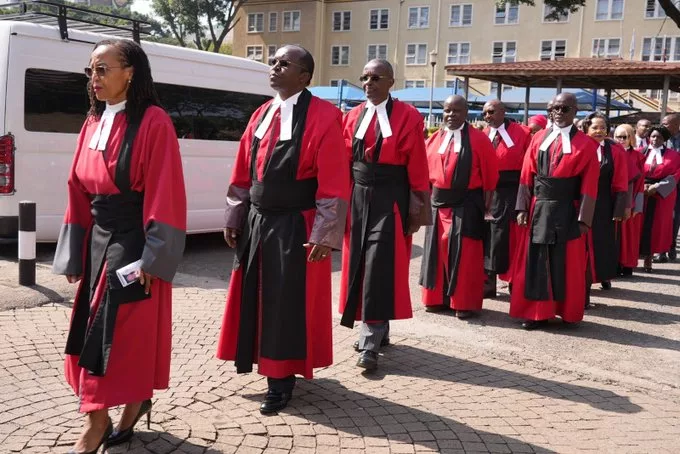
As a student I learned that only one UK judge of what are sometimes called “superior courts” had ever been removed by the formal method in the law. Sometimes, we learned, judges would be leaned on by the Chief Justice to resign. And if judges were not trusted they would not be allocated important cases.
I was reminded of this by an article I read in the last Sunday Nation paper, as I was in need of a bit of inspiration for this column, by Joseph Wangui. It featured cases against the Judicial Service Commission by judges for whom the commission had started removal proceedings.
Key concepts
The key concept for superior court judges has been “independence”. But another key idea of the constitution is accountability. This has two aspects: giving an account of what one has done, and taking responsibility for what one has done, including punishment or removal from office.
Independence is something protected by the constitution for various sorts of state officers. Members of independent commissions, the head of the police, Auditor General, Controller of Budget and Director of Public Prosecutions. These officers are given certain roles central to the functioning of government, and mostly to the achievement of accountability. Inevitably, that means they are at risk of having their work interfered with by the very people they are holding accountable.
The constitution provides ways of removing of all these people. And it’s difficult to do. And there are ways of challenging their decisions - usually through the courts.
But how are the decisions of judges challenged? Usually the decision is transferred to other judges. There is at least one appeal from the decisions of a court - except the Supreme Court, even if it was the only court deciding a case, like a presidential election petition, or an advisory opinion. The appeals are always to a court.
Judges have a collective independence, but also individual independence. The CJ has made it clear that she cannot affect the decisions of individual judges, in any way other than as an appeal judge.
The commission
The JSC has two angles to its roles, which include judicial appointments and ensuring judicial accountability in various ways. It “shall promote and facilitate the independence and accountability of the judiciary (Article 172). It must protect the interests of Kenyans in a fair, impartial, competent, honest system of justice. And it must be protecting the independence of the judiciary while having an interest in keeping it up to standard.”
It’s dominated by judges and lawyers: the CJ, three judges, the Supreme Court, the Court of Appeal, and High Court, one magistrate, all elected by the relevant section of the Judiciary and two lawyers. Then the Attorney General (the voice of government although she/he is also supposed to be champion of the rule of law), someone nominated by the Public Service Commission and two non-lawyers to represent the public chosen by the president (designed when the president would have been the largely formal head of state, not head of government). (Note there is no presence of equal status courts judges mentioned - showing their afterthought nature!)
Powers
The constitution makes it very clear that the JSC can discipline magistrates and registrars and other judicial staff. But for the superior courts it has no such power. The only sort of treatment for a judge who misbehaves is removal from office -which the JSC is involved in. But its involvement is limited to deciding if there is “a ground for removal” and passing the complaint onto the president for a formal removal process. It does not remove the judge or even make a final decision about the truth or seriousness of the complaint. That is done by a tribunal appointed by the president - although he must appoint it if the JSC recommends its formation.
And the constitution limits the grounds for removal of such judges for misbehaviour to breach of a code of conduct prescribed by an Act of Parliament, incompetence, gross misconduct or misbehaviour.
Cases
In a case involving Justice Njoki Ndungu whom the JSC “admonished”, Justice Weldon Korir said, “The JSC has no disciplinary powers over judges … It is not clear why the drafters of the constitution never provided for a mechanism for dealing with minor infractions by judges which in their nature do not meet the constitutional threshold for removal from office. One of the reasons may be found in the testimony of CJ Willy Mutunga that the admonition of a judge stains the record of the judge.”
I have commented before how difficult it is for judges to appear neutral when they are deciding cases affecting fellow judges. Unfortunately, the JSC seems to have acted on several occasions beyond its powers, and then, when the affected judge goes to court to challenge the JSC, it looks as though judges are sticking with judges.
A particular problem is how often the underlying basis for a complaint to the JSC seems to be a particular case raised by someone affected and dissatisfied by the behaviour of the judge. In Ombwayo v JSC, decided this month, a party tried to appeal to the CJ to overturn the decision by a Environment and Land Court) judge on a procedural matter. Something it is not the job of the CJ to do. In fact, the issues had already been ruled on by the Court of Appeal. What were the lawyers thinking? Then the JSC picked it up and turned it into a removal case. How come?
You cannot sue a judge for something they did as a judge in good faith. JSC proceedings must not be used as a way around this constitutional rule.
It’s disappointing when the JSC fails to observe “fair administrative justice” in its decision making - a concept created by judges and now enshrined in the Constitution (Article 47). A key element is giving a fair hearing. Similarly, when it fails to understand straightforward provisions of the constitution and previous court decisions, including about its own powers. It should be a beacon of judicial rectitude, one would think.
My sense is that it is right not to give the JSC detailed powers of discipline. No doubt within the Judiciary a system of “a word in your ear” exists. Each superior court has a head - elected by the judges. The Constitution endorses, really requires, a code of practice for judges. One exists. A defaulting judge will not just default once. It is a practice of defaulting that will lead to removal.
Judges are not above the law. They can be prosecuted for crimes - which again might lead inevitably to removal.
The JSC appoints the judges, and should be able to appoint quality - you don’t get to be a superior court judge when young with no work record. It must also respect the judges’ individual independence. The reasons for this are clear.
Equal status courts again
There is a connection to last week’s Katiba Corner about the complications caused by the creation of two courts of equal status to the High Court - the Environment and Land Court (ELC) and the Employment and Labour Relations Court (ELRC). Wangui’s article indicates that a High Court judge facing JSC removal proceedings will seek support of the High Court and an ELRC judge will go to that court. Unfortunate, you might think.
I am not criticising decisions by the ELRC on the issue of dismissing judges. However, the justification for the creation of the equal status courts was to have skilled judges in two highly complex areas of law. But when it comes to law about appointing and dismissing judges, or other state officers, we are talking about the constitution not the Employment Act – or should be.
The place and role of state institutions and state officers, in judicial terms, should be the preserve of the High Court, or the Supreme Court, given Act – or should be.
The place and role of state institutions and state officers, in judicial terms, should be the preserve of the High Court, or the Supreme Court, given such central roles in upholding the constitution.