Kenyan workers have sought employment with the British Army Training Unit Kenya (BATUK) in the hope of earning a steady income and accessing better opportunities.
However, accounts of deaths, serious injuries and alleged shortcomings in workplace safety have raised questions about whether those expectations have been fulfilled.
British troops are conducting the Haraka Storm exercises in Laikipia amid an unresolved dispute over the legal framework governing BATUK’s presence in Kenya.
The 2015 Defence Cooperation Agreement expired on October 6, 2021. A replacement agreement, signed on July 27, 2021, remained unratified amid disagreements over its provisions.
The dispute intensified on July 23, 2026, when Kenya withheld licences required for Haraka Storm.
Parliament had called for changes to give Kenyan courts greater jurisdiction over serious offences, but the two governments had not resolved their differences.
The UK Ministry of Defence announced that a planned exercise would be conducted outside Kenya. On July 28, Kenya agreed to issue the necessary permits, allowing training to resume later in the year while negotiations continued.
On August 12, victims and community representatives marched to Parliament, demanding that the agreement be halted until past complaints were addressed and compensation claims considered.
On October 8, 2026, a UK military vehicle reportedly struck and killed a Kenyan national near the Swara training ground. The circumstances of the death, including the applicable jurisdiction and the scope of Kenyan investigative powers, require clarification by the relevant authorities.
The incident has renewed questions about how Kenyan civilians are protected and how deaths involving foreign military personnel are investigated.
BATUK traces its roots to a defence agreement signed on June 3, 1964, after Kenya gained independence.
It adopted its current name in 2008 and moved its main base to Nyati Barracks near Nanyuki in 2009. It is among the British Army’s largest training contingents in Africa, with permanent UK personnel, rotating troops and hundreds of locally employed Kenyan civilians.
Under the defence arrangements, infantry battlegroups train in Kenya for periods of up to eight weeks.
BATUK also undertakes engineering projects, medical outreach and joint activities with the Kenya Defence Forces.
The partnership has, however, attracted parliamentary scrutiny. A report by the National Assembly’s Departmental Committee on Defence, Intelligence and Foreign Relations documented complaints concerning deaths, injuries, environmental degradation and other harm associated with BATUK activities.
The committee also raised concerns about compliance with Kenyan law and international obligations.
Its report identified Article 6(5), which lists offences that may be tried in Kenya, as a significant concern because it omits murder. The committee warned that the provision could undermine accountability for serious offences.
The report also questioned the nature of the arrangement between Kenya and the UK, reflecting broader concerns about sovereignty and equality in bilateral defence cooperation.
These findings raise a fundamental question: can a military partnership deliver mutual benefits if the people living and working around its training activities do not have confidence in the mechanisms available to protect them?
BATUK recruits Kenyan civilians to support its training activities. Its locally employed civilian positions include roles in labouring, land clearance, fire response and other operational support functions around Nanyuki and training areas such as Lolldaiga.
The precise number of available positions varies with recruitment needs.
Some workers and families have reportedly raised concerns about employment documents, workplace safety instructions, protective equipment and assistance following accidents.
Questions have also been raised about whether some documents signed by workers limit the employer’s liability or restrict disclosure of information about activities at the base.
These concerns warrant transparent examination.
The terms of employment, the scope of any liability provisions and the safety arrangements applying to Kenyan civilians should be established through contracts, official records and independent investigations.
Workers performing hazardous duties should understand their rights and receive appropriate training, equipment and emergency support.
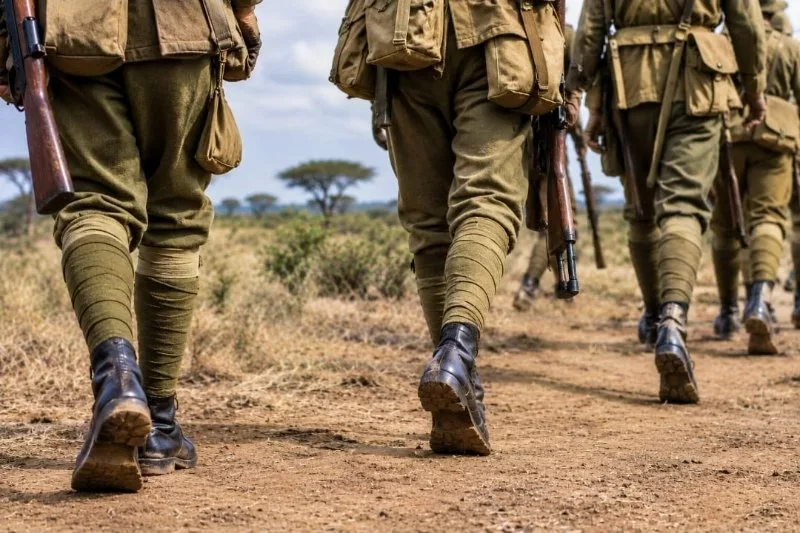
Sanguiyan Ole Legei, a 70-year-old labourer, was hired to support Exercise Haraka Storm Bravo at the Lolldaiga and Ole Naishu conservancies. Like other jobseekers in the region, he sought an income from work associated with the British military’s training activities.
According to court filings, Legei was sleeping in an open area when a lion mauled him. British soldiers reportedly provided initial first aid, but his evacuation was delayed for more than 15 hours.
The filings indicate that the exercise schedule was a factor in the delay. Legei underwent surgery and spent 19 days in hospital. He has reportedly continued to experience chronic pain and relies on crutches to walk.
Other workers involved in the same exercise subsequently lodged claims of breathing and hearing problems associated with M18 smoke grenades and simulated explosions.
They alleged that they lacked formal contracts, written safety briefings and protective equipment comparable to that provided to British troops. Reports put their average daily pay at less than £6.
The allegations raise questions about occupational safety, medical assessment and compensation for workers exposed to hazards during military exercises.
Their individual circumstances and the extent of any lasting injuries require proper assessment, but the complaints underline the importance of consistent safety standards for all personnel.
Other cases have also drawn attention to the risks associated with BATUK activities.
In 2007, Robert Swara Seurei was killed when a plastic explosive reportedly left behind after a British military exercise detonated at his family home. In 2021, Linus Murangiri was killed by a truck while responding to a bush fire linked to British training activities.
In 2016, Godfrey Muriithi collapsed and died a week after starting work. His relatives were reportedly told that he had “fallen down and died”.
The circumstances of these deaths differ, and each case requires its own assessment of responsibility and the remedies available to affected families.
Taken together, however, they demonstrate why unexploded ordnance clearance, fire prevention, medical preparedness and transparent incident investigations must remain priorities.
For many Kenyan workers, locally employed civilian positions offer a chance to earn money and support their families.
That opportunity should not come at the expense of basic workplace protections.
Where injuries occur or lives are lost, families deserve clear explanations, independent investigations and access to appropriate legal remedies.
The UK government has defended its military partnership with Kenya while acknowledging concerns about its defence presence.
In a formal written submission to Kenya’s parliamentary inquiry, published by the Ministry of Defence on October 22, 2025, the UK said it deeply regretted the challenges that had arisen and was taking steps to address them.
It described the relationship as mutually beneficial and highlighted military training, economic activity and community support associated with BATUK.
The UK said BATUK supported the training and development of Kenyan forces and contributed to the local economy through employment and spending.
Its submission reported that BATUK employed about 600 permanent Kenyan staff and up to 3,000 temporary workers during exercises, while spending approximately £50 million annually in Nanyuki and Nairobi.
It also cited community projects involving water, education, health, the environment and sport.
The ministry said it was willing to investigate new allegations raised by the parliamentary inquiry within its jurisdiction once supporting evidence was provided.
The British government also reaffirmed the value of the defence partnership during the July 2026 dispute over training licences.
The Ministry of Defence expressed regret that the necessary permissions had not been forthcoming and said the planned exercise would take place outside Kenya.
It maintained that joint training and operations with the Kenya Defence Forces contributed to the security of both countries.
These responses set out Britain’s position, but they do not by themselves resolve the specific concerns raised by workers, families and Kenyan lawmakers.
The effectiveness of the measures taken, and the handling of individual complaints, remain important questions for both governments.
The case of Agnes Wanjiru, who was killed in Nanyuki in 2012, remains a major test of accountability in the relationship between Kenya and the UK.
A Kenyan inquest concluded in 2019 that British soldiers were responsible for her death.
Kenyan investigators later named Robert James Purkiss, a former British Army medic, in connection with the case.
Purkiss was arrested in Wiltshire on November 6, 2025, and is contesting extradition. No conviction had been secured as of the time of writing.
The case continues to raise questions about the time taken to pursue justice and the practical challenges of investigating alleged crimes involving foreign military personnel.
The case also illustrates the wider importance of clear jurisdictional rules, effective cooperation between investigators and timely judicial processes.
For Wanjiru’s family, the central issue remains accountability for her death.
For the two countries, the case tests whether their defence partnership can operate alongside credible mechanisms for justice.
BATUK continues to offer employment opportunities and contribute to economic activity in the areas where it operates.
Those benefits should be recognised alongside the concerns raised by workers, families and communities.
The record of reported deaths, serious injuries and disputed safety arrangements calls for more than assurances.
Kenya and the UK should ensure that employment conditions are transparent, workplace protections are adequate, complaints are investigated independently and affected families can pursue appropriate remedies.
Parliament’s decision to extend the defence cooperation arrangement by one year provides an opportunity for both governments to address the outstanding issues.
Clarifying criminal jurisdiction, strengthening safeguards for civilian workers and establishing credible mechanisms for handling complaints would help restore public confidence in the partnership.
The question is not whether Kenya should benefit from military training and employment opportunities.
It is whether those benefits can be secured while protecting the lives, rights and dignity of Kenyan civilians.
For the next worker seeking employment in Nanyuki, the answer should be reflected in enforceable safeguards, fair treatment and accountability when things go wrong.
Idris Melik, Researcher in African Affairs and International Relations