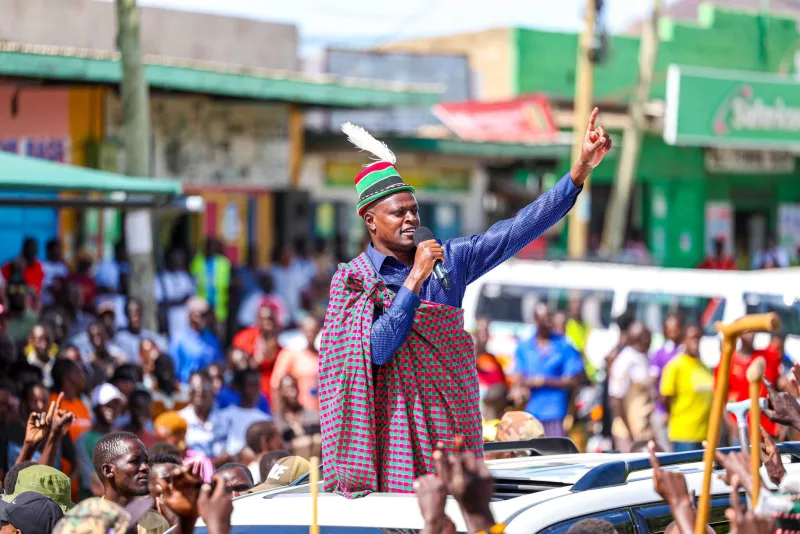
The decision by Kieni MP Njoroge Wainaina to join a new political party has renewed debate over the proliferation of political outfits in the Mt Kenya region as the 2027 General Election approaches.
Wainaina, a close ally of President William Ruto, announced on Saturday that he had left the ruling United Democratic Alliance (UDA) for the Ufanisi Kenya Party.
The party is the latest addition to a growing list of political outfits formed or revived in the region as leaders position themselves ahead of the next election.
Wainaina described himself as the region’s “newest party leader”, following in the footsteps of Democracy for Citizens Party (DCP) leader and former Deputy President Rigathi Gachagua.
“I have formed my 504. It will carry all the residents of Kieni. This is Ufanisi Kenya Party,” Wainaina said.
Other political outfits associated with Mt Kenya leaders include Kiharu MP Ndindi Nyoro’s People’s Party of Kenya (PPK), Kimani Ngunjiri’s The Future Party, Mwongozo Party, launched by former Judicial Service Commission commissioner Macharia Njeru; and the Kenya Reform Party (KRP), led by former Laikipia Governor and Kenya Revenue Authority (KRA) chairperson Ndiritu Muriithi.
The region is also home to The Service Party (TSP), led by Laikipia East MP Mwangi Kiunjuri, Chama Cha Kazi, associated with former Public Service Cabinet Secretary Moses Kuria, and the Ubuntu People’s Party, associated with Trade Cabinet Secretary Lee Kinyanjui.
The Mkenya Solidarity Party, led by former Mungiki leader Maina Njenga, is another outfit in the mix.
Ndia MP George ‘GK’ Kariuki has also been linked to The National Party (TNP), owned by former Thika Town MP Patrick Wainaina, popularly known as Jungle.
As the parties seek to establish themselves, their leaders have defended the right to form political outfits, arguing that multiparty democracy allows Kenyans to organise around their preferred leaders and ideas.
At the launch of Mwongozo Party, Njeru described himself as a potential rescuer of ordinary Kenyans, while urging citizens to take responsibility for the country’s future.
“Democracy is not about popularity — it is about stewardship. Kenya’s future will not be rescued by political messiahs or loud personalities. It will be shaped by informed citizens who understand their power, vote wisely, demand accountability and refuse to be manipulated,” Njeru said in an interview.
The growing number of parties has exposed differences among Mt Kenya leaders over whether the region should rally behind a single political outfit or embrace a wider range of choices.
Some leaders allied to Gachagua’s DCP have called for the region to unite behind one party to strengthen its bargaining power, while others argue that such a position would undermine political competition.
Nyandarua Senator John Methu, the DCP secretary-general designate, is among those advocating for a united political front.
Speaking on Sunday at Kahawa Sukari, Nairobi, during the enthronement of Bishop JJ Gitahi of Priesthood Churches Kenya as an archbishop, Methu urged Mt Kenya residents to support DCP and help it secure more than 100 parliamentary seats.
He argued that a strong parliamentary presence would enable the region to champion its interests and avoid being sidelined in national political arrangements.
“The problem facing us [Mt Kenya] is when we found ourselves without our own party. The person whom we are competing with fears the possibility of us putting our votes into one basket. He also fears that our party can get 100 MPs,” Methu said.
He urged residents to remain united under one party, arguing that a bloc of more than 100 MPs would give the region leverage even if a future presidential candidate failed to honour political commitments.
However, Kiunjuri has dismissed calls for a single regional party, arguing that voters should judge leaders by their performance rather than their political affiliations.
“We have always chosen our leaders based on their ability to serve us, not based on political parties. That is why we have no problem with people forming new parties,” he said.
“Let them form whatever they wish, but for us, our party is performance. It doesn’t matter what name your party has; what matters is your work.”
Kiunjuri added that party labels alone should not be enough to win public support, insisting that Kenyans should elect leaders who deliver results.
Political analyst James Karanja attributes the proliferation of parties in Mt Kenya to a perceived absence of a unifying political figure ahead of the 2027 elections.
“We never saw such a trend when the late Mwai Kibaki or retired President Uhuru Kenyatta was in power. This was because there was a feeling that they were the unifying factors, respectively, and thus there was no political vacuum,” Karanja said in an interview with The Star.
He argued that although Gachagua has sought to unite the region and position himself as its political kingpin, a sense of leadership uncertainty persists following his impeachment as Deputy President in 2024.
The emergence of new parties therefore reflects competing approaches to the region’s political future, with some leaders prioritising unity and collective bargaining power while others defend political pluralism and performance-based leadership.