

Kenya will host global leaders and experts this week for a summit seeking practical solutions to declining public trust in governments, institutions, the media and businesses, amid concerns that the erosion of confidence is weakening societies.
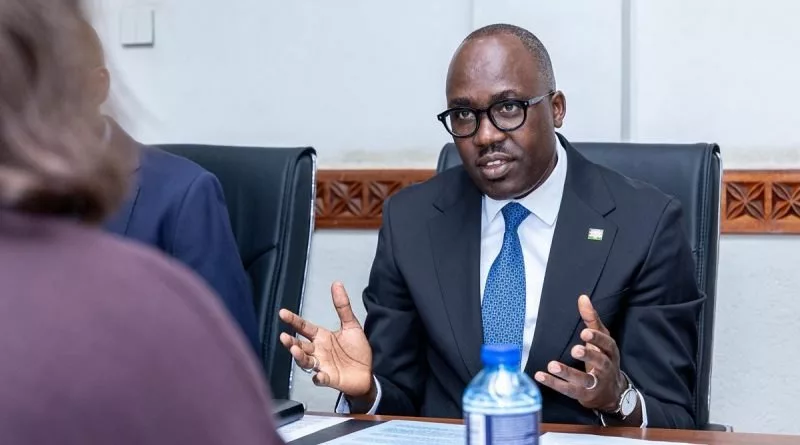
Foreign Affairs Principal Secretary Korir Sing’Oei said the inaugural Trust Summit: Nairobi Dialogues on Global Trust would seek to move beyond discussions and develop practical ways of rebuilding confidence in public institutions.
The meeting, scheduled for October 21-23 at Safari Park Hotel and Strathmore University, will be held under the theme “Weaving Trust: Binding Strands for a Stronger Global Order”.
“While everybody acknowledges that there is a problem with trust, very few are doing anything about it, and while we do nothing about it, the situation becomes worse,” Sing’Oei said.
He said the Kenyan government wanted to arrest the decline and initiate a process of rebuilding trust through concrete action.
“And so the Kenyan government is saying we need to arrest this decline in trust, and then begin a process of shifting the trajectory away from decline towards rebuilding,” he said.
Sing’Oei described the gathering as an action summit that would begin by examining the state of trust within countries before exploring how to strengthen confidence at the international level.
“This is an action summit where we start from looking at what is the trust situation at home,” he said.
He argued that national institutions remain the first point at which trust must be restored, noting that governments need to confront the problem within their own societies before seeking broader international cooperation.
“The front line of trust is always going to be at the nation state, and as Kenya, we are willing to have that conversation,” Sing’Oei said.
President William Ruto is expected to deliver the keynote address at the summit, which will bring together government and public sector leaders, civil society representatives, private sector executives, academics, media practitioners, technology leaders and young people.
Discussions will examine how declining confidence in governments, public institutions, media and information systems, markets, businesses and digital platforms is reshaping public life.
Participants are expected to explore ways to strengthen accountability, improve institutional credibility and build societies better equipped to withstand political, economic and technological disruptions.
The summit comes against a backdrop of declining confidence in institutions globally and across Africa.
The 2026 Edelman Trust Barometer recorded an average trust level of 57 per cent across business, government, media and non-governmental organisations in 28 markets.
Meanwhile, Afrobarometer’s 2025 findings put composite trust in institutions across 39 African countries at 47 per cent, a four-percentage-point decline from the previous year.
Trust in state institutions stood at 40 per cent, compared with 46 per cent for non-state institutions.
Individual-level trust was higher, at 55 per cent, according to the survey.
The figures highlight the challenge facing governments seeking to strengthen public confidence at a time when citizens are increasingly scrutinising institutional performance and accountability.
Sing’Oei said Kenya was looking forward to welcoming participants to Nairobi for discussions that would extend beyond formal meetings and outcome documents.
“Beyond the conversation, beyond the outcome documents, you will sample the beauty of our culture, the beauty of our cuisine, and the incredible offering that Nairobi has to offer,” he said.
He said the invitation was being extended on behalf of Prime Cabinet Secretary Musalia Mudavadi and President Ruto.
“It is really my honour and pleasure to convey our very warm invitation to Nairobi,” Sing’Oei said.
The summit is expected to position trust as a central issue in discussions on governance, international cooperation and the future of global institutions.







