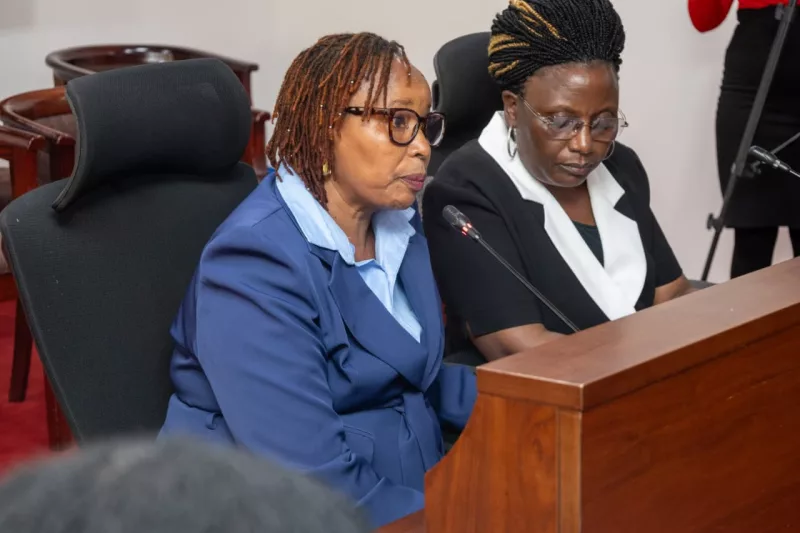
The National Assembly has widened its scrutiny of public funds paid to school heads’ associations, focussing on the Catholic Principals Schools Association (CAPSA).
MPs are querying transfers to the lobby in a similar fashion they did with subscription to Kenya Secondary School Heads Association (KESSHA), which they say is not anchored in law.
The Public Investments Committee on Governance and Education raised concerns as it questioned St Mary’s Girls High School-Igoji principal Florence Mutwiri over Sh992,950 paid to CAPSA.
Last week, the committee warned principals of leading public secondary schools against paying KESSHA subscriptions from school accounts.
PIC chairperson Luanda MP Dick Maungu led the committee in questioning the transfers running into millions of shillings.
It emerged that one school had paid KESSHA about Sh6 million, while another had remitted approximately Sh5 million, triggering concerns about the scale of public funds flowing to the association.
“If you convert them into all the schools in the country, there are billions going to KESSHA, and we want to find out whether KESSHA is a recipient of public money,” Maungu said.
MPs are demanding to know why public schools should transfer money to a members’ organisation without clear authorisation from the Ministry of Education.
The Auditor General could not confirm whether the Sh992,950 paid by St Mary’s Girls High School-Igoji to CAPSA and KESSHA represented value for money.
Auditor General Nancy Gathungu has repeatedly cited the absence of an established government funding framework and assurances on financial management and internal controls.
Mutwiri told the committee that CAPSA contributions financed activities for Catholic-sponsored schools in Meru and Tharaka Nithi counties.
These included training teacher chaplains, capacity-building programmes for principals, training for boards of management chairpersons, retreats for principals and leadership training for students.
She said pooling resources allowed schools to organise programmes that individual institutions might struggle to finance independently.
But MPs insisted that the usefulness of the activities did not remove the requirement for lawful expenditure and proper authorisation.
Bomachoge Chache MP Alpha Miruka demanded to know the legal basis for the transfers.
“How and why are you transferring money to KESSHA and CAPSA? Under which vote and under which law?” Miruka asked.
He warned that principals could be held personally liable for unauthorised transfers of public funds.
“The ministry gives you money to spend. That means the same ministry giving you money to develop infrastructure and undertake co-curricular activities expects you to manage those activities yourselves,” he said.
“If you transfer this money to another account, you will be held responsible as an individual and will pay from your own pocket.”
Narok County Woman Representative Rebecca Tonkei also challenged Mutwiri to identify the law permitting payments to CAPSA.
“What rules or law did you use to transfer this money to CAPSA? This is the first time I am hearing about it,” Tonkei said.
Mutwiri acknowledged that the arrangement was not based on a specific law.
“I will explain without quoting the law because it is not law,” she told the committee.
She said CAPSA brought together about 100 active Catholic schools in Meru and Tharaka Nithi, which fall under the Diocese of Meru, but could not provide the total number of member schools nationally.
The committee also examined Sh383,525 transferred by St Mary’s Girls High School-Igoji to KESSHA for co-curricular activities, including sports, athletics, drama and science and engineering fairs.
The payments echo concerns raised during an earlier committee sitting, when principals defended subscriptions as necessary for students to participate in regional and national competitions.
Loreto High School Limuru principal Lenah Ngesa told MPs during that inquiry that the payments were driven by the desire to develop students’ talents, while Maseno School principal Peter Owino Otieno warned that students risked being locked out of competitions without the contributions.
However, the committee questioned why schools could not finance the activities directly through approved budgets instead of transferring public money to an association.
Kasipul MP Boyd Were, the committee’s vice chairperson, said the panel would seek guidance from the Ministry of Education on both CAPSA and KESSHA.
He directed schools to stop remitting money to KESSHA until the committee had consulted the ministry and obtained guidance on the way forward.
“We have no issue with KESSHA as an association. The issue is that the Auditor General has identified it as a welfare organisation that is not recognised by law for purposes of receiving these public funds,” Were said.
INSTANT ANALYSIS
Parliament’s probe into school heads’ associations is exposing a potential accountability gap in billions of shillings channelled through public schools. By extending scrutiny to CAPSA after KESSHA, MPs are questioning whether useful educational programmes justify transfers lacking clear legal authority. The inquiry puts principals at personal financial risk and raises urgent questions about oversight, lawful spending and how extracurricular activities should be funded.