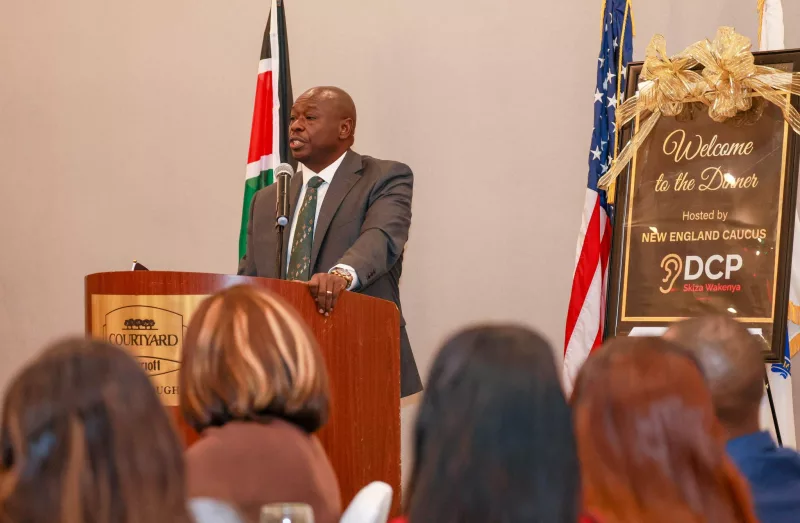
Former Deputy President Rigathi Gachagua's trend of disclosing secret details of state affairs before official communication is raising questions about the reach of his network within President William Ruto's administration.
The latest incident came on Wednesday, when the DCP leader disclosed petrol prices would rise by Sh12 per litre and diesel by Sh9, hours before the Energy and Petroleum Regulatory Authority announced increases of Sh12.93 and Sh9.90 respectively.
Gachagua alleged Ruto ordered the increases to raise money for political mobilisation, a claim he did not substantiate.
Epra attributed its price review to global petroleum increases.
While the accuracy of his prediction does not confirm confidential information was leaked, it has added to a growing list of disclosures that have helped Gachagua portray himself as one still enjoying access to the inner workings of the government he once served as the second in command.
The former DP has openly claimed to have informers within State House, government ministries and the security establishment, suggesting that his political fallout with Ruto did not sever all his connections within the administration.
In August, Gachagua said government employees, including civil servants and security officers, were volunteering information to him because they were unhappy with the administration. He also claimed people within the President's office had alerted him to Ruto’s announcement of Vision 2063 vision before its public unveiling.
Speaking during a podcast interview with political analyst Herman Manyora, Gachagua spoke of the inner workings of his intelligence apparatus, emphasising that his goal is to maintain accuracy, while exposing deep-seated administrative friction.
He urged government insiders to continue feeding him verifiable and credible intelligence, adding that he uses it to stay ahead of state operations.
But while his claims point to a potential political vulnerability for the administration, deputy government spokesperson Gabriel Muthuma dismissed such access, saying none of his announcements was classified information.
“Government information is classified and I can tell you nothing of his announcements is secret,” he said.
“That [government information] is information he can’t have access to. His announcements are information that is from the corridors.”
He said classified information is so properly handled that even those high in office but who ought not have access to it have no chance of getting it.
On the Vision 2063 case, for instance, he said there was nothing classified about the announcement as a team had already been formed to work on the successor of Vision 2030.
In dismissing Gachagua’s announcements, Muthuma said the ex-DP had gotten it wrong on his pronouncement of the Mau Summit-Rironi road construction, the alleged sale of Bomas of Kenya to a Turkish investor and the collapse of the Social Health Insurance Fund in six months.
“We need to question most of his declarations,” he said.
However, Gachagua's disclosures have not been limited to government policy announcements.
In August, he raised concerns over the Independent Electoral and Boundaries Commission's procurement of an Integrated Elections Management System ahead of the 2027 elections. Before departing for the US, he alleged that the tender process could favour South Korean firm Miru Systems.
He questioned whether the procurement was genuinely competitive and suggested that the outcome could have been predetermined.
But Muthuma said having access to tender documents was nothing extraordinary as such tenders are published.
Nevertheless, the disclosures have helped sustain an image of a former insider who retains connections across government even after his impeachment in October 2024.
Among his most-intriguing disclosures was the killing of Dr Victoria Mutiso, a mental health researcher who was shot dead in Nairobi on July 29, 2026.
Gachagua publicly raised allegations concerning police officers linked to the investigation, claiming he had received information from within the security sector and even gave the names of the suspects, who were police officers.
The disclosures prompted Director of Criminal Investigations Mohamed Amin to urge Gachagua to submit any information that could assist detectives rather than discuss the investigation publicly.
While the government has dismissed Gachagua’s access, if true, the claimed network could become an important political asset as the country moves towards 2027.
Access to inside information could help Gachagua to question official explanations and shape public debate as an opposition leader.
Gachagua could be borrowing from former ODM leader Raila Odinga’s card, who used inside information to oppose and press governments, particularly whistleblowing scandals.
In 2017, for instance, Raila alleged that the National Intelligence Service was involved in activities intended to influence voter registration ahead of the August election.
He claimed that biometric voter-registration kits were being taken into Uganda and Ethiopia to facilitate registration of foreigners, claims that have returned ahead of 2027