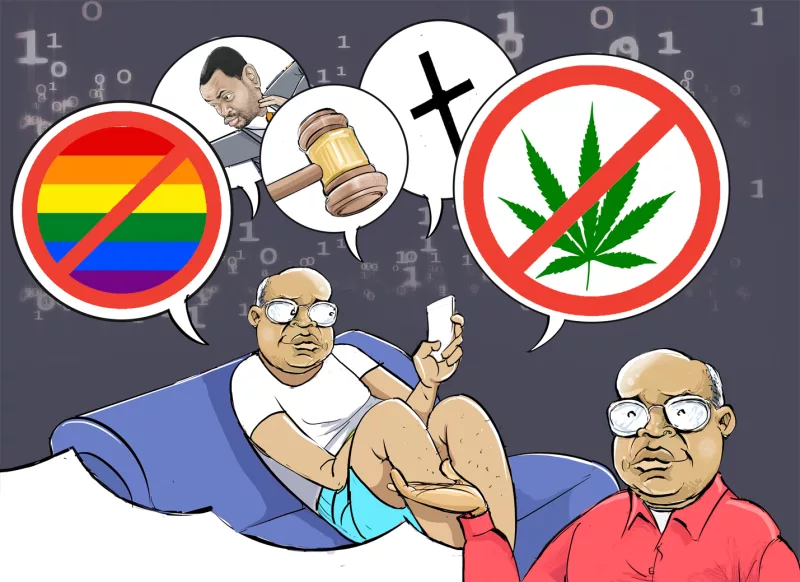
For instance, mine sent me a three-year-old video of Nairobi Senator Edwin Sifuna discussing homosexuality and the LGBTQ+ community, which has resurfaced on social media.
In it, he focuses on the distinction between identity and conduct, and the political uses of the debate. I am not sure why interest has revived in the comments, but I did find his take on the issue refreshing.
Meanwhile, I read one little story about growing hemp, and suddenly reports about the Holy Herb appeared at every turn, mainly about arrests involving marijuana possession and trafficking.
If, as some conspiracy theorists believe, every clip and headline is part of a Big Brother operation to distract us from the day’s real crisis, somebody in government deserves a medal for multitasking. We can only wonder which issue we are supposedly not looking at.
Nevertheless, I am delighted that Kenyans are discussing these subjects at all, even though our debates on cannabis and homosexuality tend to be shrill, narrow and short of curiosity. Positions harden, voices rise and anyone who asks a question risks being treated as though they have personally cancelled Christmas, Eid and Easter.
Arguments against homosexuality and cannabis often describe them as foreign vices or examples of Western cultural imperialism. Yet the laws invoked to defend authentic African values owe much to British colonial rule. We denounce colonialism, while clutching its legislation as though it were life-giving.
Kenya’s criminalisation of same-sex conduct derives from provisions based on the British colonial-era Indian Penal Code. Britain decriminalised certain homosexual acts in England and Wales in 1967, while the provisions it exported to Kenya largely survived Independence. They are now defended as guardians of indigenous culture, as though the colonial administrators arrived with certificates of African authenticity.
Cannabis prohibition also has colonial roots, shaped by regulation and international drug-control agreements. Defenders of these proscriptions get irritated when one inconveniently brings up history with all its awkward questions.
In Kenya, we are aware that religious institutions exert considerable influence on politicians, often framing reform of either cannabis or homosexuality laws as a threat to family life and national morality.
Morality in political hands is a wonderfully versatile tool: it can be waved at almost any audience, requires no budget allocation and rarely comes with measurable performance targets or an uncomfortable audit of results.
The good thing is that activists, human rights lawyers and younger Kenyans increasingly approach these issues through constitutional rights, public health and economic policy. Digital platforms let them challenge familiar arguments, though not escape backlash or the law. They also compare themselves with similar countries.
Cannabis policy offers an example. In May 2023, South African MPs held public hearings on amendments to the Cannabis for Private Purposes Bill, including provisions concerning hemp commercialisation.
Kenya may be some distance from that. Still, our policymakers might one day examine cannabis for medical and industrial uses rather than treating the plant as responsible for the nation’s moral decline.
Of course, that does not mean every commercial promise will become a green-gold bonanza. It means debating evidence instead of reaching for handcuffs as the opening contribution. The global shift towards medical and industrial cannabis makes the absence of an informed Kenyan policy debate a costly omission.
On LGBTQ+ rights, the courts offer a less encouraging but not entirely hopeless picture. On May 24, 2019, a three-judge High Court panel upheld Penal Code provisions criminalising consensual same-sex acts. The ruling reinforced the contradiction between constitutional guarantees and laws that punish intimate conduct.
Yet the story did not end there. In 2023, the Supreme Court upheld LGBTQ+ organisations' right to register as non-governmental organisations, recognising freedom of association amid fierce opposition.
Legal progress comes in increments. It shows why public debate matters: courts, lawmakers and citizens do not operate in separate universes, however much some politicians would prefer it.
So keep talking, Kenyans. Ask questions, challenge inherited assumptions and resist mistaking volume for wisdom. Conversation will not solve everything, and social media arguments are no substitute for policy. Silence, however, leaves old ideas undisturbed.
You never know where honest debate might lead. It could even lead us somewhere useful, which would be a most suspicious development indeed.