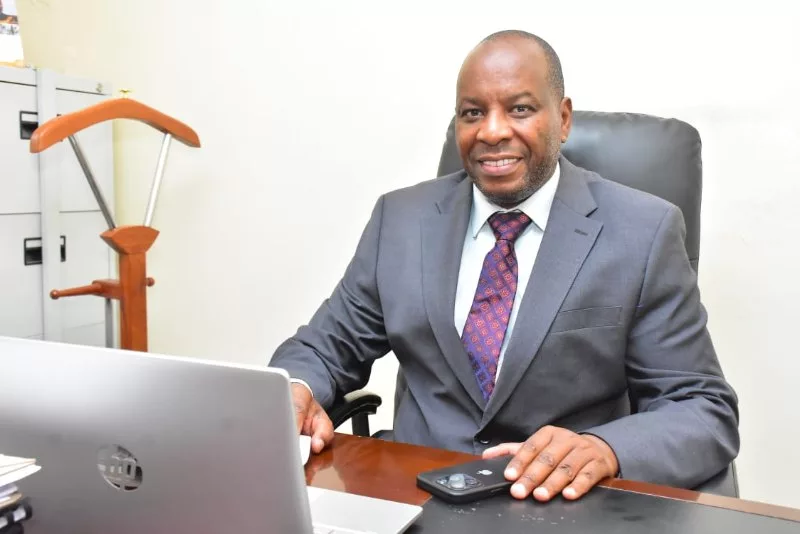
 Dr Mucemi Gakuru /HANDOUT
Dr Mucemi Gakuru vividly remembers arriving at the University of Cambridge for his doctoral studies.
The English he had used with ease for years in Kenya, at work and at home, suddenly failed him.
“In cafés, offices and train stations, people struggled to understand me, and I struggled to understand them, because we pronounced words so differently. I often had to repeat myself several times to get my message across,” he recalls with a laugh.
The experience was an eye-opener, and it planted the seed of work he has pursued for more than two decades: the Kenyan English Lexicon (KENGLEX) Project.
KENGLEX is the product of thousands of hours of painstaking research into the words and phrases Kenyans commonly use, how they pronounce them, and what they mean.
Dr Gakuru is a Cambridge-educated consulting engineer, innovator and entrepreneur who has pioneered spoken-language technology in Africa. He led the team that developed the first Kiswahili text-to-speech system in 2004, and has since extended that work through Teknobyte Limited, the company he founded and leads.
He argues that a distinct Kenyan English has been forming ever since the language arrived with missionaries, followed by the colonial administration.
Listen to almost any Kenyan conversation and the evidence is plain. Speakers move freely between English and Kiswahili, sometimes within a single sentence, a practice linguists call code-switching.
“Our pronunciation differs from British English by 87 per cent. Add our habit of switching to Kiswahili, or even our mother tongues, mid-sentence, and it is clear that our English has evolved into a distinct variety: Kenyan English,” says Dr Gakuru.
Through KENGLEX, Kenyan English has now been defined, recorded and written down, a process known as codification. It joins the small group of English varieties, such as British and American Englishes, that have their own codified reference works.
On Wednesday, 21 October 2026, Dr Gakuru will deliver a public lecture at Daystar University titled “Naming Our Own Tongue: The Codification of Kenyan English and the KENGLEX Project.”
The lecture will explore the commercial, technological and academic opportunities Kenyan English opens up, and is expected to draw participants from academia, Big Tech, the media, venture capital and development agencies.
Dr Gakuru argues that Kenya’s long effort to make its people speak British English has been futile, since even English teachers speak Kenyan English when teaching and once they step out of class.
“Kenya spends more resources teaching English than any other language, and it is still not the English we end up speaking,” says the academic, who is also the author of the memoir The School Leavers’ Party.
“On paper, British English is our official standard. On the ground, the reality is very different. We use Kenyan English even when teaching in our classrooms and lecture halls,” he says.
“We have always had our own way of pronouncing English words, and it is understood across the country. A Kenyan from Mombasa can hold a conversation with one from Embu or Kisumu, and they will understand each other perfectly.”
The KENGLEX dictionary, available free online at kenglex.com, now contains more than 133,000 words, each with its meaning and pronunciation.
Dr Gakuru is now taking the lexicon into the world of artificial intelligence, using it to build text-to-speech systems and other technologies that speak and understand Kenyan English.
He sees Kenyan English as a resource that can be exploited commercially in AI applications, education, culture and research.
With these tools, he says, a person can produce an audiobook or an app in a synthetic version of their own voice, or have speech in other languages translated into Kenyan English.
Teknobyte has already developed synthetic voices that sound naturally Kenyan, for use in animation, audiobooks and other productions.
“Teknobyte can recreate your voice exactly as it sounds when you speak naturally. It becomes an asset you own, can use to create your own products, and can leave to your children,” he says.
The possibilities extend well beyond Kenya, to other African varieties of English and to the continent’s indigenous languages.
“Language gives meaning to our culture. It is passed down from generation to generation, carrying our values, customs, beliefs and ways of seeing the world,” Dr Gakuru says, noting that Africa, with more than 2,000 languages, is the most linguistically diverse continent on the planet.
He believes the commercial value of bringing these languages into modern speech technology is immense, describing them and the culture they carry as “more valuable than the minerals we are constantly seeking to mine underground.”
“We have so much ground to cover. KENGLEX is only a stepping stone to a large body of work that lies ahead of us as researchers and innovators. The work has only just begun.”